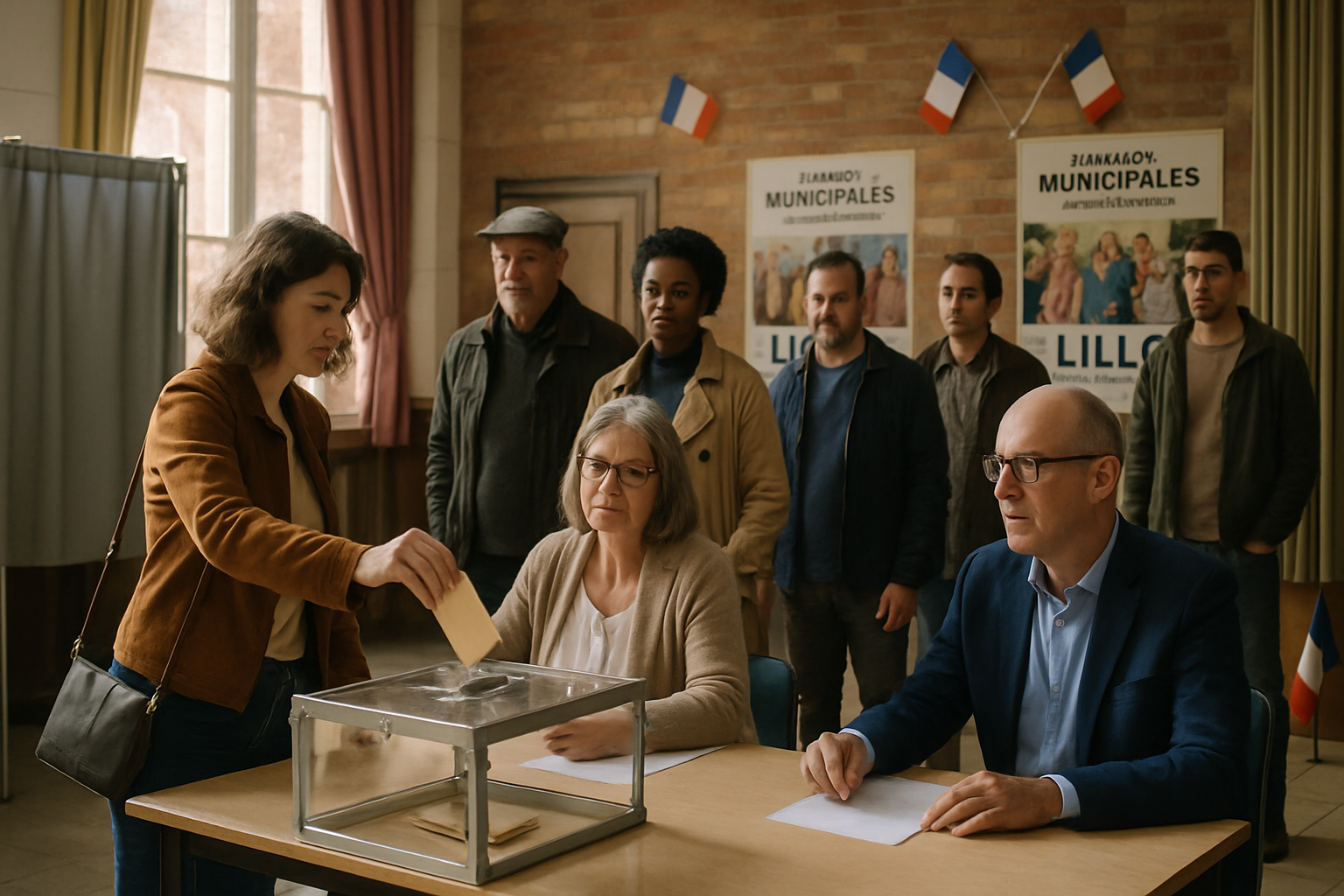
French municipal elections have delivered a complex first-round verdict that signals major political realignments ahead of the decisive second round on March 22, with Socialist-Green alliances forming in key cities while Marine Le Pen's National Rally achieved historic urban breakthroughs across France.
In a dramatic development following Sunday's first round, ecologist candidate Stéphane Baly announced the fusion of his list with the Socialist Party in Lille, where the PS finished ahead of La France Insoumise (LFI). The strategic alliance represents a broader pattern of left-wing coalition-building emerging across France's major urban centers as traditional parties scramble to prevent far-right victories.
The elections, conducted against the backdrop of February's Lyon political violence that claimed the life of 23-year-old far-right activist Quentin Deranque, have been marked by unprecedented polarization and strategic maneuvering between rounds. Seven suspects, including LFI parliamentary assistant Jacques-Elie Favrot, remain charged with intentional homicide in connection with the incident that has profoundly shaped the electoral climate.
National Rally's Historic Urban Strategy Pays Dividends
Marine Le Pen's National Rally has successfully evolved from rural populism to sophisticated urban campaigning, achieving what political analysts describe as "authoritarian innovation." The far-right party's strategic targeting of five cities for historic municipal breakthroughs has yielded significant gains in traditionally progressive strongholds.
In Menton, National Rally candidate Alexandra Masson secured a commanding lead with 36.25% of the vote, leaving three diverse right candidates to coordinate if they hope to prevent the city from falling to the far-right. The result represents a stunning defeat for Louis Sarkozy, who suffered what observers characterized as a "heavy defeat" in his bid for municipal leadership.
These gains reflect a broader European pattern of far-right parties transitioning from protest movements to potential governing forces at the local level. The National Rally's success in urban areas previously considered immune to far-right appeal demonstrates the sophistication of their electoral strategy and the changing dynamics of French politics.
"The far-right has demonstrated an unprecedented ability to capture urban voters who were previously considered beyond their reach. This represents a fundamental shift in French political geography."
— Paul Smith, Head of Modern Languages, University of Nottingham
Left-Wing Strategic Realignments Accelerate
The formation of Socialist-Green alliances in major cities including Lille represents a strategic response to the far-right threat, but also highlights the continued fragmentation of France's traditional left. In Lyon, outgoing Green mayor Grégory Doucet announced an agreement with LFI, while in Limoges, "insoumis" and Socialist candidates merged their lists for the second round.
These tactical alliances occur amid a broader crisis for the French left, which has been severely weakened by the Lyon violence and its political aftermath. The Socialist Party's decision to distance itself from Jean-Luc Mélenchon's movement has created what analysts describe as a "definitive break with LFI" over questions of democratic values and political violence.
The Interior Ministry's controversial reclassification of La France Insoumise from "left" to "extreme left" for electoral purposes has triggered legal challenges at the Council of State, with critics denouncing what they characterize as administrative manipulation of democratic processes.
Paris Witnesses Historic Left-Right Confrontation
The capital is experiencing its first direct left-right confrontation in 25 years, with Socialist Emmanuel Grégoire leading with 31-34% against Les Républicains' Rachida Dati at approximately 30%. The contest reflects the broader squeeze on moderate politics as Emmanuel Macron's Renaissance party adopted a minimal strategy, largely supporting established right-wing candidates rather than fielding comprehensive lists.
This Parisian battle symbolizes the broader national polarization that has accompanied France's most severe political crisis since the Fourth Republic. The stakes extend far beyond local governance, with municipal results serving as a crucial organizational test ahead of the 2027 presidential race, where Macron is constitutionally barred from seeking a third term.
Turnout and Democratic Resilience
Despite the intense political tensions and security concerns, voter turnout reached approximately 49%, representing a recovery from 2020's pandemic-affected levels while remaining below historical norms. The moderate participation suggests neither widespread disengagement nor overwhelming enthusiasm, indicating that democratic institutions continue to function under stress while maintaining citizen participation in self-governance.
The successful conduct of elections during heightened political tensions provides an important template for European democracies facing similar challenges. International observers monitored the process as a bellwether for democratic resilience against far-right populism and political extremism.
Implications for 2027 Presidential Race
The municipal results provide the first major insights into organizational strength and voter sentiment ahead of the 2027 presidential contest. The National Rally's urban expansion suggests broader appeal beyond their traditional rural base, potentially decisive in a presidential race where Marine Le Pen has reached the final round in both 2017 and 2022 against Macron.
However, Le Pen faces a potential career-ending legal challenge, with prosecutors demanding a 5-year public office ban in her EU Parliament fraud case. The Paris Court of Appeal's ruling, expected before summer 2026, could eliminate France's most prominent far-right leader from the presidential race entirely.
For the traditional left, the municipal elections demonstrate both resilience in defending urban bastions and the consequences of continued fragmentation. The Socialist Party's performance provides hope for rebuilding, while LFI's isolation following the Lyon violence complicates alliance-building for 2027.
March 22 Second Round Stakes
The decisive second round on March 22 will determine final outcomes in municipalities where no candidate achieved an absolute majority. Traditional withdrawal and endorsement strategies face unprecedented complexity due to political fragmentation and the toxic atmosphere created by recent violence.
National Rally municipal victories would provide the party with crucial governing experience and enhanced credibility for the presidential race. Success in managing local affairs could help normalize far-right governance and provide a platform for broader political acceptance.
For left-wing forces, the ability to coordinate effectively between rounds will test whether tactical alliances can translate into sustainable coalition-building for national politics. The stakes extend beyond local governance to the fundamental question of whether democratic forces can unite effectively against extremist challenges.
European Significance
The French municipal elections represent more than a local democratic exercise; they serve as a crucial test of European democratic resilience during a period of unprecedented far-right gains across the continent. Success in preventing extremist breakthroughs could strengthen confidence in democratic institutions, while failure might accelerate concerns about democratic backsliding.
The innovative alliance-building strategies emerging from these elections may provide templates for other European nations facing similar populist pressures. The ability to conduct free and fair elections despite security concerns demonstrates institutional strength that could influence international responses to political violence and extremist challenges.
As France prepares for the decisive second round, the world watches to see whether democratic processes can effectively channel political anger into constructive governance or whether the country will witness further institutional erosion in the face of extremist pressure. The outcome will significantly influence France's political direction and its role in European leadership during an increasingly challenging global environment.