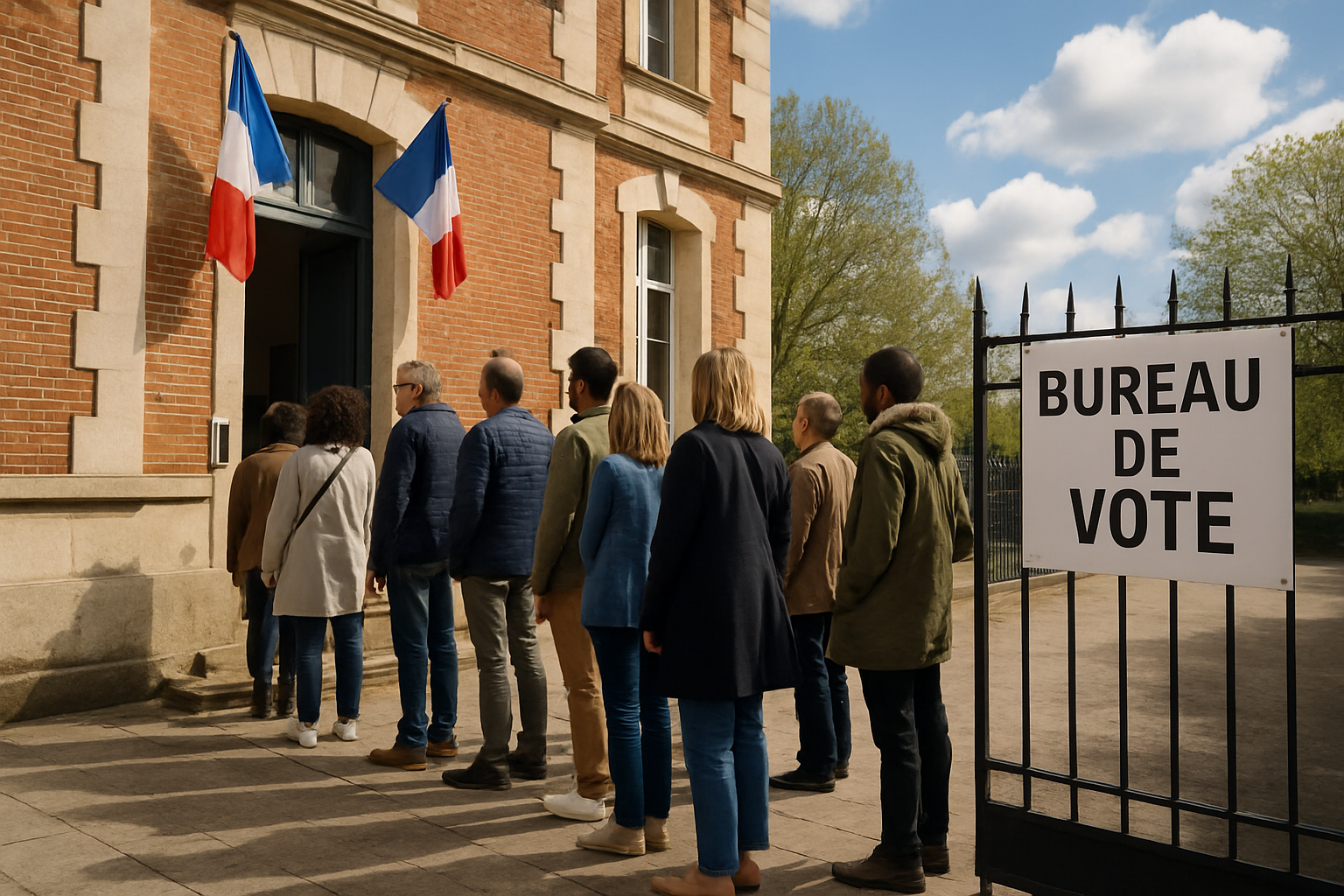
French voters headed to polling stations across 1,526 communes on Sunday for the decisive second round of municipal elections, with particularly close races expected in Paris and Marseille as political parties test their organizational strength ahead of the 2027 presidential election.
Turnout reached 20.33% by midday, according to official figures, as voters in major cities including Paris, Lyon, Bordeaux, and Marseille prepared to choose their mayors for the next six years. Most polling stations were scheduled to close at 6 PM, with extended hours until 8 PM in larger cities.
Historic Confrontations in Major Cities
Paris witnessed its first direct left-right mayoral confrontation in 25 years, with Socialist Emmanuel Grégoire leading a united left and green coalition against conservative candidate Rachida Dati. The race also featured hard-left La France Insoumise candidate Sophia Chikirou, creating a three-way contest in the capital.
The Parisian election carried particular significance as a barometer for national political sentiment, with President Emmanuel Macron constitutionally barred from seeking a third term in 2027. Grégoire's performance was closely watched as an indicator of the left's capacity to maintain control of France's political and cultural center.
In Marseille, France's second-largest city, incumbent left-wing mayor Benoît Payan faced an unprecedented challenge from far-right National Rally candidate Franck Allisio and conservative Martine Vassal. The race gained additional complexity when hard-left candidate Sébastien Delogu withdrew his candidacy in an attempt to prevent a far-right victory, highlighting the strategic calculations reshaping French electoral politics.
National Rally's Urban Breakthrough Strategy
The elections represented a crucial test for Marine Le Pen's National Rally, which evolved from its traditional rural populist base to pursue what analysts termed "authoritarian innovation" through sophisticated urban campaigning. The party targeted five cities for historic municipal breakthroughs, with Marseille representing their most significant opportunity to govern a major French metropolis.
The National Rally's strategy occurred against the backdrop of Le Pen's ongoing legal challenges, with a Paris Court of Appeal ruling expected by July 2026 on prosecutors' demand for a five-year public office ban that could eliminate her from the 2027 presidential race.
Political Crisis Shadow
The electoral process unfolded under the shadow of February's political violence in Lyon, where the death of 23-year-old Quentin Deranque during clashes between far-left and far-right groups profoundly shaped the campaign atmosphere. Seven suspects, including La France Insoumise parliamentary assistant Jacques-Elie Favrot, were formally charged with intentional homicide.
The tragedy contributed to significant left-wing fragmentation, with the Socialist Party declaring a "definitive break" with LFI over democratic values concerns. This division complicated traditional alliance-building strategies in the second round, particularly affecting calculations in competitive races.
The Interior Ministry's controversial reclassification of La France Insoumise from "left" to "extreme left" for electoral purposes triggered Council of State legal challenges, adding institutional tensions to an already polarized political environment.
Alliance Dynamics and Strategic Calculations
The second round revealed complex alliance patterns across France's political landscape. Some cities demonstrated successful pragmatic cooperation, with Green and Socialist candidates forming unified lists in Nantes and Strasbourg. However, other municipalities saw persistent ideological divisions override tactical considerations.
In several cases, traditional strategic withdrawal and endorsement practices faced unprecedented complexity due to the political fragmentation following Lyon violence and broader institutional controversies. The success or failure of various alliance strategies was expected to provide crucial insights for 2027 presidential campaign planning.
Democratic Resilience Under Pressure
International observers monitored the elections as a bellwether for democratic governance under pressure, particularly given France's role as a European democratic model. The successful conduct of free and fair elections despite security concerns, political violence, and administrative controversies provided a template for other democratic societies facing similar challenges.
The elections occurred during what observers characterized as "the most challenging period for continental democracy since World War II," with far-right gains, coalition instabilities, and violent political confrontations affecting multiple European Union member states.
Economic and Social Context
Beyond political calculations, the municipal elections addressed practical governance challenges including economic recovery, climate adaptation, and public safety. Mayors elected in these contests would oversee municipal budgets, urban planning, and local services during a period of significant economic uncertainty and environmental pressures.
The outcomes were particularly significant given the expanded powers of French mayors and the critical role of local governance in implementing national policies at the community level.
2027 Presidential Preview
Political analysts viewed the municipal results as providing the first major insights into party organizational strength ahead of the wide-open 2027 presidential race. With Macron constitutionally barred from a third term, the elections tested whether traditional parties could maintain voter loyalty or if anti-establishment forces would continue gaining ground.
Bruno Retailleau's announcement of his presidential candidacy for Les Républicains, promising immigration reduction through referendums, added another dimension to the evolving political landscape that municipal results would help clarify.
Looking Forward
As vote counting began Sunday evening, the results were expected to influence political alliance negotiations, candidate selection processes, and strategic positioning for the upcoming presidential campaign. The success of various political movements at the local level would provide crucial data about voter sentiment and organizational capacity.
The municipal elections served as both a test of democratic resilience and a preview of France's political future, with outcomes carrying implications extending far beyond local governance to the country's role in European leadership and global democratic development.