French President Emmanuel Macron announced on Monday that France will significantly expand its nuclear arsenal and establish unprecedented European cooperation in nuclear deterrence exercises, marking the most significant shift in French nuclear doctrine in decades and potentially reshaping continental defense architecture.
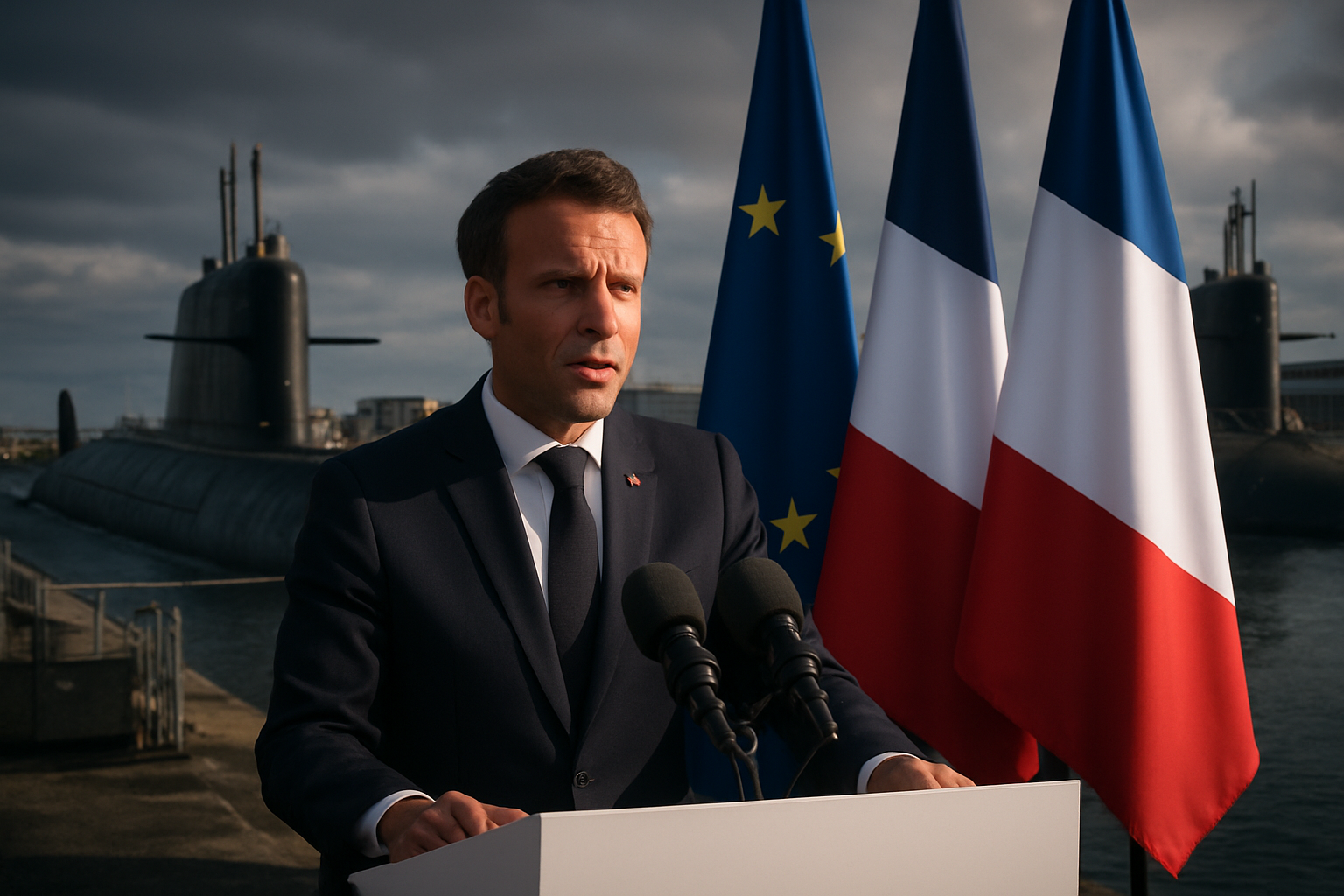
Speaking at the Île Longue submarine base in Brest, Macron declared France was entering "the path of what I will call advanced deterrence," confirming that eight European countries have agreed to participate in France's expanded nuclear deterrence framework while emphasizing that "there will be no sharing of the ultimate decision – neither in its planning nor in its implementation."
The announcement represents a historic departure from France's traditionally independent nuclear posture, coinciding with growing concerns about American security guarantee reliability and occurring against the backdrop of the worst nuclear governance crisis in over 50 years following the February 5, 2026 expiration of the New START Treaty between the United States and Russia.
European Nuclear Deterrence Revolution
For the first time since the Cold War's end, European capitals are seriously exploring nuclear umbrella arrangements beyond American guarantees. German Chancellor Friedrich Merz confirmed direct negotiations with Macron about nuclear cooperation, while Poland, Finland, and other allies have engaged in preliminary conversations about extended deterrence arrangements.
French sources indicate the eight participating European nations include Germany, Poland, Finland, Sweden, Italy, and several others, though official confirmation remains limited for security reasons. Swedish Prime Minister Ulf Kristersson confirmed Sweden would participate in "deepened dialogue" about French nuclear weapons, stating discussions would focus on "how France's national nuclear weapons could contribute to clearer European deterrence."
"We are entering the path of advanced deterrence. The conversations will address how France's national nuclear weapons could contribute to a clearer European deterrence."
— Emmanuel Macron, President of France
This development coincides with Sweden's historic policy shift, as Defense Minister Pål Jonson announced Sweden's willingness to host nuclear weapons during wartime conditions – the most dramatic departure from Stockholm's nuclear-free stance maintained throughout the Cold War.
Arsenal Expansion and Strategic Opacity
Macron confirmed France will increase the number of its nuclear warheads beyond the current estimated 290 weapons, though he declined to specify exact numbers. Significantly, he announced France would cease publishing data about its nuclear arsenal – a major shift toward strategic opacity designed to complicate adversaries' calculations.
The decision to expand represents France's first nuclear buildup in over 30 years, according to Norwegian media reports. This expansion occurs as global nuclear governance faces unprecedented challenges, with both Russia (~4,380 warheads) and the United States (~3,708 warheads) now free to expand their arsenals without bilateral constraints for the first time since the early Cold War.
French nuclear doctrine traditionally emphasized "strict sufficiency" with a force designed primarily for national deterrence. The expansion toward European deterrence represents a fundamental strategic evolution requiring new legal frameworks, enhanced production capabilities, and complex alliance coordination mechanisms.
Franco-German Nuclear Cooperation Framework
Germany and France have established a joint nuclear steering group to coordinate their cooperation, representing the most significant bilateral nuclear arrangement in post-war European history. German sources confirmed intensive consultations have been underway since the Munich Security Conference in February, where European strategic autonomy emerged as a dominant theme.
The cooperation framework addresses growing European concerns about transatlantic alliance reliability, particularly following controversial statements by American officials regarding NATO Article 5 commitments. European officials indicate these discussions reflect the deepest strain in US-European relations since the Cold War.
Technical challenges remain substantial. Any meaningful expansion of French nuclear deterrence would require significant modifications to nuclear doctrine, new legal frameworks, parliamentary approvals across participating nations, and massive financial investments estimated in the hundreds of billions of euros.
Geopolitical Context and Russian Response
The announcement comes amid accelerating global nuclear competition and strategic instability. The expiration of the New START Treaty has eliminated 50 years of US-Russian nuclear constraints, creating what UN Secretary-General António Guterres called a "grave turning point" with nuclear risks at their "highest in decades."
Russia has condemned the European nuclear discussions as "escalatory," threatening countermeasures while continuing its own nuclear modernization programs. Moscow's deployment of intermediate-range missiles and tactical nuclear weapons has already undermined strategic balance, prompting European responses through enhanced cooperation frameworks.
The timing coincides with ongoing Ukraine diplomatic efforts, including recent peace talks that achieved significant progress on ceasefire monitoring mechanisms despite unresolved territorial disputes. European leaders fear marginalization from American-led negotiations affecting their continental security interests.
Alliance Implications and NATO Coordination
The European nuclear initiative raises complex questions about coordination with existing NATO nuclear sharing arrangements and command structures. Alliance officials acknowledge the need for careful integration to avoid competing authorities that could complicate crisis management.
European strategic autonomy discussions reflect broader defense cooperation acceleration, including the recent commitment by France, Germany, Italy, Poland, and Britain to develop low-cost air defense systems within 12 months. This represents the most significant European defense collaboration since NATO's founding.
NATO's Arctic Sentry mission, featuring European leadership with UK troops doubling in Norway and Swedish Gripen jets conducting Greenland exercises, demonstrates the alliance's adaptation to European-led initiatives while maintaining collective defense principles.
Technical and Legal Challenges
Implementing expanded nuclear deterrence faces unprecedented obstacles. Verification mechanisms, command and control systems, and democratic oversight procedures must be developed for multinational nuclear arrangements never before attempted in Europe.
Legal experts indicate that formal agreements would require parliamentary approval across all participating nations, international treaty negotiations, and careful coordination with existing arms control obligations under the Non-Proliferation Treaty framework.
The financial implications are staggering. Conservative estimates suggest that meaningful European nuclear deterrence expansion could require investments comparable to major infrastructure programs, potentially exceeding current European defense spending commitments.
International Reactions and Global Implications
International responses have been mixed, with some allies welcoming enhanced European defense capabilities while others express concern about nuclear proliferation precedents. Non-proliferation advocates worry about the impact on global arms control regimes already under severe strain.
The development occurs as China continues rapid nuclear expansion, North Korea advances tactical nuclear capabilities, and Iran remains close to weapons-grade uranium enrichment. European nuclear expansion could influence other regions facing security challenges to consider similar arrangements.
Arms control experts note that European nuclear cooperation could either strengthen alliance deterrence or complicate international efforts to maintain strategic stability during a period of unprecedented nuclear competition among major powers.
Historical Significance and Future Trajectory
This represents the most fundamental shift in European security architecture since NATO's founding. European leaders are choosing strategic autonomy over traditional American dependence while attempting to preserve alliance relationships – a delicate balance with implications extending far beyond Europe.
Success in developing credible European nuclear deterrence could provide a template for other regions facing security challenges, while failure might fragment Western alliance structures at a critical moment in global power competition.
The initiative reflects French President Macron's long-standing vision of Europe as a "geopolitical power providing its own security." Whether this vision becomes operational reality or remains aspirational will determine European strategic influence for decades to come.
Coming Phase and Implementation Timeline
Implementation timelines remain preliminary, with even basic frameworks requiring years to develop. Technical obstacles, legal challenges, and political coordination across 27 EU members while balancing NATO obligations present formidable challenges.
The success or failure of European nuclear cooperation will be closely watched globally as a test of whether strategic autonomy can become operational reality in the 21st century's multipolar security environment. The stakes extend well beyond European borders, potentially reshaping global security architecture for generations.
As Europe enters this unprecedented phase of strategic autonomy, the world watches to see whether innovative diplomatic and defense solutions can provide stability in an era of increasing nuclear risks and great power competition.