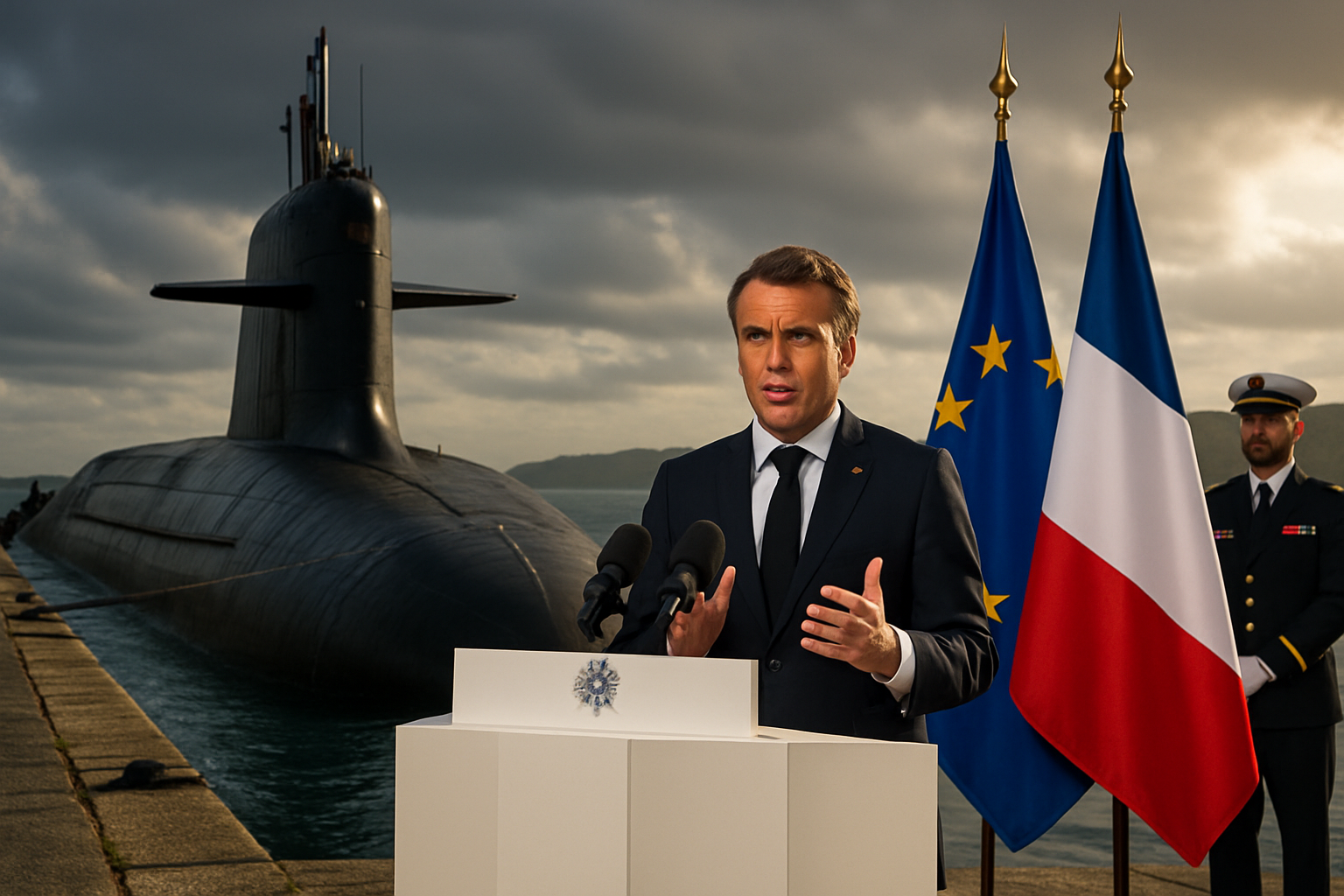
French President Emmanuel Macron announced a historic expansion of France's nuclear arsenal and unveiled an ambitious new "forward deterrence" strategy for Europe, marking the most significant shift in French nuclear doctrine since the end of the Cold War.
Speaking from a ballistic-missile submarine base in Brittany, Macron declared: "I have ordered an increase in the number of nuclear warheads in our arsenal." In a dramatic departure from previous practice, the French president added that France would no longer publicly disclose the size of its nuclear arsenal, citing strategic opacity as essential for effective deterrence.
European Nuclear Protection Framework
The announcement comes as Romania becomes the latest European nation invited to participate in discussions about France's nuclear protection umbrella. Romanian Foreign Minister Oana Țoiu confirmed that France has invited Romania to join talks about hosting elements of the "nuclear shield," according to Reuters reports.
"France has invited Romania to participate in discussions about the nuclear umbrella," Țoiu announced during an official visit to Poland, adding that any decision would ultimately be made by Romania's Supreme Defense Council.
"This represents a fundamental shift in European security architecture, moving from American dependence toward genuine strategic autonomy."
— Senior EU Defense Official
Strategic Context and Global Implications
The French nuclear expansion announcement comes at a critical juncture in international security. The New START Treaty between the United States and Russia expired on February 5, 2026, creating the first nuclear governance vacuum in over 50 years. With both superpowers now free to expand their arsenals without bilateral constraints, European leaders are reassessing their defense strategies.
France's current nuclear arsenal is estimated at approximately 290-300 warheads, significantly smaller than the American (3,708) and Russian (4,380) stockpiles. However, French officials argue that their force provides sufficient deterrent capability for European defense needs, particularly with the proposed expansion.
The timing coincides with heightened European anxiety over US security guarantee reliability and Russia's ongoing war in Ukraine, where territorial gains have accelerated to 481 square kilometers in January 2026 versus 260 square kilometers in December 2025.
Romania's Strategic Position
Romania's invitation to nuclear protection discussions reflects its critical position in Eastern European security. As a NATO member state bordering Ukraine, Romania has been at the forefront of concerns about Russian territorial expansion and hybrid warfare threats.
The invitation comes as European nations increasingly seek alternatives to traditional US-dominated nuclear sharing arrangements. Romania's potential participation would extend France's deterrence umbrella to the Black Sea region, significantly altering regional power dynamics.
However, Romanian officials note that despite Țoiu's announcement, Romania was not among the eight countries publicly identified by President Macron in his initial framework announcement, suggesting ongoing negotiations and potential expansion of the initiative.
Technical and Military Implications
The "forward deterrence" strategy represents a revolutionary approach to European nuclear security. Unlike traditional nuclear sharing arrangements, where host countries provide bases for another nation's weapons, the French model maintains sole decision-making authority while extending deterrence benefits to participating allies.
Technical implementation would likely involve temporary deployment of French nuclear-armed aircraft to allied European territories during crisis situations, supported by joint nuclear deterrence exercises and enhanced command-and-control coordination.
The strategy builds on existing French capabilities, including the force de frappe submarine-launched ballistic missiles and air-launched cruise missiles, while adding new operational flexibility through allied territory access.
International Reactions and Challenges
Russian officials have condemned the French initiative as "escalatory," with Moscow threatening countermeasures against participating nations. The Kremlin argues that expanded European nuclear cooperation represents a violation of non-proliferation principles and regional stability.
However, European strategic autonomy advocates view the French initiative as long overdue. Munich Security Conference discussions in February 2026 emphasized Europe's need to develop independent defense capabilities amid what German Chancellor Friedrich Merz described as the end of the "post-war order."
Implementation challenges remain substantial. The initiative requires new legal frameworks, parliamentary approvals across participating nations, massive financial investments estimated in the hundreds of billions of euros, and complex coordination mechanisms to avoid competing authorities during crisis management.
Historical Significance
The French nuclear expansion represents the most significant European nuclear arrangement since the 1960s establishment of the force de frappe. For the first time since NATO's founding, European leaders are seriously considering nuclear deterrence arrangements that do not depend primarily on American guarantees.
This shift reflects deeper concerns about transatlantic relations following controversial statements about NATO Article 5 commitments and growing European determination to assume greater responsibility for continental security in an increasingly multipolar world.
"We are witnessing the most fundamental shift in European security since the Cold War's end. The success or failure of this initiative will determine whether Europe becomes a credible strategic actor or remains dependent on uncertain American guarantees."
— Institute for Strategic Studies Analyst
Future Implications
The success of France's expanded deterrence strategy could provide a template for regional nuclear cooperation beyond traditional superpower frameworks. However, failure might fragment existing Western alliance structures during a critical period of global power competition.
European Parliament approval processes and national legislative authorization will be required across participating countries, creating a complex timeline extending throughout the current decade for full operational capability.
The initiative occurs alongside ongoing Ukraine peace negotiations, with Geneva talks achieving limited progress on ceasefire monitoring while fundamental territorial disputes remain unresolved. The June 2026 Washington summit deadline adds urgency to European strategic autonomy discussions.
As Europe faces its most significant security challenges since World War II, France's nuclear expansion and Romania's potential participation represent a historic test of whether European strategic autonomy can become operational reality rather than continued aspiration in 21st-century security architecture.