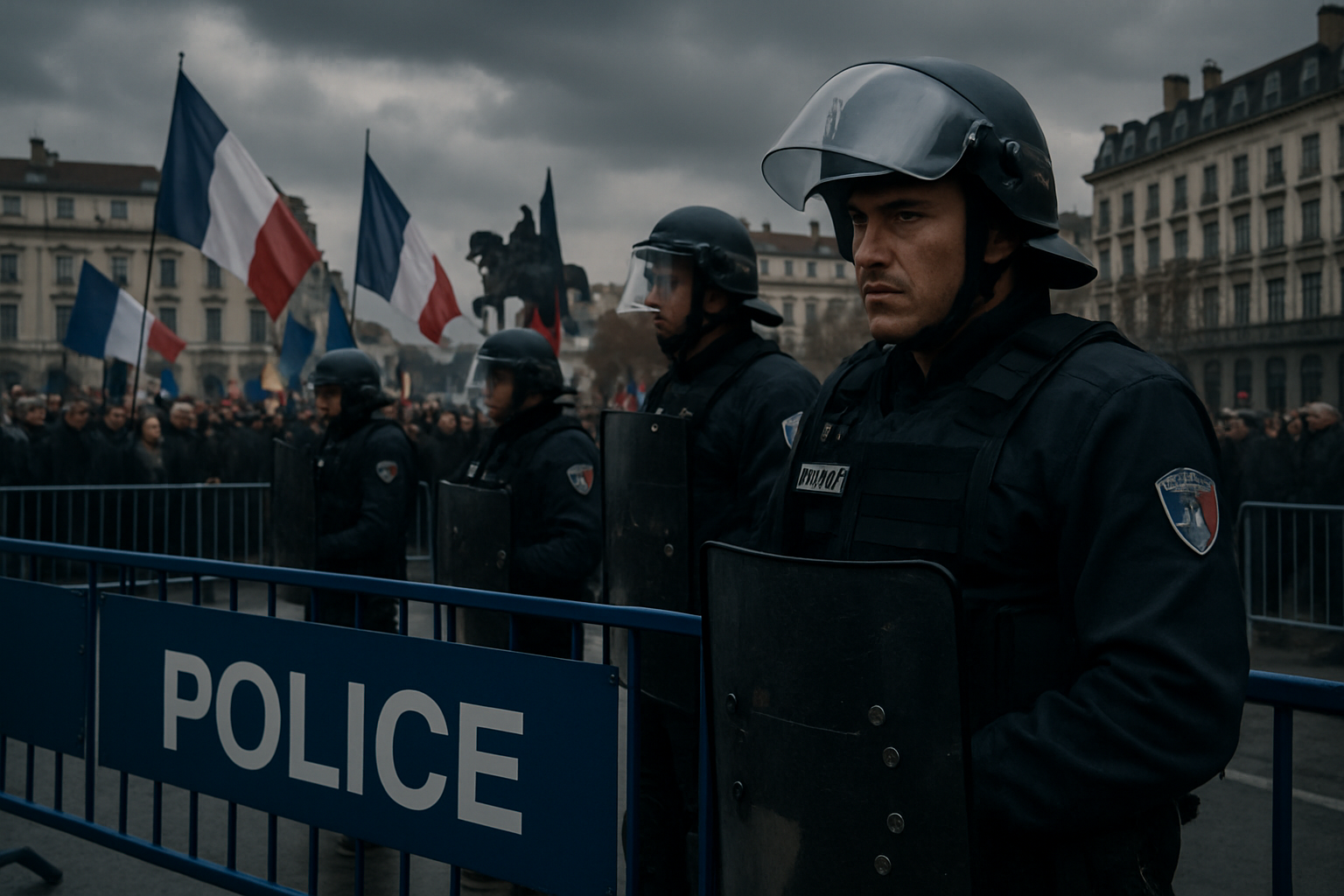
France finds itself at a critical juncture as hundreds of police officers mobilize across the country for memorial rallies honoring Quentin Deranque, the 23-year-old far-right activist whose fatal beating has ignited the most serious political crisis in recent French history and drawn unprecedented international attention.
President Emmanuel Macron appealed for "calm and restraint" on Saturday as authorities authorized demonstrations in Rennes at 11 AM and Lyon in the afternoon, despite mounting security concerns and warnings from local officials about potential public disorder. The rallies, expected to draw between 2,000 and 3,000 participants, represent a watershed moment for French democracy as the nation grapples with escalating political violence and deepening societal divisions.
A Tragedy That Divided France
Deranque, a 23-year-old mathematics student and devout Catholic from Lyon, died on February 15, 2026, from severe cranial injuries sustained during a violent confrontation that erupted on the margins of a pro-Palestinian conference featuring MEP Rima Hassan. What began as counter-protests at a Lyon university spiraled into deadly violence when at least six masked individuals brutally attacked the young nationalist activist.
The incident has since evolved into a defining moment for contemporary French politics, exposing deep fractures within the country's political landscape and testing the resilience of its democratic institutions. The case has become a rallying cry for Marine Le Pen's National Rally while increasingly isolating Jean-Luc Mélenchon's La France Insoumise (LFI) movement ahead of crucial March 2026 municipal elections and the 2027 presidential race.
Investigation and Arrests
Lyon prosecutor Thierry Dran has formally charged seven suspects with intentional homicide, with all recommended to remain in custody to prevent "disturbance to public order." The investigation has revealed the systematic nature of the attack, with six suspects participating directly in the beating while three others aided the attackers.
Among those charged is Jacques-Elie Favrot, a parliamentary assistant to LFI deputy Raphaël Arnault, a development that has intensified political pressure on Mélenchon's movement and raised serious questions about the extent of far-left involvement in political violence. The arrest has prompted calls for enhanced university political meeting restrictions as authorities seek to prevent future confrontations.
Political Fallout and International Dimensions
The death of Deranque has triggered an unprecedented political crisis that extends far beyond France's borders. Justice Minister Gérald Darmanin's immediate attribution of blame to the "ultra-left" and National Rally leader Jordan Bardella's declaration of Mélenchon's "immense moral responsibility" have inflamed tensions across the political spectrum.
The international dimension became particularly acute when Italian Prime Minister Giorgia Meloni expressed shock at the killing, calling it a "wound for all of Europe" and condemning the "climate of ideological hatred." President Macron's sharp response, telling Rome not to "comment on what is happening in other countries," marked one of the most public diplomatic spats between France and Italy in recent years.
"This represents one of the most serious tests of French democratic institutions since the post-war period."
— European Political Analyst
Security Preparations and Political Calculations
Interior Minister Laurent Nuñez's decision to authorize the memorial rally despite Lyon's mayor urging authorities to ban it citing "proven risks of public disorder" reflects the delicate balance between freedom of expression and public safety. Nuñez stated that "for now, freedom is more important than anxiety," though hundreds of police officers have been deployed to ensure security.
The Trump administration's involvement adds another layer of complexity to the situation. US officials have denounced what they term "terrorism" and left-wing violence in France, with the administration closely monitoring developments as French police prepare for weekend demonstrations. This international attention underscores the broader implications of France's internal political tensions.
A Nation Grappling with Extremism
The Deranque case has exposed the dangerous escalation of political confrontations in France, where the boundary between legitimate political expression and criminal violence has become increasingly blurred. The incident occurred against a backdrop of growing political fragmentation following recent budget crises and repeated use of constitutional Article 49.3 to bypass parliamentary approval.
Videos of the deadly confrontation have been widely shared on social media, inflaming political tensions while providing crucial evidence for the ongoing investigation. However, the case has also been complicated by false accusations, including defamatory claims against a Lyon woman from La Jeune Garde who was actually in South America at the time of the attack.
Electoral Implications
The political ramifications extend well beyond immediate security concerns. The Socialist Party has begun distancing itself from LFI, further isolating Mélenchon's movement as France approaches critical municipal elections in March 2026. The case has become a powerful tool for Marine Le Pen's National Rally to mobilize support and position itself as the defender of order against what it characterizes as far-left extremism.
The crisis occurs at a particularly sensitive time, with the 2027 presidential election on the horizon and uncertainty surrounding Le Pen's potential candidacy due to ongoing legal challenges related to EU Parliament fraud allegations. Bruno Retailleau's recent announcement of his presidential candidacy for Les Républicains adds another dimension to the evolving political landscape.
Testing Democratic Resilience
As France prepares for Saturday's memorial rallies, the nation faces a fundamental test of its democratic institutions' ability to manage political violence through legal rather than vigilante means. The government's response—balancing free expression with public order while pursuing justice through proper judicial channels—will set important precedents for how democratic societies address the intersection of political extremism and criminal violence.
The case highlights broader challenges facing European democracies as they confront rising political polarization, the normalization of violence in political discourse, and the exploitation of democratic freedoms by extremist movements. The international attention focused on France's handling of this crisis reflects wider concerns about the health of democratic institutions across the continent.
Looking Ahead
The coming days will prove crucial for France's political stability and democratic governance. The success or failure of authorities in maintaining order during the memorial rallies while protecting democratic rights will influence how similar situations are handled across Europe. More broadly, the case represents a critical moment for France to reaffirm its commitment to democratic values while addressing the root causes of political extremism.
As hundreds of police officers take their positions across Lyon and Rennes, the eyes of Europe—and indeed the world—will be watching to see whether France can navigate this crisis while preserving both security and democratic principles. The legacy of Quentin Deranque's tragic death may ultimately be determined not by the violence that claimed his life, but by how French society chooses to respond to the challenge it represents.