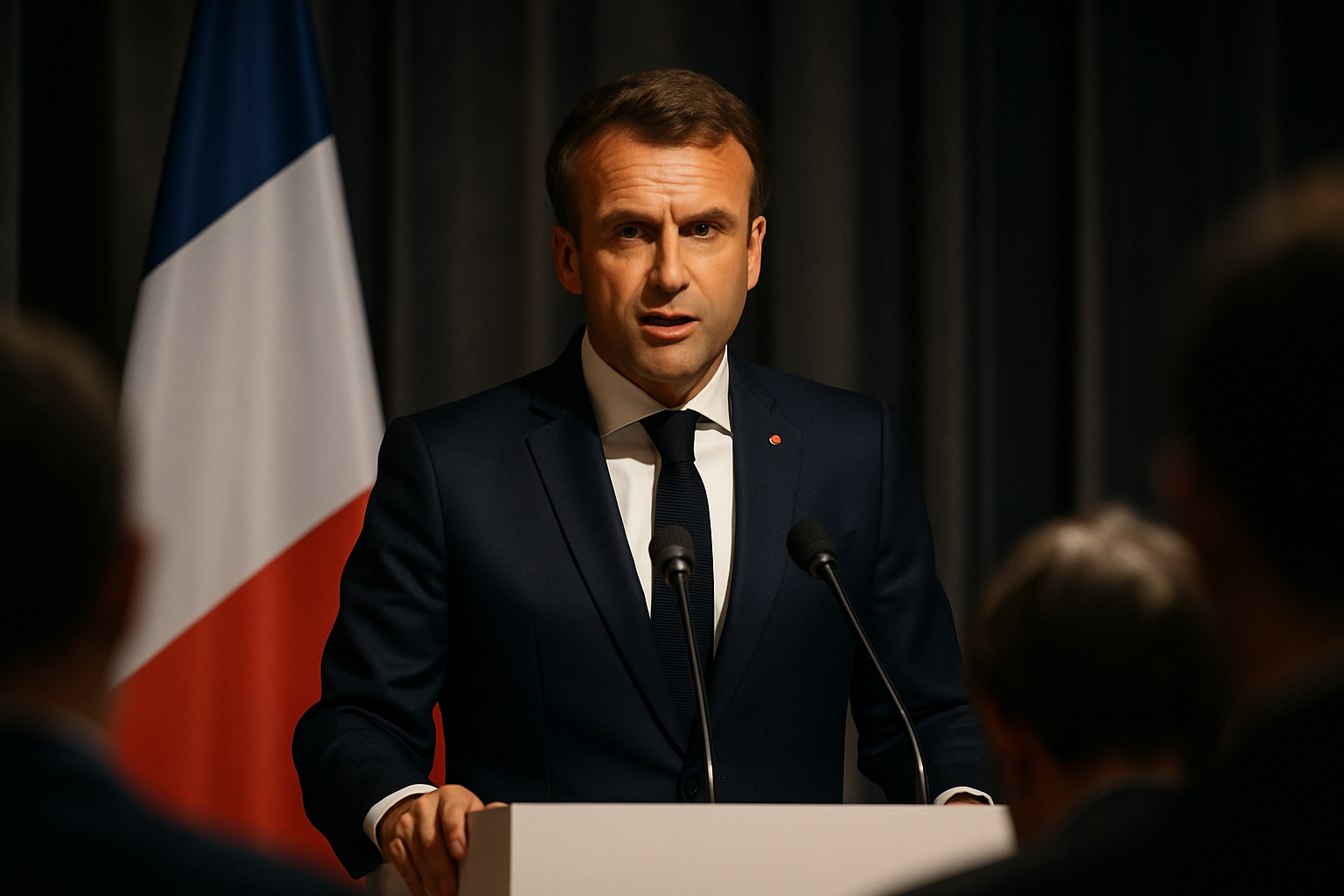
President Emmanuel Macron confirmed Tuesday that France will not participate in military operations to open the Strait of Hormuz while fighting continues in the Iran war, delivering a significant blow to Trump's efforts to build an international naval coalition to secure the critical waterway.
Speaking at a press conference, Macron stated that France is "ready to help escort ships 'once the situation becomes calmer,'" according to sources from The Local France. The French president's rejection comes as President Trump has been urgently calling on China, France, Japan, South Korea, and the UK to deploy warships to jointly secure the Strait of Hormuz, which handles 40% of global seaborne oil transit.
The French position represents a careful distinction between defensive territorial protection and offensive military operations. While France has deployed significant naval assets to protect European territory following Iranian attacks on Cyprus, Paris draws a clear line at participating in operations to forcibly reopen the strategically vital waterway.
European Allies Deliver Coordinated Rejection
France's refusal is part of a broader European rejection of Trump's coalition demands. German Defense Minister Boris Pistorius led resistance by asking "What does Donald Trump expect handful European frigates to do that powerful US Navy cannot?" Japan and Australia have also explicitly declined sending naval vessels despite direct US requests.
The coordinated European response reflects what analysts describe as the most significant transatlantic crisis since the Iraq War, with allies choosing strategic autonomy over military support for what many view as an optional American military adventure.
Despite rejecting Gulf operations, European nations have demonstrated unprecedented unity in defending their own territory. The first Iranian attack on European soil since World War II - drone strikes on RAF Akrotiri Cyprus - prompted an immediate four-nation naval coalition including HMS Dragon, Spanish frigates, and vessels from Italy, France, Netherlands, and Greece.
Energy Crisis Reaches Critical Phase
The French rejection comes as the global energy crisis reaches historic proportions. Oil prices have surged past $100 per barrel for the first time since 2022, with Brent crude peaking at $119.50 and WTI jumping a record 18.98% in a single day to $108.15.
Iran's Revolutionary Guard has deployed an estimated 2,000-6,000 naval mines throughout the 21-mile Strait of Hormuz, effectively closing the waterway that carries 40% of global oil transit. The International Energy Agency has announced its largest strategic petroleum reserve release in 50 years - 400 million barrels from 32 countries - in response to the crisis.
"This is a historic moment that will determine whether the international community can manage 21st-century crises through multilateral cooperation."
— UN Secretary-General António Guterres
The closure has stranded over 150 oil and LNG tankers worth billions in the Persian Gulf, with major shipping companies Maersk and MSC suspending all operations in the region. Natural gas prices have exploded 24% in Europe and 78% in the US, reaching levels not seen since February 2025.
Global Aviation and Economic Disruption
The crisis has triggered the most severe aviation disruption since COVID-19, with over 18,000 flights cancelled worldwide. Eight Middle Eastern countries have simultaneously closed their airspace, severing critical Asia-Europe corridors. Dubai International, the world's busiest airport with 86 million passengers annually, remains shuttered due to missile damage.
Financial markets have crashed globally, with Pakistan's KSE-100 recording its largest single-day decline in history at -8.97%. South Korea's KOSPI fell 12% triggering circuit breakers, while the Korean won hit a 17-year low. Even PayPal postponed its $1.1 billion IPO due to market volatility.
Congressional Opposition Mounts in Washington
Trump's coalition efforts face mounting Congressional opposition at home, with bipartisan lawmakers demanding answers about strategy, costs, and the potential for ground troop deployment. Senator Blumenthal stated he is "more concerned than ever" about boots on the ground, while the conflict's unpopularity has reached "almost unprecedented" levels with only 25% American support.
Operation Epic Fury has cost $11.3 billion in its first week, with Pentagon operations extending through September - far beyond the initially projected 4-6 week timeline. The operation has resulted in 150 US troops wounded, 8 in critical condition, and 3 confirmed killed.
Diplomatic Breakdown and Nuclear Concerns
The current military crisis emerged from the complete collapse of US-Iran nuclear negotiations despite achieving "broad agreement on guiding principles" - the most progress since the 2018 JCPOA collapse. The fundamental disagreement proved insurmountable: Iran excluded ballistic missiles and regional proxies as "red lines" for nuclear-only talks, while the US demanded comprehensive agreements including missiles, armed groups, and human rights.
The crisis occurs amid broader nuclear governance breakdown, with the New START treaty having expired in February 2026 - the first time in 50+ years without US-Russia nuclear constraints. Iran continues 60% uranium enrichment with over 400kg of weapons-grade material, sufficient for multiple nuclear weapons.
Regional Coalition Under Severe Strain
The unprecedented Saudi/UAE/Qatar/Egypt coalition that had supported diplomatic solutions now faces severe strain as Iranian retaliation targets their territories directly. The UAE has reported 1 civilian killed in Abu Dhabi, Kuwait 32 injured in airport strikes, and Qatar 8 injured despite Patriots intercepting 65 missiles and 12 drones.
Egyptian President Sisi condemned attacks on "sisterly Arab countries," warning of "comprehensive chaos spreading across the region." The coalition members find themselves caught between alliance obligations to the US and Iranian pressure affecting decades-old security arrangements.
Template-Setting Crisis for 21st Century
UN Secretary-General António Guterres has called this "the greatest test of multilateral cooperation in crisis management in the modern era." The rapid transition from diplomatic framework to military confrontation demonstrates what experts describe as the fragility of crisis management mechanisms in the multipolar era.
France's rejection, alongside similar responses from other allies, may represent a fundamental shift in how partners view military intervention. The distinction between European territorial defense and American military adventures could define a new paradigm of alliance cooperation based on strategic autonomy rather than automatic support.
The stakes could not be higher: regional war prevention, global energy security, nuclear governance credibility, and international law enforcement are all being tested simultaneously. Success in containing the crisis could provide a framework for future nuclear crisis resolution, while failure might accelerate military solutions that reshape Middle Eastern geopolitics for decades.
Looking Forward
As the crisis enters its third week, France's position reflects broader European concerns about unlimited military support for what many allies view as avoidable conflicts. The French willingness to consider ship escort missions only "once the situation becomes calmer" suggests a pathway for eventual international cooperation - but only after military operations cease.
The energy crisis shows no signs of abating, with Qatar's Energy Minister warning that Gulf states may declare force majeure "within weeks" if oil approaches $150-200 per barrel, potentially "bringing down the economies of the world." Recovery timelines remain uncertain, dependent on military and diplomatic resolution rather than predictable factors like weather disruptions.
March 17, 2026 may prove to be a watershed moment in international relations, testing whether Western alliance unity can survive fundamental disagreements over military intervention, or whether strategic autonomy will emerge as the defining principle of 21st-century international cooperation.