Europe faces its most severe political crisis since World War II as France's municipal election campaigns deteriorate into scandal and potential violence, while Sweden confronts a historic political realignment that could fundamentally alter the Nordic country's democratic landscape.
The unfolding crisis represents a convergence of multiple threats to European democratic institutions, with traditional political norms collapsing under unprecedented pressure from extremist movements, coalition instability, and violent political confrontations that have already claimed lives.
French Municipal Elections Spiral Into Chaos
France's March 15-22 municipal elections, originally intended as a preview for the crucial 2027 presidential race, have become a dangerous testing ground for European democracy's resilience against extremist violence and institutional breakdown.
In Nice, the campaign between former allies Christian Estrosi and Eric Ciotti has descended into what sources describe as a "mauvais feuilleton" (bad soap opera), with reciprocal accusations of manipulation escalating since the discovery of a pig's head at one candidate's home in late February. Police custody proceedings are ongoing as authorities struggle to contain the deteriorating situation in France's fifth-largest city.
The crisis has been exacerbated by the February killing of 23-year-old far-right activist Quentin Deranque in Lyon, which resulted in eleven arrests including Jacques-Elie Favrot, a parliamentary assistant to La France Insoumise deputy Raphaël Arnault. The incident has fundamentally altered France's political landscape, with President Emmanuel Macron's government announcing unprecedented restrictions on university political meetings.
"The lutte contre l'extrême droite est une urgence dans tous les territoires"
— Civil Society Collective, Le Monde Tribune
A collective of civil society actors has published an urgent appeal in Le Monde calling for massive mobilization against the far-right during the municipal elections, emphasizing the critical importance of finding compromise and dialogue to preserve democratic institutions.
Sweden's Democratic Foundations Under Threat
Simultaneously, Sweden faces its own constitutional crisis as multiple media sources report that the Liberal Party (Liberalerna) is preparing to abandon its longstanding opposition to cooperation with the far-right Sweden Democrats (Sverigedemokraterna), potentially allowing the party into formal government collaboration for the first time.
According to sources speaking to Dagens Nyheter, internal Liberal Party discussions have reached a critical juncture, with one party insider warning that cooperation with the Sweden Democrats "risks killing our party." The potential shift represents the most significant political realignment in Swedish politics since the rise of the Social Democratic hegemony.
The Sweden Democrats, founded with roots in the white nationalist movement, have gradually gained acceptance within Sweden's political mainstream despite their controversial origins. Their potential inclusion in government would mark a watershed moment for Nordic democracy, breaking decades of political consensus that has kept far-right movements isolated from power.
Broader European Context: Democracy Under Siege
These developments occur within the broader context of what experts describe as the most challenging period for European democracy since World War II. The continent has witnessed an unprecedented surge in far-right electoral gains, coalition instabilities, and violent political confrontations across multiple member states.
The crisis extends beyond France and Sweden, with recent memory of political upheavals across the continent including the Netherlands' coalition difficulties, Germany's far-right gains in eastern states, and continuing tensions in Central European countries like Hungary and Poland over rule of law concerns.
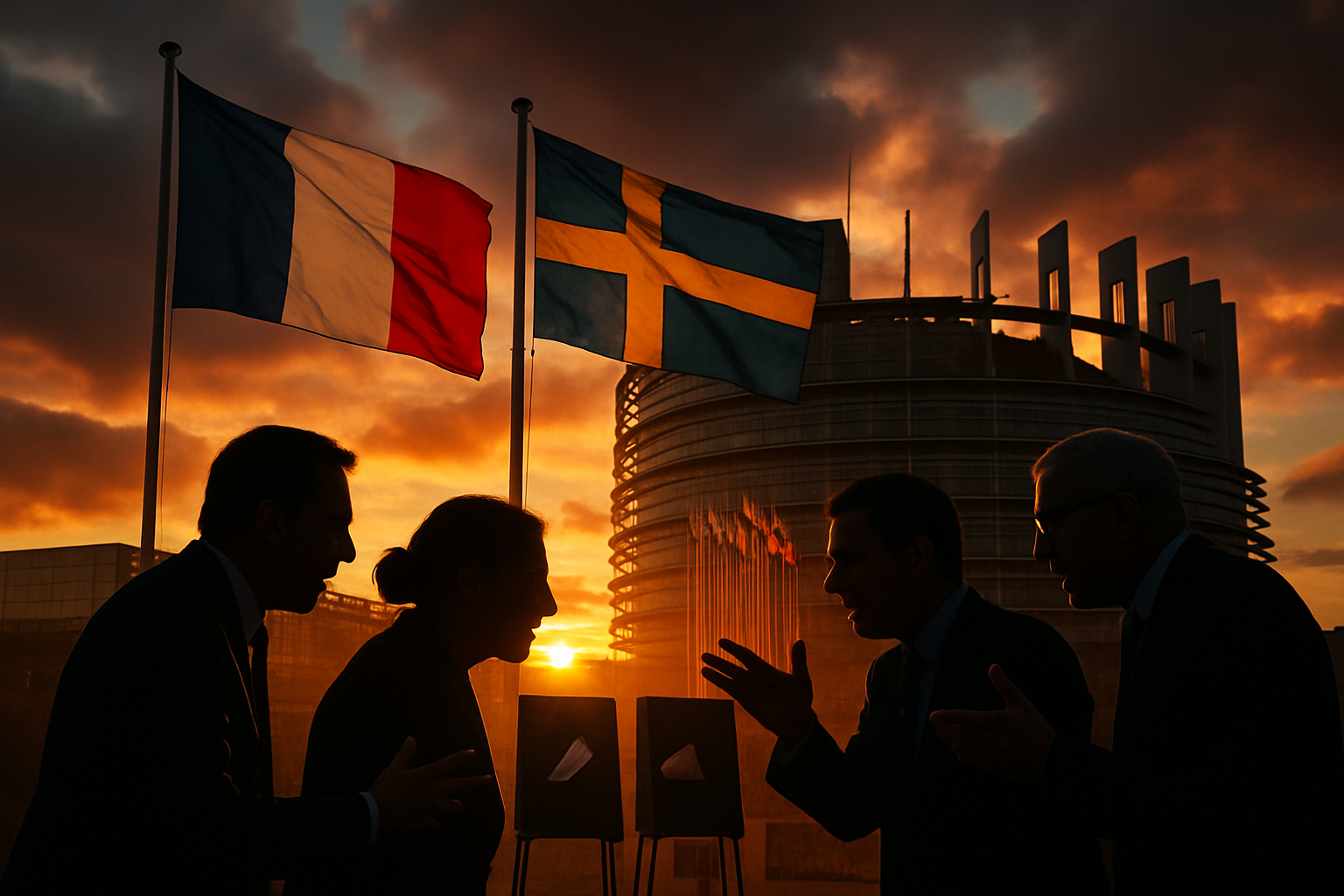
The French Fragmentation Accelerates
The situation in France has been further complicated by Raphaël Glucksmann's dramatic call for the political left to "definitively break" with La France Insoumise during a municipal campaign rally in Limoges. Glucksmann, leader of Place Publique, declared that "one cannot fight for democracy with a friend of tyrants in our ranks," in remarks delivered alongside Socialist Party first secretary Olivier Faure.
This fracturing of France's traditional left-wing coalition comes at a critical moment when unity against far-right advances is seen as essential. The breakdown reflects deeper ideological divisions that have emerged since the Lyon violence and ongoing controversies surrounding Jean-Luc Mélenchon's movement.
The French Interior Ministry's controversial reclassification of La France Insoumise from "left" to "extreme left" for electoral purposes has added another layer of institutional tension, with the party filing challenges through the Council of State over what they characterize as administrative manipulation of democratic processes.
Sweden's Coalition Mathematics Crisis
In Sweden, the potential Liberal Party pivot would fundamentally alter the country's coalition mathematics and could provide the Sweden Democrats with unprecedented influence over government policy. The party has steadily grown from a fringe movement to Sweden's second-largest party, capitalizing on concerns over immigration, integration, and social change.
The Liberal Party's internal debate reflects broader challenges facing European centrist parties caught between traditional conservative allies and the need to maintain democratic norms. Similar dynamics have played out across the continent, with varying degrees of success in containing far-right influence.
Swedish political observers note that the potential coalition would break with decades of Nordic political tradition that has successfully marginalized extremist movements through democratic consensus and institutional resilience.
International Implications
The convergence of crises in two of Europe's most stable democracies sends alarming signals about the continent's democratic resilience. France and Sweden have historically served as models of democratic governance and political stability, making their current troubles particularly concerning for European Union leadership.
European polling consistently shows that 89% of Europeans demand greater EU unity, yet the political reality demonstrates increasing fragmentation, sovereignty assertions, and institutional friction across member states. This disconnect between public aspirations and political reality underscores the depth of the current crisis.
Historical Context and Precedents
The current situation recalls some of Europe's darkest historical moments while occurring in an entirely different context of established democratic institutions and international cooperation frameworks. Unlike the 1930s, today's challenges emerge from within democratic systems rather than external authoritarian threats, making the appropriate responses less clear.
The February killing of Quentin Deranque in Lyon represents the most serious episode of political violence in France since the height of the Yellow Vest protests, but occurs within a context of growing international tensions and domestic polarization that amplifies its impact.
Previous episodes of political violence in European democracies have typically been contained through judicial processes and political moderation, but the current period's multiple simultaneous crises test whether these traditional mechanisms remain adequate.
Stakes for European Integration
The resolution of these crises will establish critical precedents for how European democratic institutions adapt to 21st-century pressures while preserving fundamental values. Success in managing political extremism and coalition instability could strengthen European integration, while failure might accelerate fragmentation trends already visible across the continent.
The timing is particularly critical given ongoing global challenges including climate change, technological disruption, and international power competition that require sustained European cooperation and institutional effectiveness.
French municipal elections serve as a crucial test case for whether democratic processes can channel political anger into constructive governance, while Sweden's coalition negotiations will determine whether Nordic political traditions can withstand contemporary pressures.
Looking Forward: Critical Decision Points
The coming weeks will prove decisive for European democratic resilience. France's municipal elections on March 15 and 22 will test whether political violence can be contained through legal mechanisms and democratic participation, while Sweden's coalition negotiations will establish precedents for far-right inclusion in Nordic governance.
Success in both cases requires unprecedented cooperation between traditional political rivals, effective law enforcement responses to extremist violence, and institutional adaptation to contemporary challenges without compromising democratic principles.
The international community is closely monitoring these developments as templates for managing similar challenges in other democratic societies facing pressure from authoritarian movements and political fragmentation.
European leaders recognize that failure to effectively address these crises could accelerate democratic backsliding concerns that have characterized recent European political discussions, potentially undermining the continental project's fundamental foundations during its most challenging period since World War II.