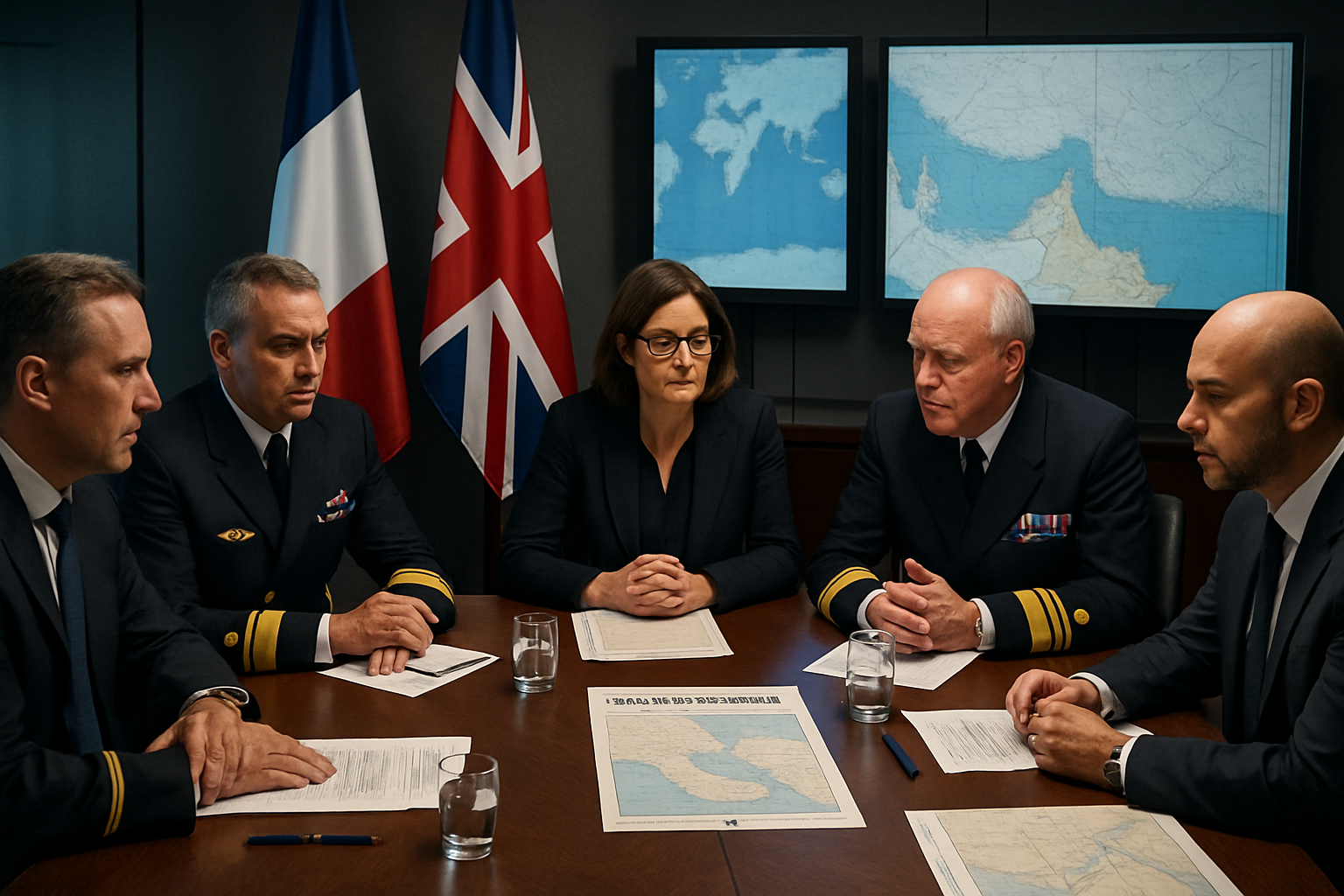
French President Emmanuel Macron and British Prime Minister Keir Starmer are chairing a crucial meeting of approximately 40 "non-belligerent" countries this Friday to discuss securing navigation through the strategically vital Strait of Hormuz, as the waterway remains subject to Iranian oversight following the most severe maritime crisis since World War II.
The Paris summit, with many participants joining via video conference, represents the latest diplomatic effort by sidelined nations to mitigate the impact of a conflict they neither initiated nor joined. France and the UK have emphasized their intention to focus on strictly defensive and diplomatic measures as the international community grapples with the ongoing disruption to global shipping lanes.
Critical Maritime Chokepoint Under Pressure
The Strait of Hormuz, a narrow 21-mile waterway handling 40% of global seaborne oil transit, has been at the center of international attention since Iran's Revolutionary Guard implemented comprehensive vessel vetting procedures in March 2026. The crisis began following the complete breakdown of U.S.-Iran nuclear negotiations despite significant diplomatic progress, leading to Operation Epic Fury and Iran's retaliatory Operation True Promise 4.
Iran's Foreign Minister Abbas Araghchi maintains that "We have not closed the strait. It is open" but requires "coordination with Iranian authorities with full respect for sovereignty and security." However, the selective passage system has effectively created what analysts describe as a "toll booth" regime, dramatically reducing normal shipping traffic through the critical waterway.
"The closure of this vital route has triggered what is being described as the worst oil price shock in history."
— France 24 International Report
International Coalition Response
According to diplomatic sources, the meeting signals to the United States that some of its closest allies are prepared to play a role in restoring freedom of navigation once conditions allow. The coalition includes major European powers alongside nations from across the globe, representing an unprecedented level of international coordination on maritime security.
Eurogroup President and Greek Finance Minister Kyriakos Pierrakakis has warned that "If the Strait of Hormuz were to remain closed for an extended period, we could experience the largest energy crisis in history." His assessment reflects the widespread concern about the duration and economic impact of the current situation on European economies.
Norwegian Participation and Capabilities
Norway has confirmed its willingness to contribute to maritime security efforts, with sources indicating that several European countries possess the technical capabilities necessary for mine-clearing operations in the strait. France's defense minister has specifically noted the collective European capacity for mine clearance operations, should they become necessary.
Economic and Humanitarian Impact
The ongoing situation has created the most severe global energy crisis since the 1970s oil shocks. Oil prices reached historic peaks with Brent crude hitting $119.50 and WTI climbing to $108.15 in a record 18.98% single-day jump during the height of the crisis in March 2026.
The International Energy Agency (IEA) deployed the largest strategic petroleum reserve release in its 50-year history—400 million barrels from 32 countries—to help stabilize markets. However, over 150 oil and LNG tankers remain stranded in the Persian Gulf, representing billions in cargo value.
Aviation and Supply Chain Disruption
Beyond energy markets, the crisis has created unprecedented disruption to global aviation and supply chains. Over 18,000 flights have been cancelled worldwide, representing the most extensive aviation disruption since COVID-19. Eight countries maintain simultaneous airspace closures, effectively severing critical Europe-Asia air corridors.
Major shipping companies Maersk and MSC continue to suspend operations in the Persian Gulf, while alternative routes around the Arabian Peninsula cannot handle the diverted volume and impose significant time and cost penalties.
Diplomatic Complexities and Regional Tensions
The current crisis has severely strained the regional coalition that previously maintained diplomatic consensus. Iranian attacks on coalition territories during Operation True Promise 4 resulted in casualties across multiple countries: one civilian killed in Abu Dhabi, 32 injured in Kuwait airport strikes, and 8 wounded in Qatar despite Patriot missile interceptions.
Italian sources suggest that disagreements over American participation in any potential operation risk dividing European leaders. The French position on U.S. involvement reportedly differs from other European approaches, highlighting the complex diplomatic calculations involved in any international response.
"Uncertainty and the duration of the crisis are the main factors that will determine the economic impact on Europe."
— Eurogroup President Kyriakos Pierrakakis
Nuclear Governance Context
The maritime crisis emerged from the complete collapse of U.S.-Iran nuclear talks despite achieving "broad agreement on guiding principles"—the most progress since the 2018 JCPOA withdrawal. Iran excluded ballistic missiles and proxy groups from negotiations as "red lines," while the U.S. demanded comprehensive coverage including missiles, armed groups, and human rights issues.
The situation has been complicated by the expiration of New START in February 2026, marking the first time in over 50 years without U.S.-Russia nuclear constraints. Iran continues uranium enrichment at 60% purity with over 400kg of weapons-grade material, sufficient for multiple nuclear weapons according to international experts.
Long-term Energy Security Implications
Security experts describe the crisis as exposing fundamental vulnerabilities in global energy architecture. Samuel Ciszuk, an energy analyst, characterized it as "the most severe energy security crisis in decades, exposing single-chokepoint vulnerabilities."
The 21-mile Strait of Hormuz represents a single-point failure for modern logistics, with no realistic alternatives capable of handling the diverted shipping volume. This has accelerated discussions about fundamental energy transformation, supply diversification, and renewable transitions, though such changes require years or decades to implement.
Strategic Reserve Limitations
While strategic petroleum reserves have provided temporary market stabilization, they serve only as buffers for sustained disruptions of this magnitude. Qatar's Energy Minister Saad Al Kaabi has warned that Gulf states may be forced to declare force majeure "within weeks," potentially driving oil prices to $150 per barrel with catastrophic economic consequences worldwide.
Template-Setting Crisis Management
UN Secretary-General António Guterres has described the situation as the "greatest test of multilateral cooperation in the modern era," with nuclear risks at their "highest in decades." The crisis affects multiple systems simultaneously: regional war prevention, global energy security, nuclear governance credibility, and international law enforcement.
The success or failure of diplomatic solutions will establish precedents for 21st-century conflict resolution approaches. Success could provide a framework for nuclear crisis resolution, while failure might accelerate preference for military solutions, potentially encouraging proliferation and undermining diplomatic credibility globally.
Path Forward
The Friday meeting in Paris represents a critical moment for international cooperation in addressing maritime security challenges. With approximately 20,000 seafarers stranded on over 3,200 vessels in what has become the most severe maritime humanitarian crisis in decades, the urgency for diplomatic solutions continues to mount.
Recovery timelines remain uncertain, depending on military and diplomatic resolutions rather than predictable factors like weather disruptions. The effectiveness of multilateral cooperation mechanisms will determine whether this crisis provides a template for peaceful resolution or marks a watershed toward more militarized international relations.
As European Commission President Ursula von der Leyen prepares emergency measures to accelerate electrification and reduce Middle Eastern energy dependence, the international community faces fundamental questions about energy security architecture that will shape global stability for decades to come.