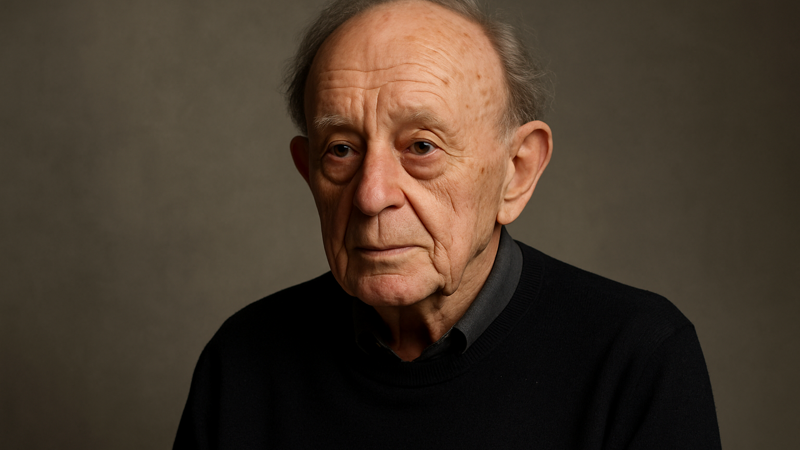
Frederick Wiseman, the pioneering documentary filmmaker whose unflinching examination of American institutions revolutionized cinema vérité and earned him recognition as one of the most important documentarians in film history, died Monday, February 16, 2026, at his home in Cambridge, Massachusetts. He was 96.
Wiseman's death was announced in a joint statement by his production company, Zipporah Films, and his family. The filmmaker, who remained active well into his 90s, leaves behind a monumental body of work spanning more than five decades and nearly 50 feature-length documentaries that collectively form what critics have called "an immense and unequaled social fresco of American society."
The Revolutionary Impact of 'Titicut Follies'
Wiseman burst onto the documentary scene in 1967 with "Titicut Follies," a devastating exposé of the deplorable conditions at the Bridgewater State Hospital for the Criminally Insane in Massachusetts. The film, which revealed shocking treatment of mentally ill patients, became both a landmark of documentary cinema and a legal controversy that would shadow Wiseman for decades.
The Massachusetts government attempted to ban the film, arguing it violated patient privacy, leading to a 24-year legal battle that finally ended in 1991 when the film was allowed unrestricted public exhibition. The controversy established Wiseman as a fearless chronicler of institutional power and set the template for his career-long investigation into the mechanics of American society.
"He served the protocols of documentary as others serve fiction, to find the drama."
— Portuguese film critic, Público
Master of Direct Cinema
Wiseman became internationally recognized as a master of "Direct Cinema," the American equivalent of cinéma vérité, characterized by long, observational takes without narration, interviews, or music. His approach was deceptively simple: point the camera at institutions and let them reveal themselves through the accumulated weight of mundane interactions and bureaucratic procedures.
Over five decades, Wiseman's camera explored an extraordinary range of American institutions. He filmed hospitals ("Hospital," 1970), high schools ("High School," 1968), police departments ("Law and Order," 1969), courts ("Juvenile Court," 1973), department stores ("The Store," 1983), museums ("National Gallery," 2014), libraries ("Ex Libris: The New York Public Library," 2017), and universities ("At Berkeley," 2013).
The Footprints of Life
Swiss critics described Wiseman as searching for "the footprints of life," and indeed his work revealed the profound humanity within seemingly impersonal institutional frameworks. His films typically ran between 90 minutes and four hours, requiring patience from audiences but rewarding them with deep insights into how power operates in democratic societies.
Unlike many documentarians, Wiseman avoided sensationalism or explicit political messaging. Instead, he trusted viewers to draw their own conclusions from his meticulous observations. This approach made his work simultaneously more subtle and more powerful, allowing institutions to indict themselves through their own actions and words.
A Prolific Final Chapter
Wiseman remained remarkably productive throughout his 90s. His final films included explorations of cultural institutions such as the London National Gallery and the New York Public Library, demonstrating his continued fascination with how institutions shape human experience. Even in his final works, he maintained the rigorous standards and observational discipline that had defined his career.
His method was consistent throughout: extensive research, months of filming, and painstaking editing that could take up to a year per film. Wiseman often served as his own producer, director, editor, and sound engineer, maintaining complete creative control over projects that were funded through a combination of grants, public television, and his own resources.
International Recognition and Influence
Wiseman's influence extended far beyond American borders. His work was celebrated at film festivals worldwide and studied in film schools across continents. The Swiss newspaper Neue Zürcher Zeitung noted that "for five decades, Wiseman tracked with his camera the rules of institutions – in asylums, courts, and opera houses."
His approach influenced generations of documentary filmmakers who adopted his patient, observational style. Unlike the more confrontational style of many contemporary documentarians, Wiseman proved that restraint and careful observation could be more revealing than aggressive questioning or dramatic reconstruction.
A Legacy of Democratic Transparency
Perhaps Wiseman's greatest contribution was his role in creating what might be called a documentary democracy – using film to make visible the ordinarily invisible workings of institutions that shape daily life. His cameras revealed how power operates not through grand gestures but through countless small interactions, bureaucratic procedures, and institutional routines.
Born in Boston in 1930, Wiseman was educated at Williams College and Yale Law School. He practiced law briefly before turning to filmmaking, bringing a lawyer's analytical mind to documentary cinema. This background may have contributed to his methodical approach and his interest in institutional structures.
The End of an Era
Wiseman's death marks the end of an era in documentary filmmaking. He was among the last living pioneers of Direct Cinema, a movement that included D.A. Pennebaker, the Maysles brothers, and Richard Leacock. While digital technology has democratized documentary production, few contemporary filmmakers match Wiseman's patience, discipline, and institutional access.
His work remains more relevant than ever in an era of increasing skepticism about institutions and growing demands for transparency in public life. Wiseman's films serve as both historical documents and instructional guides for understanding how democratic institutions function – or fail to function.
As news of his death spread across international media, critics and filmmakers worldwide paid tribute to a man who spent his career revealing the complex machinery of modern society. His films will continue to serve as windows into American life and as masterclasses in the art of documentary observation, ensuring that Frederick Wiseman's influence on cinema and society will endure long beyond his 96 years.