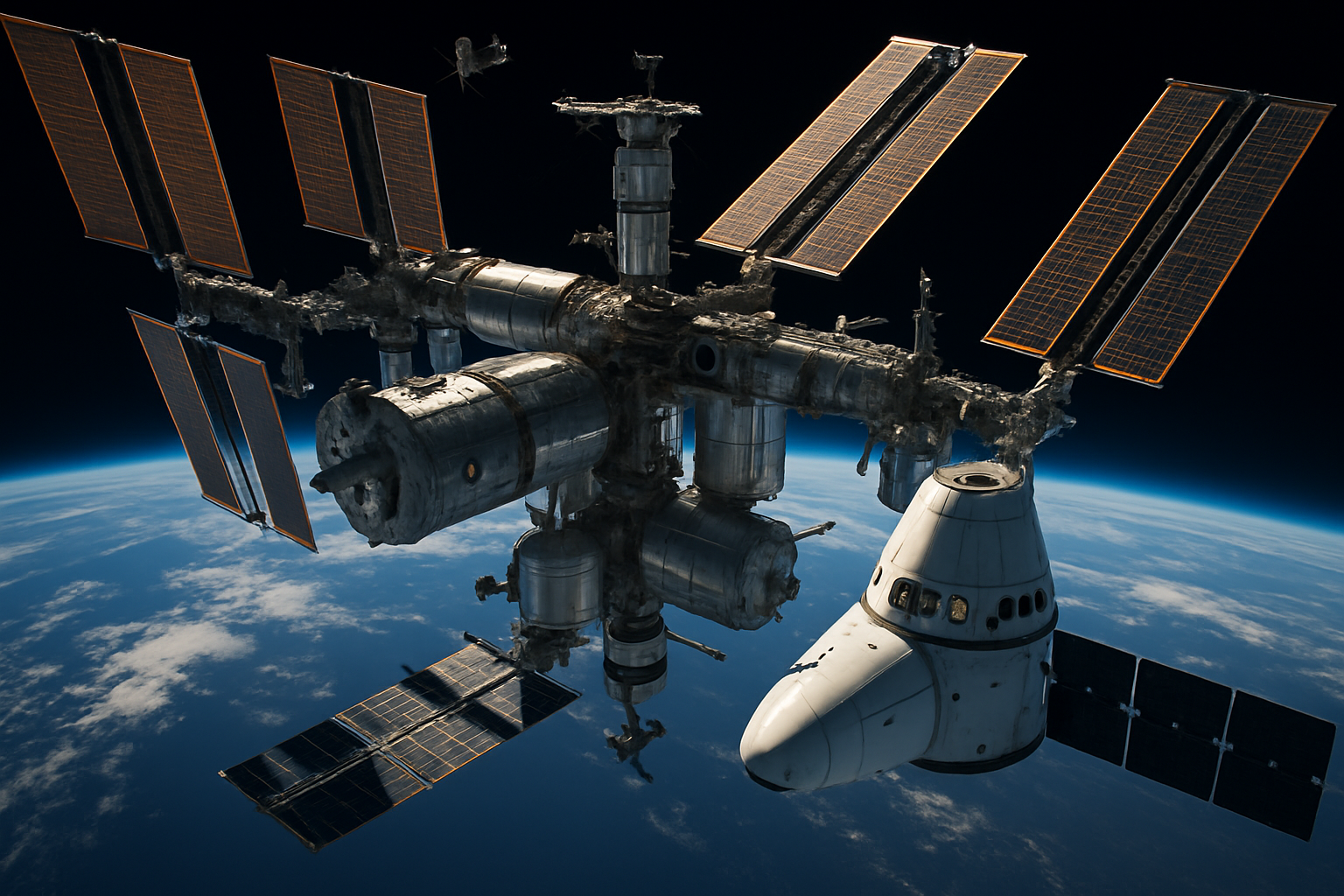
French astronaut Sophie Adenot and her fellow Crew-12 members have successfully docked with the International Space Station after a 34-hour journey, marking a historic milestone as Adenot becomes only the second French woman to travel to space and the first to reach the ISS.
The SpaceX Dragon capsule "Freedom" completed its docking maneuver with the ISS's Harmony module at 21:15 Paris time on Saturday, February 15, 2026, while orbiting over South Africa. The successful arrival restores the space station to its full seven-person operational capacity after an unprecedented medical evacuation earlier this year left a skeleton crew of just three astronauts.
A Historic International Crew
The Crew-12 mission brings together astronauts from three nations, representing continued international cooperation in space exploration. Jessica Meir, a Swedish-American marine biologist, serves as mission commander, while Jack Hathaway fills the pilot role for NASA. Alongside Adenot, Russian cosmonaut Andrey Fedyaev completes the international quartet as Mission Specialist.
"With that gentle contact, we have bridged the legacy of humankind's continuous presence in space. It has been more than 25 years at this very site," Commander Meir radioed after the successful docking, referencing the ISS's remarkable record of continuous human habitation.
For France, Adenot's arrival represents a significant return to human spaceflight. At 43, the engineer and former helicopter pilot becomes the first French woman to reach the ISS and only the second French woman in space after Claudie Haigneré, who flew 25 years ago. This lengthy gap underscores the rarity of French participation in human spaceflight missions.
Mission of Record Duration
The Crew-12 mission is scheduled to last approximately eight months, setting a record for the longest mission duration by a European astronaut. This extended timeline will enable comprehensive long-term research that wasn't possible with shorter missions, particularly in areas critical to future deep space exploration.
The mission's scientific objectives focus heavily on advancing our understanding of human biology in microgravity environments. Key research areas include lung tissue cultivation studies, which are crucial for understanding how human tissue behaves during extended periods of weightlessness. This research directly supports planning for future lunar settlements and Mars exploration missions.
Additionally, the crew will conduct extensive research into Space-Associated Neuro-Ocular Syndrome (SANS), a condition that affects astronauts' vision during extended missions. Understanding and addressing SANS is critical for the success of future deep space missions, where astronauts may spend months or years away from Earth.
Restoring Full ISS Operations
The successful arrival of Crew-12 comes at a critical time for ISS operations. Earlier this year, an unprecedented medical evacuation – the first in NASA's 65-year history of human spaceflight – forced the early return of crew members and left the station operating with a reduced complement of just three astronauts.
This reduced crew size significantly limited the station's scientific research capacity and operational capabilities. The arrival of the four new crew members restores the ISS to its optimal seven-person complement, enabling the resumption of full scientific operations and research programs.
The medical evacuation that preceded this mission highlighted the challenges and risks of human spaceflight, while also demonstrating the robust safety protocols and international cooperation that make such emergency responses possible. The successful launch and arrival of Crew-12 represents a return to normal operations and confidence in the safety systems.
International Cooperation in Action
The Crew-12 mission exemplifies the spirit of international cooperation that has defined the ISS program since its inception. Despite ongoing terrestrial tensions between various nations, the space station continues to serve as a platform where astronauts and cosmonauts from different countries work together toward common scientific goals.
Russian cosmonaut Andrey Fedyaev's participation in the mission demonstrates the continued cooperation between NASA, ESA, and Roscosmos, even as the global space industry undergoes significant transformation. This collaboration provides valuable experience in managing international crews for future deep space missions that will require even greater levels of cooperation and coordination.
The mission also represents the maturation of commercial spaceflight capabilities. SpaceX's Dragon capsule has become a reliable workhorse for crew transportation, completing its journey from Cape Canaveral to the ISS with precision timing and flawless execution.
Preparing for the Next Phase of Space Exploration
The Crew-12 mission arrives during what space industry analysts describe as a transition from the "AI revolution to the space economy golden age." This period is characterized by rapidly expanding commercial space capabilities, increased international participation, and ambitious plans for lunar and Mars exploration.
The research conducted during Adenot's eight-month mission will directly inform medical and operational protocols for future lunar bases and Mars missions. Understanding how the human body adapts to extended periods in microgravity is essential for planning missions that may last years and travel millions of miles from Earth.
The mission also serves as a testing ground for international crew coordination models that will be crucial for future deep space exploration. As missions venture farther from Earth, the ability of multinational crews to work effectively together becomes even more critical.
Technical Achievement and Safety Protocols
The successful launch and docking of Crew-12 demonstrates the maturity of current space transportation systems. The Dragon capsule traveled at speeds exceeding 27,000 kilometers per hour while executing precise orbital rendezvous maneuvers to dock with the ISS.
NASA's safety-first approach was evident throughout the mission preparation, with the crew undergoing extensive quarantine procedures at Kennedy Space Center to prevent the introduction of illness to the ISS. This meticulous preparation reflects lessons learned from decades of human spaceflight and the agency's commitment to astronaut safety.
The mission's success also highlights the reliability of SpaceX's Dragon system, which has now completed numerous crew transportation missions to the ISS. This reliability is crucial as commercial space transportation becomes the primary means of accessing the space station.
Looking Ahead
As Sophie Adenot begins her historic eight-month mission aboard the ISS, her work will contribute to humanity's understanding of long-duration spaceflight and help pave the way for future exploration beyond Earth orbit. Her research, along with that of her international colleagues, will inform the design of life support systems, medical protocols, and operational procedures for lunar bases and Mars missions.
The successful arrival of Crew-12 marks not just a restoration of full ISS operations, but also a step forward in the continued evolution of human space exploration. As the space economy enters its golden age, missions like Crew-12 demonstrate that international cooperation, rigorous safety protocols, and scientific dedication remain the foundation of successful human spaceflight.
The next eight months will see Adenot and her colleagues conduct groundbreaking research while living and working in one of humanity's most remarkable achievements – a permanently inhabited outpost in space that continues to serve as a stepping stone to the stars.