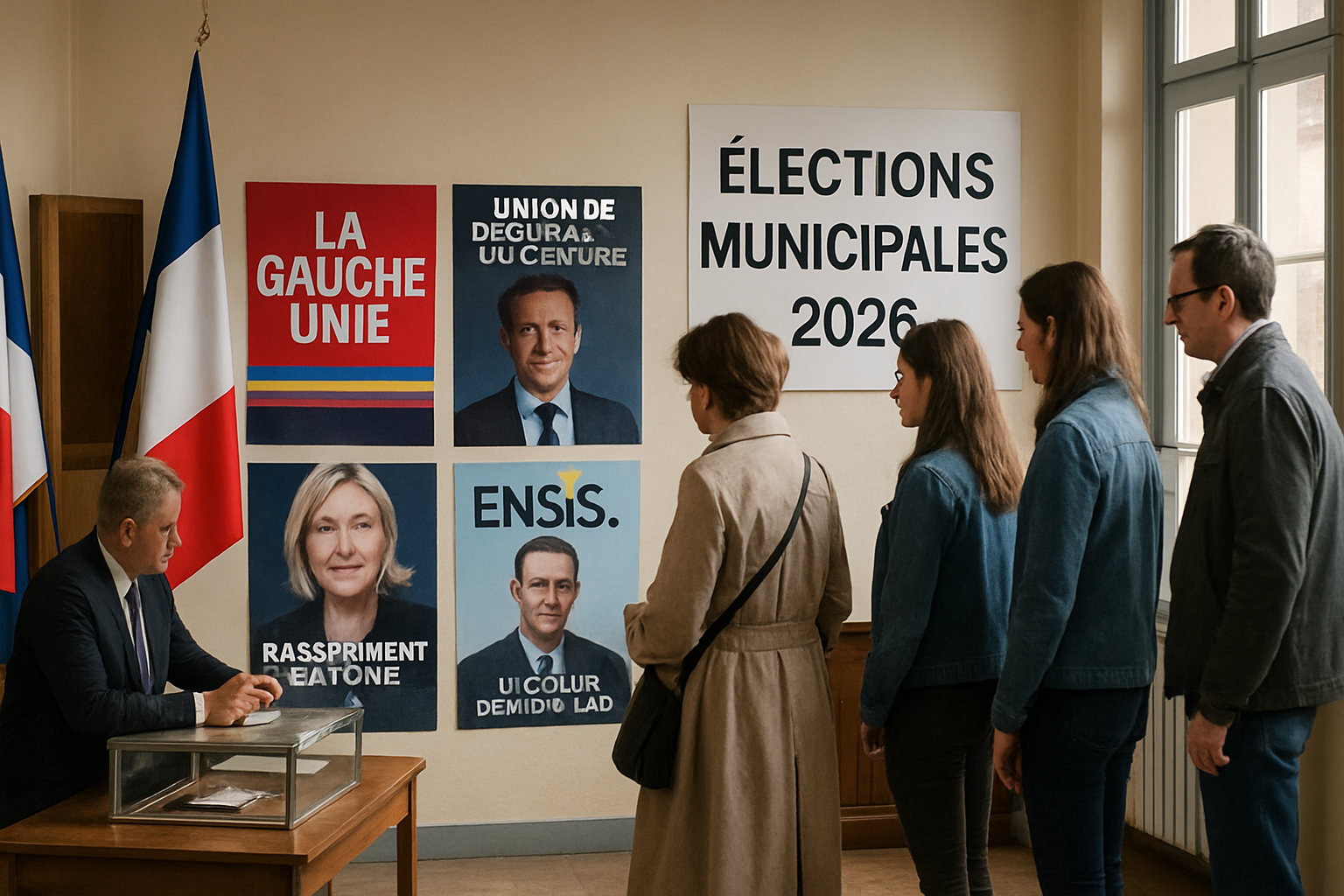
France's municipal elections on March 15, 2026, have unveiled the most fragmented political landscape in decades, with both far-left La France Insoumise (LFI) and Marine Le Pen's National Rally achieving unprecedented breakthroughs that are fundamentally reshaping French politics ahead of the 2027 presidential race.
The first round results demonstrate a dramatic reconfiguration of French political life, with traditional left-right dynamics giving way to a complex multi-polar system that reflects deeper societal divisions. Over 48 million voters participated in elections overshadowed by February's Lyon violence, where the death of 23-year-old Quentin Deranque intensified political tensions nationwide.
La France Insoumise's Historic Breakthrough
Jean-Luc Mélenchon's La France Insoumise achieved its most significant electoral success to date, with candidate Bally Bagayoko securing victory in Saint-Denis, making it the first major city to be governed by LFI. The victory in France's largest city outside Paris after Nice represents a symbolic triumph that has energized the hard-left movement.
"Voilà la première grande ville insoumise," declared supporters in Saint-Denis, where the mobilization of young voters and working-class neighborhoods proved decisive in overturning six years of Socialist governance.
— LFI supporters, Saint-Denis celebration
The LFI surge extends beyond Saint-Denis, with strong performances across Seine-Saint-Denis and northern France exceeding all predictions. In Lyon, Green incumbent Grégory Doucet leads with 37.3% but faces pressure to ally with LFI's Anaïs Belouassa-Cherifi, who achieved a remarkable 10.4% in her breakthrough performance.
This success comes despite significant political headwinds following the Lyon violence, which saw LFI parliamentary assistant Jacques-Elie Favrot charged with intentional homicide in connection with Deranque's death. The Interior Ministry's controversial reclassification of LFI from "left" to "extreme left" for electoral purposes has been challenged at the Council of State as administrative manipulation.
National Rally's Urban Expansion Strategy
Marine Le Pen's National Rally has successfully evolved from rural populism to sophisticated urban campaigning, achieving what political analysts describe as "authoritarian innovation." The party's strategic targeting of five cities for historic breakthroughs has yielded significant results, particularly in traditionally progressive strongholds.
In Marseille, incumbent left-wing mayor Benoît Payan finds himself in an unprecedented dead heat with National Rally candidate Franck Allisio, marking the first time the far-right has achieved such competitiveness in France's second-largest city. This represents a historic breakthrough for Le Pen's party in a traditionally progressive Mediterranean port city.
Toulon provides the clearest example of National Rally's urban success, where candidate Laure Lavalette achieved a commanding 42.05% in the first round, leading the center-right incumbent by more than 12 points. The result reflects the party's growing appeal beyond its traditional rural base.
Paris: A Rare Left-Right Confrontation
The capital presents France's first direct left-right confrontation in 25 years, with Socialist Emmanuel Grégoire leading with approximately 31-34% against Les Républicains' Rachida Dati at around 30%. The result demonstrates both the resilience of left-wing control of City Hall and the renewed appeal of conservative politics in the current climate.
The absence of a viable centrist candidate reflects the broader squeeze on traditional moderate politics, with President Macron's Renaissance party adopting a minimal strategy of supporting established right-wing candidates rather than fielding competitive lists of their own.
Socialist Resilience Amid Fragmentation
Despite the broader left-wing fragmentation, the Socialist Party has demonstrated remarkable resilience in defending its municipal bastions. In Strasbourg, former mayor Catherine Trautmann leads with significant advantage over the Green incumbent, while maintaining competitive positions in traditional strongholds.
However, this success comes at the cost of party unity, with the Socialists increasingly distancing themselves from Mélenchon's movement following the Lyon violence. As one party official noted: "The definitive break with LFI reflects our commitment to democratic values."
The Green Wave Recedes
The ecological candidates who achieved breakthrough victories in 2020 now face significant challenges. Political scientist Florent Gougou observes that while Green mayors remain competitive for second rounds, they are increasingly "talonnés par leurs principaux adversaires" (closely pursued by their main adversaries).
In Bordeaux, ecological mayor Pierre Hurmic leads with 27.68% but faces a serious challenge from Thomas Cazenave (25.58%). The results suggest that the environmental wave that swept French cities in 2020 has lost momentum amid economic and security concerns.
Political Violence Shadows the Campaign
The February death of Quentin Deranque during political violence in Lyon has profoundly shaped the electoral campaign. The incident, which resulted in seven charges including against LFI assistant Jacques-Elie Favrot, has been weaponized by the far-right while contributing to left-wing fragmentation.
Justice Minister Gérald Darmanin's characterization of "ultra-left" responsibility and the government's restrictions on university political meetings have created an atmosphere of tension that has influenced voter sentiment nationwide.
Implications for 2027
These municipal results provide crucial insights into party organizational strength ahead of the 2027 presidential race, where Emmanuel Macron is constitutionally barred from seeking a third term. The National Rally's urban expansion demonstrates broader appeal that could prove decisive in a presidential contest, while LFI's breakthrough provides Mélenchon's movement with governing experience and enhanced credibility.
The fragmentation of traditional left-wing cooperation complicates alliance-building for the second rounds, scheduled for March 22. Traditional withdrawal and endorsement strategies face unprecedented complexity due to the political polarization following the Lyon violence.
"A un an du scrutin présidentiel, la reconfiguration de la vie politique que promettait le macronisme en 2017 semble toujours en cours, et la bataille se joue dorénavant au sein des arcs de la gauche et de la droite, tiraillés par les populismes très différents de LFI et du RN."
— Le Monde analysis
Turnout and Democratic Participation
Voter turnout reached approximately 49%, representing recovery from the 2020 pandemic-affected elections but remaining below historical norms. The moderate participation suggests neither complete political disengagement nor overwhelming enthusiasm, indicating democracy functioning under stress while maintaining citizen participation in self-governance.
The relatively stable turnout despite the charged political atmosphere demonstrates the resilience of French democratic institutions, even as they face unprecedented challenges from political extremism and fragmentation.
The Path Forward
The March 22 second round will determine final outcomes in municipalities where no candidate achieved an absolute majority. These results will provide additional insights into alliance patterns and voter transfer dynamics that will preview 2027 coalition strategies.
For the National Rally, municipal victories would provide crucial governing experience and credibility for the presidential race where the party polls suggest potential success. For LFI, the need to demonstrate effective governance in Saint-Denis and other potential victories will test whether the movement can transition from protest to responsible administration.
The elections represent a defining moment for French democracy's capacity to manage political extremism through electoral rather than extra-legal means. The successful conduct of free and fair elections despite heightened tensions provides a template for European institutions addressing similar challenges.
As France moves toward the decisive second round and the 2027 presidential campaign beyond, these municipal elections have established that the political reconfiguration promised by Macronism in 2017 continues to evolve, with the battle now taking place within the arcs of left and right, each pulled by very different populist forces. The ultimate test will be whether French democratic institutions can channel this fragmentation into constructive governance rather than dangerous polarization.