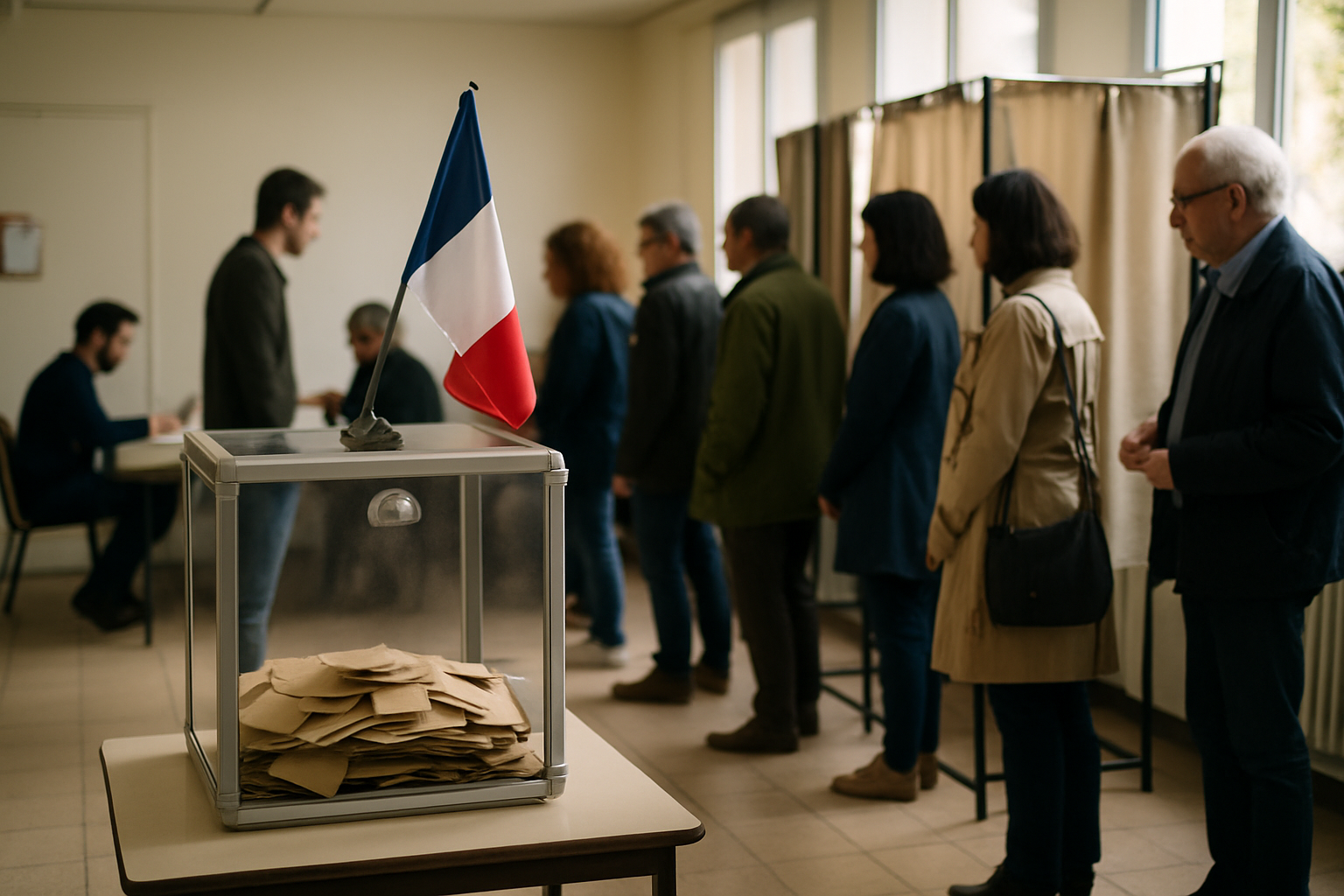
More than 48 million French voters headed to polling stations Sunday for the first round of municipal elections, a critical democratic test taking place against a backdrop of unprecedented political violence and a surging far-right movement six years after COVID-19 disrupted the last municipal contest.
The two-round electoral process, concluding March 22, will determine mayors and municipal councils across thousands of French communities. However, the stakes extend far beyond local governance, with political analysts viewing these elections as a crucial preview of the 2027 presidential race and a barometer of France's democratic resilience during one of its most turbulent political periods since the Fourth Republic.
Shadow of Political Violence
The electoral campaign has been overshadowed by the tragic death of 23-year-old Quentin Deranque, a far-right activist who died following violent clashes in Lyon during February. Seven suspects, including Jacques-Elie Favrot, a parliamentary assistant to La France Insoumise deputy Raphaël Arnault, have been formally charged with intentional homicide in connection with the fatal beating.
The incident has exposed deep fractures in French political discourse, with Justice Minister Gérald Darmanin blaming the "ultra-left" while National Rally leader Jordan Bardella declared Jean-Luc Mélenchon bears "immense moral responsibility." The violence prompted government restrictions on university political meetings and created a diplomatic crisis when Italian Prime Minister Giorgia Meloni called the death a "wound for all of Europe," prompting a sharp rebuke from President Emmanuel Macron.
"The results will be unveiled starting at 8 PM, following a day that our reporters will cover throughout as voters make their voices heard in this crucial democratic exercise."
— Le Monde
Far-Right Strategic Breakthrough
Marine Le Pen's National Rally has fundamentally shifted its electoral strategy, targeting five major cities for historic municipal breakthroughs. This represents a sophisticated evolution from rural populism to urban campaigning, what political scientists term "authoritarian innovation" – far-right movements operating within democratic systems while gradually eroding liberal norms through electoral success.
The strategic pivot comes as Le Pen faces a potential career-ending legal challenge. Prosecutors have demanded a five-year public office ban in her ongoing EU Parliament fraud case, which could eliminate France's most prominent far-right leader from the 2027 presidential race. The appeals court ruling, expected before summer 2026, will determine whether the politician who reached presidential runoffs in 2017 and 2022 can continue her political career.
Paris has emerged as a particularly symbolic battleground, representing the first direct left-right confrontation in the capital in 25 years. The contest reflects broader national polarization, with traditional centrist politics increasingly squeezed between radical alternatives.
Institutional Crisis and Democratic Resilience
These elections occur during what experts describe as the most severe European political crisis since World War II. France has witnessed coalition instability, the controversial Interior Ministry reclassification of La France Insoumise from "left" to "extreme left" for electoral purposes, and unprecedented political violence disrupting democratic discourse.
The electoral context has been further complicated by administrative tensions. La France Insoumise has filed Council of State challenges over its reclassification, characterizing the move as administrative manipulation of democratic processes. Such institutional disputes reflect broader concerns about the erosion of democratic norms amid heightened polarization.

The 2027 Presidential Preview
While ostensibly focused on local governance, these municipal elections serve as an unofficial primary for the 2027 presidential contest. Macron, constitutionally barred from seeking a third term, has watched his Renaissance party adopt a minimal strategy, designating few lists and largely supporting established right-wing candidates – a strategic retreat reflecting the movement's declining influence.
The political landscape for 2027 is already taking shape with Bruno Retailleau, former Interior Minister and Les Républicains leader, officially announcing his presidential candidacy in February. Retailleau promises to "drastically reduce immigration" through direct referendums and has criticized "excesses of rule of law," positioning himself as a hardline conservative alternative in a potentially crowded field.
The fragmentation of the traditional left has created additional uncertainty. Raphaël Glucksmann of Place Publique has called for a "definitive break" with La France Insoumise, while the Socialist Party distances itself from Mélenchon's movement following the Lyon violence. This fracturing occurs precisely when unity against the far-right is seen as essential by many observers.
Municipal Elections as Democratic Laboratory
French mayors consistently rank among the most trusted political figures, with approximately 70% of citizens expressing confidence in municipal leadership. This trust makes municipal elections a crucial gauge of political sentiment, particularly during periods of national political crisis.
The two-round system encourages coalition-building and strategic voting, providing insights into how political alliances might form for 2027. Results from major cities will be scrutinized for evidence of voter preferences regarding cooperation between traditional parties and emerging political movements.
International Implications
European observers are monitoring these elections as a template for democratic resilience under pressure. France's ability to conduct free and fair elections while managing political violence through legal rather than extrajudicial means will influence how other democracies respond to similar challenges.
The elections occur as 89% of Europeans demand greater EU unity according to Eurobarometer polling, yet political reality shows increasing fragmentation and sovereignty assertions across member states. France's municipal results could either demonstrate democratic adaptability or signal accelerating democratic backsliding concerns characterizing recent European discussions.
"Some candidates are looking to use the polls as a springboard for higher office, with the 2027 presidential vote looming large less than a year away."
— France 24
Challenges to Electoral Integrity
The campaign has been marked by significant security concerns and allegations of manipulation. Anti-racism demonstrations on the eve of the first round drew thousands in Marseille, Toulouse, and Bordeaux, reflecting deep societal tensions over immigration and national identity that have become central to French political discourse.
Counter-demonstrations with antifascist slogans created additional tensions, particularly in Lyon where memorial rallies for Quentin Deranque documented Nazi salutes and racist chants, leading to legal action by the Rhône prefecture. The intersection of memorial politics and electoral campaigning has created unprecedented challenges for maintaining public order while respecting democratic freedoms.
Voter Participation and Democratic Legitimacy
Despite political tensions, voter turnout rates will be closely watched as an indicator of democratic engagement. Historical abstention patterns in municipal elections, typically lower than national contests, could be disrupted by the high-stakes political environment and polarized campaign atmosphere.
The elections represent a test of whether democratic processes can channel political anger into constructive governance rather than destructive confrontation. Success would strengthen confidence in French institutional resilience, while failure could accelerate concerns about democratic degradation.
Looking Ahead to March 22
The March 22 second round will determine final outcomes in municipalities where no candidate achieved an absolute majority. This round traditionally sees intensified coalition negotiations and strategic withdrawals, providing additional insights into political alliance patterns for 2027.
Results will be analyzed for evidence of the National Rally's urban breakthrough strategy effectiveness, the resilience of traditional Republican institutions, and the capacity of democratic processes to manage political extremism through electoral rather than violent means.
As France navigates this critical democratic moment, the municipal elections serve not just as local governance contests but as a fundamental test of the Republic's ability to maintain democratic values while adapting to 21st-century political pressures. The outcomes will resonate far beyond French borders, influencing European approaches to managing political extremism and preserving democratic institutions under unprecedented strain.