French Muslim communities navigate an increasingly complex landscape during Ramadan 2026, as nearly six million believers balance traditional Islamic observances with France's secular republican framework while confronting persistent integration challenges and growing interfaith dialogue opportunities.
As part of the global Ramadan observance that began February 19, 2026, following international crescent moon sighting confirmations, France's diverse Muslim population—representing Europe's largest Islamic community—faces unique cultural and social dynamics that distinguish their experience from Muslim-majority nations worldwide.
The French Ramadan Experience: Unity Within Diversity
The Paris Grand Mosque, serving as a unifying focal point, emphasized community solidarity among France's remarkably diverse Muslim population during the holy month's commencement. This diversity spans multiple generations of immigrants from North Africa, sub-Saharan Africa, Turkey, and the Middle East, alongside French converts and second- and third-generation French Muslims.
"France offers both opportunities and challenges for authentic Islamic practice," explains Dr. Amira Bendali, a sociologist at the Sorbonne specializing in French Islamic communities. "Ramadan becomes a particularly visible period where questions of religious expression, workplace accommodation, and social integration intersect most prominently."
"We maintain our spiritual traditions while contributing to French society. Ramadan teaches us discipline and empathy—values that strengthen both our faith and our citizenship."
— Fatima Benali, Community Leader, Marseille Islamic Association
Workplace and Educational Adaptations
Unlike Muslim-majority countries that implement nationwide schedule modifications, French Muslims must navigate individual accommodation requests within secular institutional frameworks. Many employers have developed sophisticated approaches to supporting Muslim employees during Ramadan, including flexible working hours and quiet spaces for prayer and reflection.
French educational institutions, following Finland's model of "fasting parks" for Muslim students, have increasingly created inclusive environments that respect religious diversity while maintaining republican principles of laïcité (secularism). Several Paris-area schools have implemented discreet support systems, including adjusted lunch period activities and counseling services sensitive to fasting students' needs.
The French business sector has also adapted, with many companies extending evening hours during Ramadan to accommodate iftar gatherings and modified energy levels associated with daily fasting. This practical accommodation demonstrates growing institutional understanding of religious practice's intersection with professional life.
Cultural Bridge-Building Through Food and Fellowship
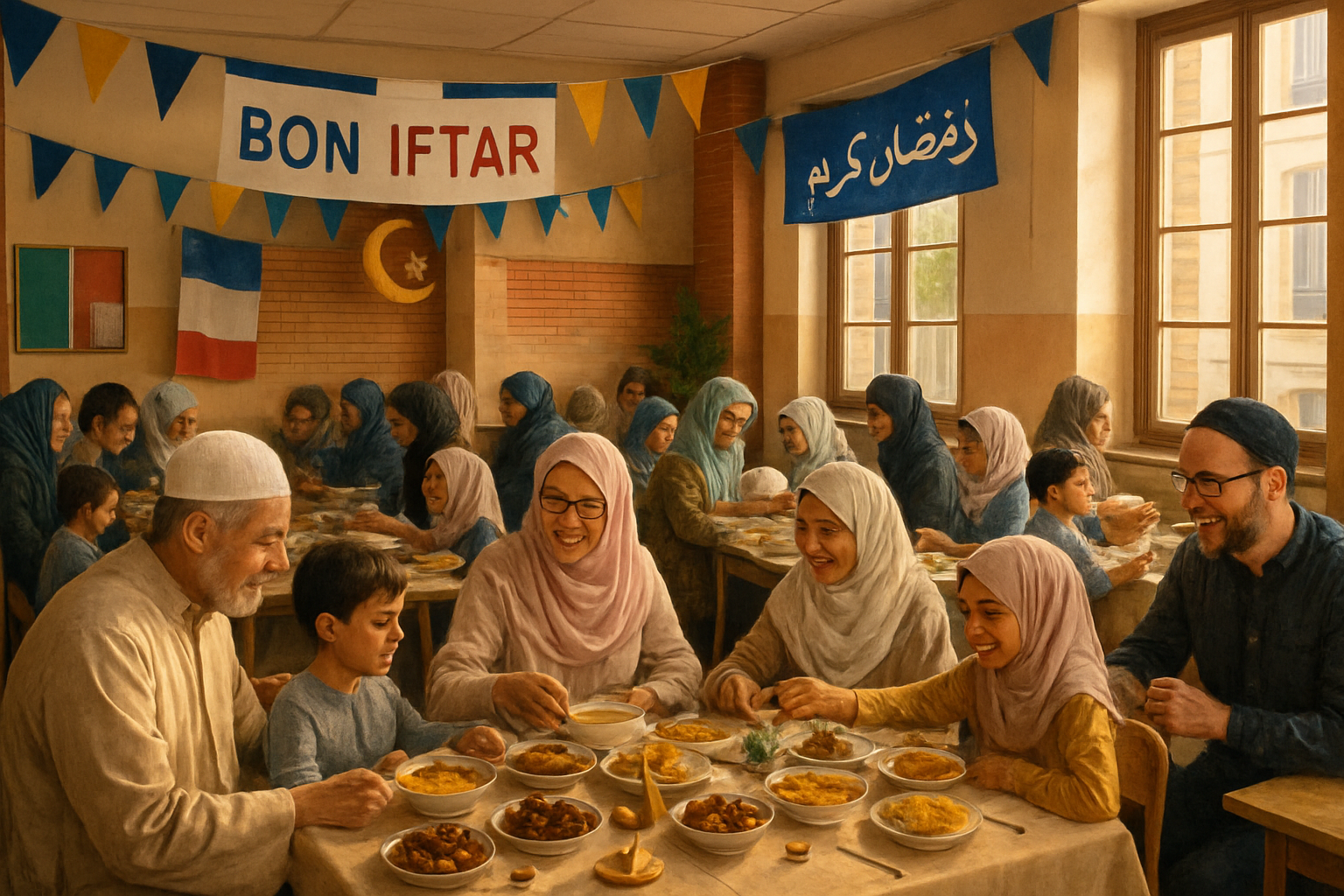
One of the most successful integration initiatives has emerged through Ramadan's emphasis on community and charitable giving. French Muslim communities have organized extensive iftar programs that welcome non-Muslim neighbors, creating unprecedented opportunities for cross-cultural understanding and dialogue.
The Strasbourg Islamic Cultural Center, for example, hosts weekly community iftar meals that regularly attract local French families, city officials, and interfaith groups. These gatherings demonstrate Islam's emphasis on hospitality while fostering genuine personal connections that transcend religious boundaries.
"Breaking fast together creates bonds that no policy can mandate," observes Imam Hassan Chalghoumi from Drancy, a vocal advocate for French Muslim integration. "Through sharing meals and stories, we build the France we all want to live in—one of mutual respect and understanding."
Technology and Tradition: Modern Tools for Ancient Practices
French Muslims have embraced technology to enhance traditional Ramadan observances while connecting with global Islamic communities. Mobile applications providing precise prayer times for French cities, Quranic recitation in multiple languages, and charitable giving platforms have enabled seamless religious practice within France's urban environments.
Social media platforms have become vital tools for community building, with French Muslim influencers and religious leaders using digital channels to share educational content about Islamic practices while addressing misconceptions and promoting positive community relations.
Challenges and Resilience
Despite progress in many areas, French Muslim communities continue facing significant challenges during Ramadan and throughout the year. Issues include persistent employment discrimination, residential segregation in certain urban areas, and occasionally strained relationships with law enforcement.
The ongoing debate over Islamic symbols in public spaces, including the wearing of hijabs and the construction of mosque minarets, creates additional complexity for communities seeking to practice their faith openly while respecting French republican values.
Recent incidents of Islamophobic rhetoric and discrimination have particularly affected young French Muslims, who often struggle with questions of identity and belonging. However, community leaders report increased resilience and solidarity during Ramadan, when Islamic values of patience, forgiveness, and social justice provide spiritual resources for addressing these challenges.
"Ramadan reminds us that our struggles are temporary, but our commitment to justice and compassion must be permanent. We fast not just from food, but from hatred and despair."
— Dr. Tareq Oubrou, Imam and Theologian, Bordeaux
Economic and Social Contributions
During Ramadan 2026, French Muslim communities have demonstrated significant economic and social contributions to broader French society. Zakat (obligatory charitable giving) and voluntary Ramadan donations have supported not only Islamic community programs but also secular charitable initiatives addressing homelessness, food insecurity, and educational support for disadvantaged youth.
Muslim-owned businesses across France report increased economic activity during Ramadan, with halal food markets, restaurants, and cultural centers contributing millions to local economies while creating employment opportunities for both Muslim and non-Muslim workers.
Interfaith Dialogue and Secular Cooperation
The simultaneous observance of Ramadan and Lent in 2026 has created unique opportunities for Catholic-Muslim dialogue in France. Several dioceses have organized joint prayer services and charitable initiatives, emphasizing shared values of spiritual discipline, social justice, and community service.
French secular organizations have also increased engagement with Muslim communities during Ramadan, with human rights groups, academic institutions, and cultural associations developing programming that explores Islamic contributions to French culture and society.
Looking Forward: Integration and Authenticity
As Ramadan 2026 continues through March 19, French Muslim communities are working to define a distinctly French Islamic identity that honors both religious authenticity and republican citizenship. This involves developing Islamic theology and practice that speaks to French contexts while maintaining connection to global Muslim communities.
Community leaders emphasize that successful integration requires mutual effort—Muslim communities must engage constructively with French institutions and values, while broader French society must recognize Islam as a legitimate and contributing element of French national identity.
The success of Ramadan community initiatives demonstrates the potential for French Muslims to serve as bridges between France and the broader Islamic world, contributing to international understanding while strengthening French social cohesion.
Conclusion: A Model for European Islam
French Muslim communities' navigation of Ramadan 2026 offers valuable insights for European Islam's future development. By balancing religious authenticity with civic engagement, creating inclusive community spaces, and fostering genuine interfaith dialogue, these communities are developing approaches that may serve as models for Muslim minorities throughout Europe.
The ongoing challenge involves ensuring that this progress continues beyond Ramadan's conclusion, creating lasting institutional changes and social relationships that support Muslim integration while preserving Islamic identity and practice.
As France's Muslim communities conclude their daily fasts and gather for iftar meals across the country, they continue writing a uniquely French chapter in global Islamic history—one characterized by resilience, adaptation, and hope for a more inclusive future.