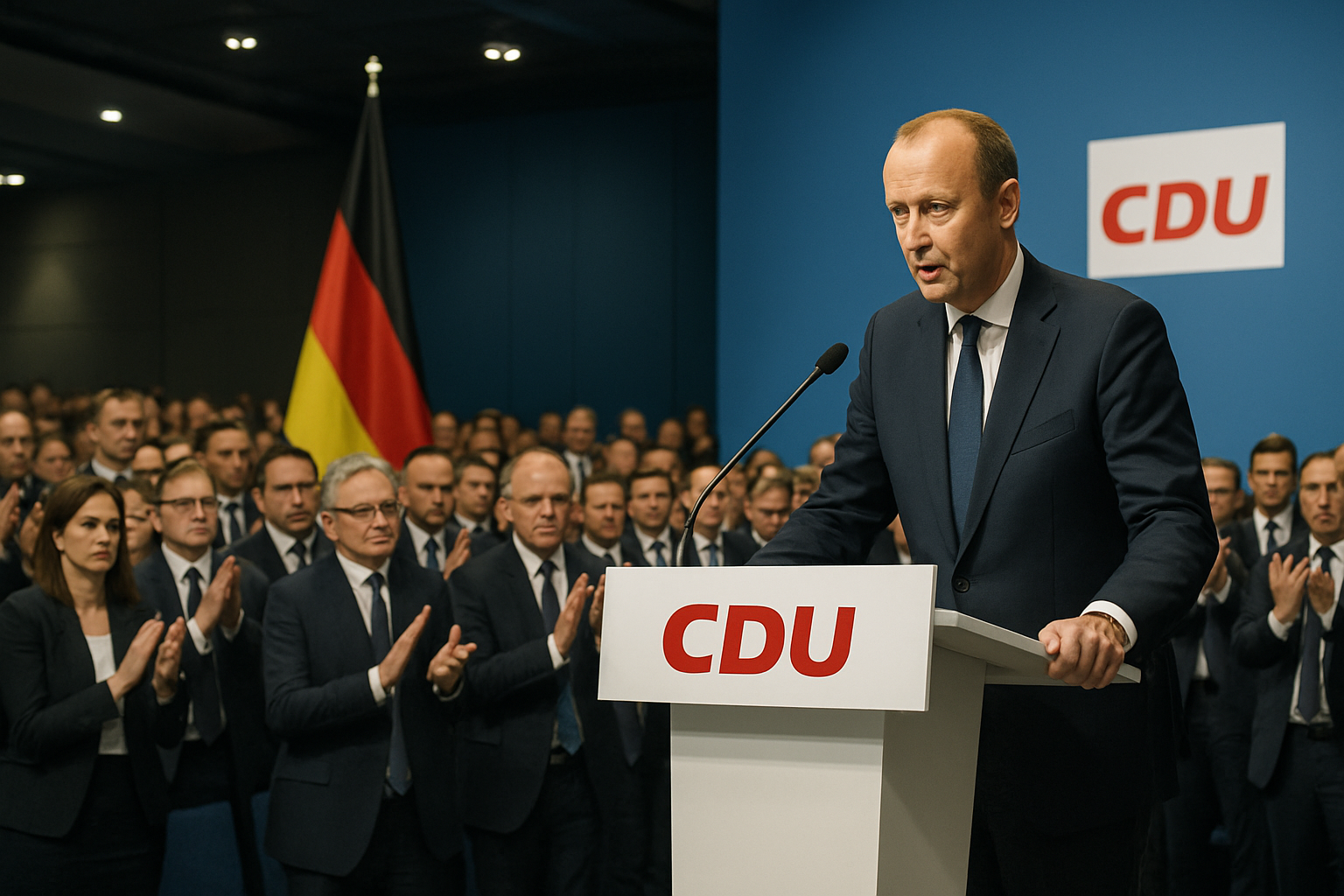
German Chancellor Friedrich Merz achieved a commanding re-election as leader of the Christian Democratic Union (CDU) on Friday, securing 91.2% of delegate votes at the party congress in Stuttgart while delivering stark warnings about far-right extremism and a fundamentally changed world order.
The 878 votes in favor out of 963 valid ballots cast represented a significant improvement from Merz's performance in previous leadership contests, providing him with a strong mandate as Germany faces mounting political challenges. The result came after a day marked by significant technical problems that delayed proceedings for hours.
Technical Difficulties and Democratic Resilience
The CDU had planned to use tablets for rapid digital voting at the Stuttgart congress, with results expected within minutes. However, repeated technical failures forced organizers to resort to traditional paper ballots, causing substantial delays throughout the day. Despite these disruptions, the democratic process ultimately prevailed, delivering a clear mandate for continued leadership.
Multiple international sources confirmed the final tally, with Bosnian media reporting that Merz "won more than 90 percent of the votes" after the prolonged technical difficulties. The Austrian People's Party was among the first international partners to congratulate Merz on his re-election, emphasizing that "strong bourgeois politics in Germany is a gain for all of Europe."
Coalition Strategy and Far-Right Exclusion
In his address to delegates, Merz delivered uncompromising rhetoric against cooperation with far-right parties, particularly the Alternative for Germany (AfD). According to reports from multiple sources, the Chancellor vowed that the AfD would not be allowed to "ruin our country," positioning the CDU as a bulwark against extremist politics.
This stance takes on particular significance given recent electoral developments across Europe, where far-right parties have gained ground. Portuguese sources noted that Merz "reaffirmed that he will only seek 'approval in the political center,'" maintaining the coalition with the Social Democratic Party (SPD) while refusing to negotiate with the AfD.
The exclusion strategy reflects broader concerns within the CDU about the normalization of far-right politics in German political discourse. Merz's clear positioning aims to consolidate centrist voters while preventing defection to populist alternatives.
Warnings of a Changed World Order
Beyond domestic politics, Merz used his re-election speech to address fundamental shifts in the international system. Israeli sources reported that at the "Christian Democrat party conference ahead of series of state elections, chancellor vows to not let AfD 'ruin' Germany" while warning of "a changed world."
This assessment aligns with broader European concerns about global stability, coming in the context of ongoing conflicts, nuclear governance challenges, and shifting geopolitical alignments. The timing of Merz's warnings coincides with intense diplomatic activity, including recent prisoner exchanges between Russia and Ukraine and ongoing nuclear negotiations involving multiple international actors.
European Context and International Relations
The re-election occurs against a backdrop of significant European political developments. Recent memory from the Planet News archives shows that Germany has been actively engaged in discussions about European strategic autonomy, including unprecedented conversations about nuclear deterrence cooperation with France.
Merz's leadership has been characterized by efforts to maintain Germany's central role in European integration while adapting to new security challenges. His recent participation in international forums, including the Munich Security Conference, has positioned him as a key voice in discussions about transatlantic relations and European defense cooperation.
The CDU leader's approach reflects a broader European trend toward greater strategic independence while maintaining alliance relationships. This balance between autonomy and cooperation has become increasingly important as traditional security frameworks face new pressures.
Domestic Challenges and Reform Agenda
Despite the strong electoral mandate, Merz faces significant domestic challenges. German sources noted that while he was re-elected by the "Kanzlerwahlverein" (Chancellor-election association), he "did not ignite enthusiasm" with his speech. This suggests that while party loyalty remains strong, the emotional connection with voters may require further development.
The CDU leader has promised continued domestic reforms while maintaining his anti-extremist positioning. This dual approach aims to address citizen concerns about governance effectiveness while preserving democratic institutions against populist pressure.
Analysis from the party congress suggests that Merz's strategy involves combining practical policy solutions with clear ideological positioning. This approach seeks to demonstrate governing competence while maintaining principled opposition to political extremism.
Electoral Implications and Future Outlook
The timing of Merz's re-election is particularly significant given upcoming electoral challenges. The strong mandate provides stability for the CDU as it prepares for crucial state elections where the party will face direct competition from both traditional rivals and emerging populist movements.
Recent European electoral developments, including significant far-right gains in regional contests across the continent, underscore the importance of Merz's exclusion strategy. The CDU's approach of maintaining centrist positioning while refusing extremist cooperation represents a test case for how mainstream conservative parties can respond to populist pressure.
International observers will closely watch how Merz's strengthened leadership translates into electoral performance. The success or failure of his anti-extremist strategy could influence similar approaches by conservative parties throughout Europe.
Looking Forward: Leadership in Uncertain Times
Friedrich Merz's overwhelming re-election as CDU leader provides him with the political capital necessary to navigate increasingly complex domestic and international challenges. His clear stance against far-right cooperation, combined with warnings about global order changes, positions the CDU as a stabilizing force in turbulent times.
The technical difficulties that marked the voting process, while problematic, ultimately demonstrated the resilience of democratic institutions. The ability to adapt and complete the democratic process despite technological failures may serve as a metaphor for broader institutional resilience in challenging times.
As Germany continues to play a central role in European politics and international affairs, Merz's leadership will be tested by his ability to maintain coalition stability, resist extremist pressure, and adapt to the "changed world" he has identified. The strong mandate from Friday's vote provides him with the foundation necessary to meet these challenges, but success will ultimately depend on translating party support into effective governance and electoral success.