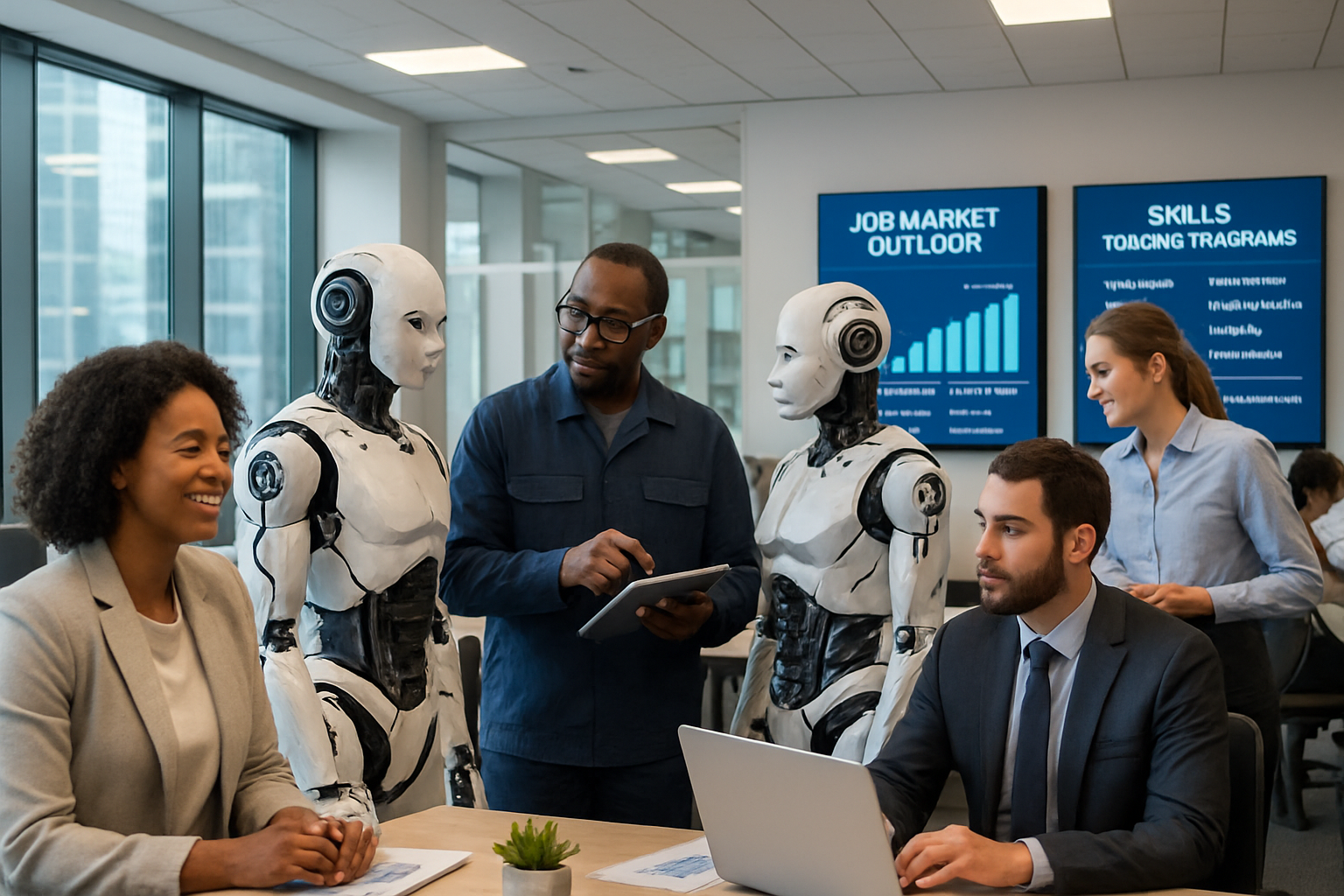
The global workforce stands at a historic crossroads as artificial intelligence, automation, and geopolitical shifts fundamentally reshape employment landscapes across continents, creating unprecedented opportunities for those who adapt while threatening traditional career paths that have defined generations.
Recent comprehensive analysis by Udemy and the World Economic Forum provides crucial insights into employment trends through 2030, revealing a complex picture where technological advancement creates both disruption and opportunity. The findings emerge as countries worldwide grapple with massive workforce transformations, from AI integration in educational systems to fundamental restructuring of entire industries.
The Great Skills Revolution: What Jobs Will Define 2030
According to the latest World Economic Forum projections, the employment landscape by 2030 will be dramatically different from today's job market. The most in-demand positions will blend human creativity with technological proficiency, requiring workers to develop hybrid skill sets that were barely conceivable a decade ago.
AI specialists, data scientists, and automation engineers top the projected growth charts, but surprisingly, the report emphasizes that many traditional roles will evolve rather than disappear. Healthcare workers, educators, and creative professionals will find their roles enhanced by AI tools rather than replaced by them, provided they develop complementary technical skills.
"The future workforce won't be replaced by AI – it will be divided between those who use AI and those who don't,"
— Industry analyst quoted in the Udemy-WEF collaborative report
Global Educational Revolution: Preparing Tomorrow's Workers
The employment transformation is already visible in educational initiatives worldwide. Malaysia has pioneered the world's first AI-integrated Islamic schools, combining artificial intelligence with traditional religious and academic learning. Singapore's WonderBot 2.0 program teaches heritage education through interactive AI, while Canadian universities deploy AI teaching assistants that maintain critical thinking standards.
These innovations represent a fundamental shift from traditional educational models toward what experts term "human-centered AI integration" – using technology to enhance rather than replace human learning processes.
Sierra Leone's Ministry of Communication, Technology, and Innovation recently launched a nationwide school tour preparing young innovators for robotics competitions, while Ghana's National Service Authority partnered with the UN Population Fund to implement Work Readiness and Leadership Training Programmes affecting approximately 150,000 graduates annually.
The Productivity Paradox: AI's Unexpected Workplace Reality
However, recent German research by Dr. Frank Bäumer reveals a troubling disconnect between AI promises and workplace reality. Many organizations implementing AI systems experience "mehr Arbeit und nachlassender Effizienz" (more work and declining efficiency) rather than the promised productivity gains.
Workers increasingly report a "double workload" effect – performing their original responsibilities while also supervising and correcting AI outputs. This phenomenon suggests that successful AI integration requires fundamental workflow redesign and comprehensive change management, not simple technology deployment.

Industry Disruption: The "SaaSpocalypse" and Beyond
The technology sector itself faces unprecedented disruption through what industry analysts term the "SaaSpocalypse" – the elimination of hundreds of billions in market capitalization as AI systems demonstrate the ability to replace traditional software functions directly.
Salesforce recently implemented layoffs affecting nearly 1,000 employees while simultaneously hiring for AI roles, exemplifying the complex employment landscape where companies reduce traditional positions while expanding AI-focused teams. This pattern repeats across major technology companies, from Indian IT giants experiencing stock declines to German software houses facing what analysts describe as an "apocalypse for traditional software models."
Microsoft's Mustafa Suleyman predicts AI will replace the majority of office workers within two years, with lawyers and auditors facing displacement within 18 months. However, Oxford Economics research suggests a more gradual 20% automation risk over two decades, highlighting the uncertainty surrounding implementation timelines.
Infrastructure Constraints Creating Adaptation Time
Paradoxically, the global semiconductor crisis – with memory chip prices increasing sixfold due to supply shortages at Samsung, SK Hynix, and Micron – is forcing selective AI deployment strategies rather than comprehensive automation. This infrastructure bottleneck inadvertently provides workforce adaptation time that might otherwise be unavailable.
Success Models: Countries Leading Workforce Transformation
Several nations demonstrate effective approaches to managing workforce transitions. Estonia leads renewable energy development with 88% renewable electricity and Europe's largest battery storage system, creating specialized employment in emerging green technologies. Croatia's geothermal energy breakthrough near Zagreb promises 150MW generation capacity supporting 200,000 households and creating thousands of specialized jobs.
The Dominican Republic's National Institute of Technical and Professional Training graduated 209 specialized technicians supporting the hotel sector, while Malta achieved unprecedented recognition with Maltese composers included in UK postgraduate conservatory programs for the first time.
"Success in the future economy requires countries to invest in both technological infrastructure and human capital development simultaneously,"
— World Economic Forum workforce development specialist
The Critical Skills Gap: Reskilling an Entire Generation
The transition to an AI-integrated economy creates an urgent reskilling imperative. Workers across industries must develop what researchers term "AI literacy" – not necessarily programming skills, but the ability to collaborate effectively with AI systems, interpret their outputs, and maintain human judgment in automated processes.
Key skill categories for 2030 include:
- AI Collaboration: Understanding how to work alongside automated systems
- Critical Thinking: Evaluating AI outputs and maintaining human oversight
- Emotional Intelligence: Managing human relationships in increasingly automated workplaces
- Adaptability: Continuously learning new tools and processes
- Creative Problem-Solving: Addressing challenges that require human insight
Regional Variations: How Geography Shapes Employment Futures
Employment transformation varies significantly across regions. Latin American countries focus on tourism and agricultural modernization, with Bolivia implementing comprehensive tax incentives for cultural tourism and Ecuador distributing agricultural recovery kits to farmers. African nations emphasize infrastructure and technical education, with Sierra Leone commissioning modern poultry facilities and Uganda securing €641.1 million for infrastructure projects.
European countries pursue energy independence and advanced manufacturing, while Asian nations lead AI development and educational innovation. These regional specializations suggest that future employment opportunities will be closely tied to geographic advantages and government policy choices.
The Regulatory Response: Governments Grapple with AI Employment Impact
Governments worldwide struggle to balance AI innovation with workforce protection. Spain implemented the world's first criminal executive liability framework for social media platforms, while France conducted cybercrime raids on AI companies. The European Union discovered TikTok violations of the Digital Services Act with potential billion-dollar penalties.
The UN established an Independent International Scientific Panel with 40 experts to conduct the first fully independent global AI impact assessment, recognizing that technological development pace outstrips societal adaptation capacity.
Future Implications: Navigating the Transformation
The evidence suggests that successful workforce transformation requires unprecedented coordination between governments, educational institutions, and private sector organizations. Countries implementing comprehensive approaches – combining infrastructure investment, educational reform, and worker retraining – show greater resilience and economic competitiveness.
The window for proactive adaptation narrows rapidly as AI capabilities expand. Organizations and individuals who begin reskilling initiatives immediately position themselves advantageously, while those waiting risk being left behind in an increasingly automated economy.
"The future belongs not to humans or AI, but to humans who understand how to leverage AI effectively,"
— Leading workforce development researcher
Preparing for an Uncertain but Opportunity-Rich Future
The transformation of global employment by 2030 presents both unprecedented challenges and remarkable opportunities. While AI will eliminate certain job categories, it simultaneously creates new roles that didn't exist previously. The key for individuals, organizations, and nations lies in proactive preparation rather than reactive adaptation.
Success requires embracing lifelong learning, developing AI collaboration skills, and maintaining uniquely human capabilities like creativity, empathy, and strategic thinking. Those who view AI as a tool to enhance human potential rather than a threat to replace it will thrive in the employment landscape of 2030.
The future of work is not predetermined – it will be shaped by the choices we make today about education, technology integration, and workforce development. The countries and individuals who act decisively to prepare for this transformation will define the global economy of the next decade.