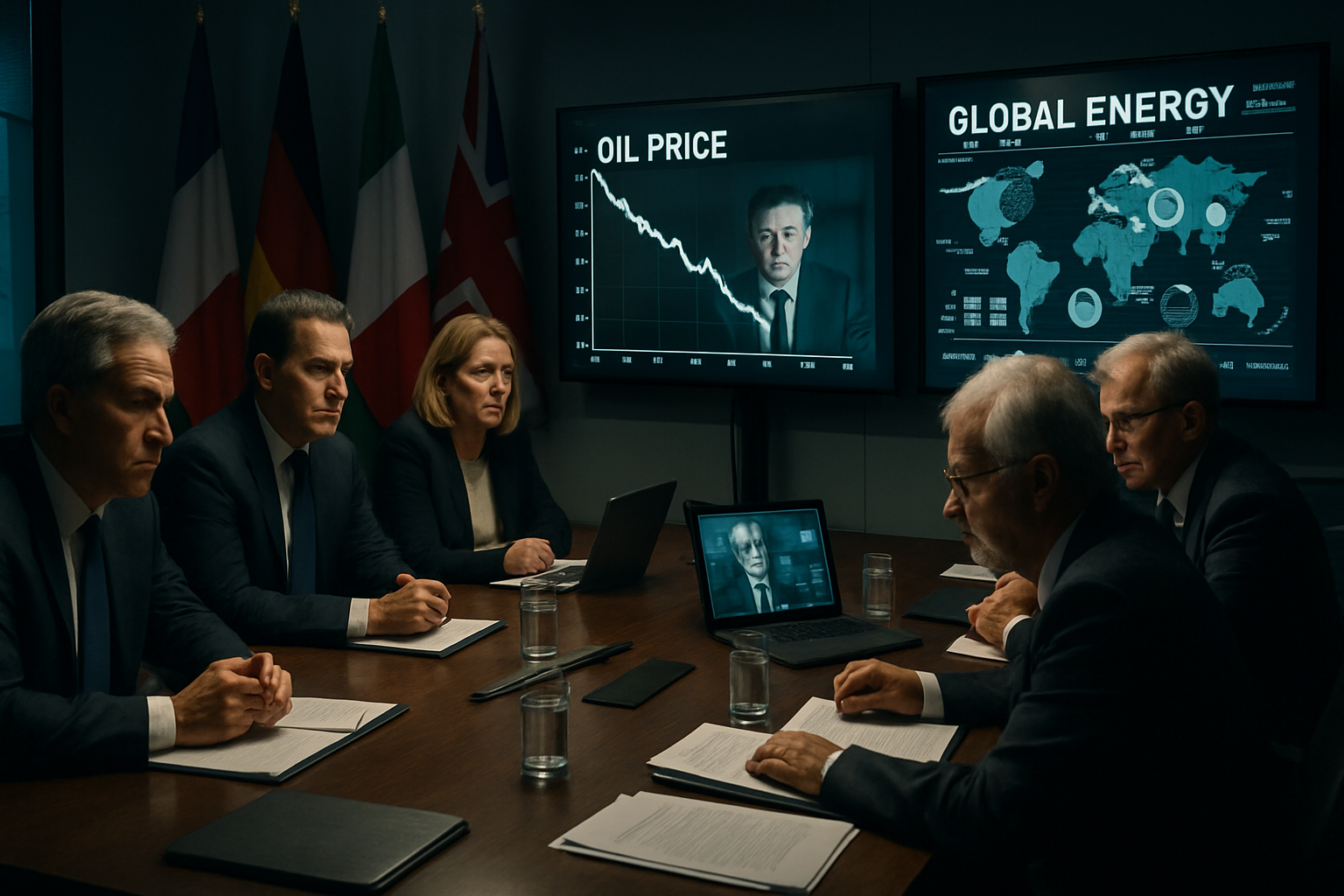
G7 finance ministers are conducting emergency discussions about releasing strategic oil reserves as crude prices breach $100 per barrel for the first time since 2022, triggered by Iran's effective closure of the Strait of Hormuz and the most severe global energy crisis in decades.
French Finance Minister Roland Lescure, currently chairing the G7 finance ministers' group, is hosting a virtual meeting scheduled for Monday at 13:30 CET. French President Emmanuel Macron confirmed that "the use of strategic reserves is an option being considered" as the international community grapples with unprecedented energy market disruptions.
Energy Crisis Reaches Critical Level
Oil prices have surged dramatically, with Brent crude reaching $119.50 per barrel and West Texas Intermediate jumping 18.98% to $108.15 per barrel - representing the biggest single-day increase on record. The crisis stems from Iran's Revolutionary Guard declaring the Strait of Hormuz "unsafe for shipping," effectively closing the strategic waterway that handles 40% of global seaborne oil transit.
Natural gas prices have exploded alongside crude oil, with European markets seeing increases of 24% and U.S. markets surging 78%. European gas prices have rocketed to €47.32 per MWh, the highest level since February 2025. The crisis has intensified with Qatar halting LNG production at its Ras Laffan and Mesaid facilities, which account for approximately 20% of global LNG exports.
Strategic Petroleum Reserve Deployment Considered
Multiple G7 nations are evaluating the unprecedented step of coordinated strategic petroleum reserve releases. Japan is considering deploying its national oil stockpiles for the first time since the 2011 Fukushima disaster, a particularly significant move given that Japan relies on the Middle East for 95% of its oil supplies, with 70% transiting through the now-closed Strait of Hormuz.
The United States is reportedly considering lifting additional Russian oil sanctions to help ease global supply shortages, with Energy Secretary Christopher Wright confirming that "hundreds of millions of barrels of sanctioned oil" could potentially be made available for market stabilization.
"This is a historic moment that requires coordinated international action to prevent a global economic catastrophe."
— Roland Lescure, French Finance Minister
Global Economic Shockwaves
The energy crisis has triggered the most severe financial market disruption in years. Pakistan's KSE-100 index crashed 8.97% in its largest single-day decline in history, while South Korea's KOSPI plunged 12% with circuit breakers activated and the Korean won hitting a 17-year low. U.S. Dow futures dropped 400-570 points, signaling global financial contagion.
The crisis has forced major shipping companies Maersk and MSC to suspend operations in the Persian Gulf, leaving over 150 oil and LNG tankers stranded with billions of dollars in cargo. Alternative Arabian Peninsula routes lack adequate capacity and involve significant time and cost penalties.
Aviation Industry in Parallel Crisis
The energy emergency coincides with an unprecedented aviation crisis, with over 18,000 flights canceled worldwide - the most extensive disruption since the COVID-19 pandemic. Eight Middle Eastern countries have simultaneously closed their civilian airspace, and Dubai International Airport, the world's busiest with over 86 million annual passengers, remains completely shut down due to missile damage.
Consumer Impact Spreading Globally
The effects are already reaching consumers worldwide. Sweden is predicting electricity price increases of 10-20 öre and gasoline price rises of 1-2 kronor, with the southern Malmö region most exposed due to continental European market integration. Ireland is experiencing what officials call "brazen rip-offs" in heating oil prices, approaching €2 per liter.
In Asia-Pacific, New Zealand is expecting petrol prices to exceed $3 per liter, while Bangladesh has implemented comprehensive fuel rationing for its 170 million people. Malta reports that fuel prices would be 45% higher without government subsidies.
OPEC Response Proves Insufficient
The Organization of Petroleum Exporting Countries' emergency meeting approved a 206,000 barrels per day production increase for April, but analysts confirm this is insufficient to offset the Strait of Hormuz shipping disruption. The challenge facing OPEC is that increased production becomes meaningless if tankers cannot transit safely through critical waterways.
Qatar Energy Minister Saad Al Kaabi has warned that Gulf states may be "forced to declare force majeure" within weeks if the situation continues unchanged, potentially driving oil prices toward $150 per barrel and threatening to "bring down economies of the world."
Diplomatic Context and Nuclear Crisis
The current crisis stems from the complete collapse of U.S.-Iran nuclear negotiations, despite achieving what was described as "broad agreement on guiding principles" - the most progress since the JCPOA collapse in 2018. Iran excluded ballistic missiles and regional proxies as "red lines," while the United States demanded a comprehensive approach including missiles, armed groups, and human rights issues.
This breakdown led to Operation Epic Fury, the largest U.S.-Israeli coordinated operation since 2003, and subsequent massive Iranian retaliation through Operation True Promise 4. The escalation occurs amid broader nuclear governance concerns, as the New START treaty expired on February 5 - the first time in over 50 years without U.S.-Russia nuclear constraints.
Regional Coalition Under Strain
An unprecedented regional coalition of Saudi Arabia, UAE, Qatar, and Egypt that had supported diplomatic solutions is now severely strained following Iranian retaliation attacks on member territories. The UAE reported one civilian death in Abu Dhabi, Kuwait suffered 32 injuries from airport strikes, and Qatar intercepted 65 missiles and 12 drones, resulting in eight injuries despite Patriot missile defenses.
Egyptian President Al-Sisi condemned attacks on "sisterly Arab countries," warning of "comprehensive chaos" if the escalation continues.
Supply Chain Vulnerabilities Exposed
The crisis has exposed critical vulnerabilities in global supply chains beyond energy. The Persian Gulf serves as a crucial hub for international trade affecting consumer goods and industrial materials worldwide. The 21-mile-wide Strait of Hormuz represents a geographic single-point failure for modern logistics, with no realistic alternatives for the affected volume of trade.
Manufacturing sectors dependent on Gulf networks - including automotive, electronics, and textiles - are experiencing severe disruptions. The crisis highlights the dangerous over-dependence on strategic chokepoints in volatile geopolitical regions.
Central Bank Coordination Efforts
The European Central Bank and Bank of Japan are leading coordinated emergency liquidity provision to prevent broader financial contagion. However, traditional monetary policy tools are showing limited effectiveness against structural geopolitical disruptions affecting physical infrastructure and international relationships.
Historical Significance and Future Implications
Energy analysts describe this as the most severe energy security crisis in decades, with Samuel Ciszuk noting the "single-chokepoint vulnerabilities exposed" and portfolio strategist Damien Boey warning that the "situation is going longer than initially thought, with financial markets representing the ultimate constraint on prolonged conflict."
The March 2026 crisis represents a watershed moment for global energy security, exposing strategic vulnerabilities that have developed over decades of energy market evolution. Unlike weather-related disruptions with predictable timelines, recovery depends entirely on military operations resolution and diplomatic normalization.
Template-Setting Crisis Management
This crisis serves as a template for 21st-century international relations, testing whether multilateral cooperation can effectively manage energy emergencies in an increasingly multipolar world. Success in containing the escalation could provide a framework for future nuclear crisis resolution, while failure might accelerate military solutions and reshape Middle Eastern geopolitics for decades.
The G7's coordinated response to strategic petroleum reserve deployment represents one of the most significant tests of international energy cooperation since the oil crises of the 1970s. The decisions made in the coming days will reverberate through international relations and energy markets for years to come, potentially reshaping global approaches to energy security and crisis management.
As the situation continues to evolve, the international community faces critical decisions between immediate supply needs and long-term energy security architecture that could fundamentally restructure global energy markets and diplomatic relationships for generations.