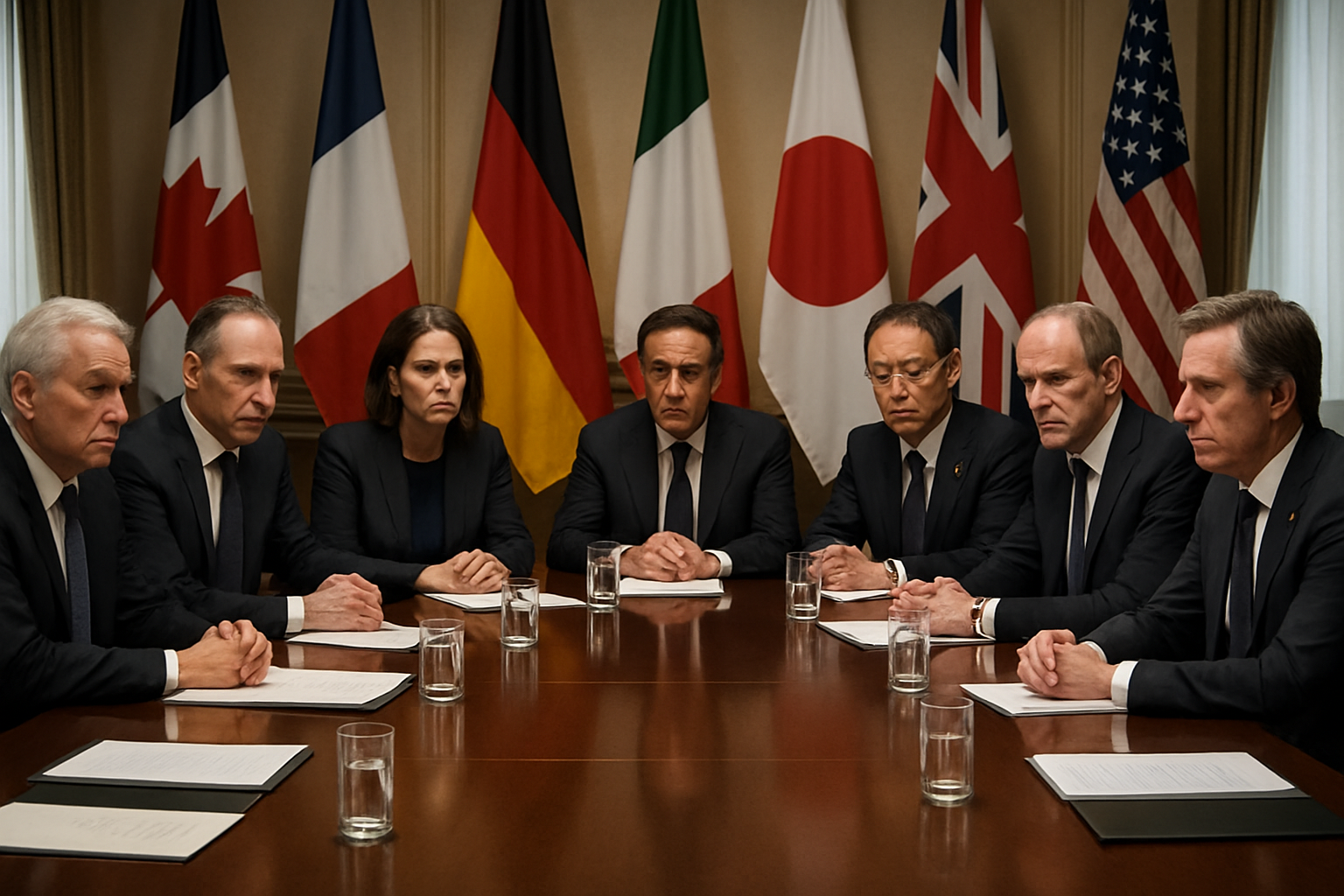
G7 foreign ministers issued a joint statement on Friday calling for an immediate halt to attacks against civilians in the escalating Middle East conflict and demanding Iran restore freedom of navigation in the strategic Strait of Hormuz, as the world faces its most dangerous international crisis since the Cold War.
The urgent diplomatic intervention comes as the crisis enters its fourth week, with oil prices breaching $100 per barrel for the first time since 2022 and global aviation networks in chaos following Iran's closure of the critical waterway that handles 40% of global seaborne oil transit.
Meeting on the sidelines of the G7 gathering in France, foreign ministers from the world's leading democracies condemned the systematic targeting of civilian populations and infrastructure that has characterized the current phase of the conflict, known as Iran's "Operation True Promise 4" in retaliation for the US-Israeli "Operation Epic Fury."
Strait of Hormuz Crisis Threatens Global Economy
The ministers' statement specifically addressed Iran's Revolutionary Guard declaration that the 21-mile Strait of Hormuz is "unsafe for shipping," effectively blocking a critical chokepoint that serves as the world's most important oil transit route. This closure has stranded over 150 oil and LNG tankers in the Persian Gulf, representing billions of dollars in cargo value.
"We urge Iran to immediately restore freedom of navigation in the strategic Strait of Hormuz," the joint statement read, reflecting growing alarm over the economic implications of the crisis that has already triggered the largest strategic petroleum reserve release in International Energy Agency history.
The G7's intervention comes as member nations grapple with severe energy price volatility. Brent crude has peaked at $119.50 per barrel, while natural gas prices have surged 24% in Europe and 78% in the United States. Japan, which depends on the Middle East for 95% of its oil supplies with 70% transiting through the now-closed Strait, has already begun releasing 80 million barrels from strategic reserves.
Diplomatic Tensions Within Alliance
The meeting revealed underlying tensions within the G7, particularly regarding military involvement in the crisis. French Foreign Minister Jean-Noel Barrot used the gathering to directly rebuke Russian Foreign Minister Sergei Lavrov's recent television appearance, stating: "Mr. Lavrov was able to calmly spread his propaganda last night on a French television channel... You do not defend international law by launching a war of aggression."
The comments underscore the complex diplomatic calculations facing G7 nations as they attempt to balance support for their American ally while maintaining regional stability and avoiding broader international confrontation.
Humanitarian Crisis Mounts
The ministers' statement emphasized protection of civilian populations as regional casualties continue to mount. Iran's Red Crescent has documented over 787 civilian casualties from US-Israeli strikes, including the devastating attack on Minab girls' school that killed between 53-85 students and staff. Meanwhile, Iranian retaliation has resulted in civilian deaths across the Gulf region, including one death in Abu Dhabi and injuries in Kuwait and Qatar despite sophisticated Patriot missile defense systems.
The humanitarian dimension has prompted the largest international evacuation effort since the Arab Spring of 2011, with European nations activating emergency protocols. Cyprus implemented its ESTIA evacuation plan for the first time in history, coordinating the extraction of over 2,000 EU nationals from the UAE following Iranian drone strikes on RAF Akrotiri - the first attack on European territory since World War II.
Aviation Industry in Crisis
The G7 statement comes against the backdrop of unprecedented disruption to global aviation networks. Over 18,000 flights have been cancelled worldwide - the most extensive disruption since the COVID-19 pandemic. Eight Middle Eastern countries have simultaneously closed their airspace: Iran, Iraq, Israel, UAE, Qatar, Syria, Kuwait, and Bahrain.
Dubai International Airport, the world's busiest with 86 million passengers annually, remains completely shut down following missile damage. Major carriers including Emirates, Air France-KLM, Wizz Air, and Bulgaria Air have suspended operations indefinitely, affecting hundreds of thousands of travelers globally.
Nuclear Diplomacy Collapse
The current crisis emerged from the complete breakdown of US-Iran nuclear negotiations despite what Iranian Foreign Minister Abbas Araghchi had described as "broad agreement on guiding principles" - the most promising diplomatic progress since the 2018 JCPOA collapse.
The fundamental obstacle remained unchanged: Iran's insistence on excluding ballistic missiles and regional proxy forces as "red lines" in nuclear-only talks, while the United States demanded a comprehensive agreement addressing missiles, armed groups, and human rights issues.
This diplomatic failure occurs against the backdrop of a broader nuclear governance crisis, with the New START treaty between the US and Russia having expired in February 2026 - the first time in over 50 years that the superpowers operate without nuclear constraints.
Regional Coalition Under Strain
The G7 statement reflects broader concerns about the stability of the unprecedented Saudi-UAE-Qatar-Egypt coalition that had supported diplomatic engagement. This regional consensus has come under severe strain as Iranian retaliation has directly targeted coalition member territories.
Egyptian President Abdel Fattah al-Sisi condemned Iranian attacks on what he termed "sisterly countries," warning of potential "comprehensive chaos" spreading across the region. The attacks have included civilian casualties in the UAE, strikes on Kuwait's airport that injured 32 foreign nationals, and successful interception of 65 missiles and 12 drones targeting Qatar.
Global Economic Implications
The crisis has triggered severe market volatility worldwide. Pakistan's stock exchange recorded its largest single-day decline in history at -8.97%, while South Korea's KOSPI fell 12%, triggering circuit breakers as the Korean won hit a 17-year low. The disruption extends far beyond energy markets, affecting global supply chains dependent on Persian Gulf logistics networks.
Consumer impacts are being felt globally, from fuel rationing affecting 170 million people in Bangladesh to wartime austerity measures in Pakistan, where the government has implemented four-day work weeks. European nations are experiencing significant price increases, with Sweden reporting electricity price rises and gasoline increases approaching 1-2 kronor.
Template-Setting Moment
The G7 intervention represents what UN Secretary-General António Guterres has described as "the greatest test of multilateral cooperation and crisis management in the modern era." The rapid transition from diplomatic engagement to military confrontation demonstrates the fragility of crisis management mechanisms in an increasingly multipolar world.
The outcome of this crisis will establish precedents for international dispute resolution, nuclear proliferation policies, and energy security architecture for decades to come. Success in containing the escalation could provide a framework for future nuclear crisis resolution, while failure may accelerate military approaches to conflict resolution and encourage proliferation globally.
Looking Ahead
As the G7 ministers concluded their emergency consultations, the international community faces critical decisions in the coming days and weeks. The crisis has exposed dangerous over-dependence on strategic chokepoints like the Strait of Hormuz and highlighted the need for fundamental restructuring of global energy architecture.
With Iran continuing to enrich uranium at 60% purity - approaching the 90% weapons-grade threshold - and possessing over 400 kilograms of enriched material sufficient for multiple weapons, the window for diplomatic resolution continues to narrow. The G7's call for civilian protection and navigation freedom represents perhaps the last coordinated effort to prevent what could become the most dangerous international conflict since the end of the Cold War.
The world now watches as the most powerful democracies attempt to balance alliance solidarity with the urgent need for regional stability, while civilians across the Middle East pay the price of diplomatic failure.