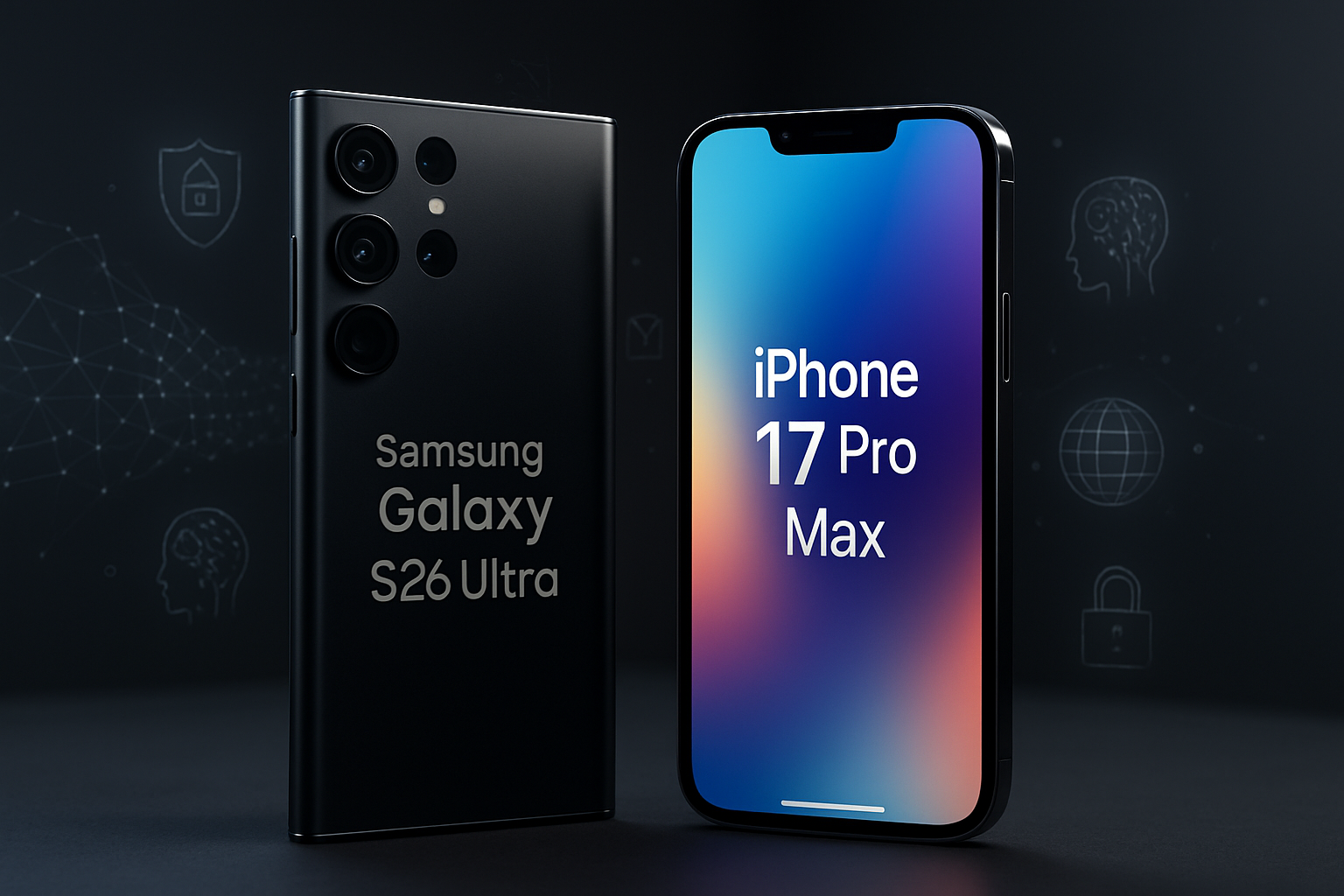
The smartphone industry has entered a revolutionary phase as Samsung's Galaxy S26 series and Apple's iPhone 17 lineup introduce groundbreaking artificial intelligence capabilities, advanced battery technology, and innovative privacy features that redefine mobile computing expectations.
Samsung officially unveiled its Galaxy S26 series at the Galaxy Unpacked event in San Francisco, featuring the industry's first hardware-level Privacy Display technology alongside third-generation Galaxy AI integration. The flagship Galaxy S26 Ultra introduces revolutionary features including privacy display shields that control pixel light dispersion to prevent side-angle viewing, effectively eliminating "shoulder surfing" without permanent screen protectors.
Privacy Display Technology Breakthrough
The Galaxy S26 Ultra's Privacy Display represents a paradigm shift in smartphone privacy protection. The technology enables on-demand activation while maintaining full display quality when privacy isn't necessary. This hardware-level solution addresses growing workplace, public transportation, and general digital security concerns through pixel light dispersion control technology.
According to technical specifications released by Samsung, the Galaxy S26 Ultra features a QHD+ 6.9-inch display with 200MP main camera and computational photography AI-powered enhancement. The design improvements include a thinner profile with raised camera island replacing individual lenses, center-aligned hole-punch display, and rounded corners for enhanced ergonomics.
AI Integration and Creators Studio Revolution
Samsung presented the Creators Studio at Galaxy Unpacked 2026, marking what executives describe as "the end of conventional mobile photography for the era of creative synthesis." This integrated tool in the Galaxy S26 series utilizes local generative artificial intelligence to transform text instructions into high-fidelity visual compositions, democratizing professional aesthetics and positioning the processor as the new engine of imagination.
"This advancement eliminates technical barriers between idea and final image, transforming how users create content on mobile devices."
— Samsung Galaxy Unpacked 2026
The multi-agent Galaxy AI ecosystem spans Notes, Clock, Gallery, Reminders, Calendar, plus third-party applications through confirmed Perplexity AI partnership. The system combines on-device neural processing with secure cloud capabilities via encrypted channels, featuring conversational search, intelligent content generation, predictive scheduling, and advanced image analysis.
iPhone 17 Battery Performance Competition
Comprehensive battery testing reveals intense competition between flagship smartphones, with the iPhone 17 Pro Max, Galaxy S26 Ultra, and Google Pixel 10 Pro XL representing the current pinnacle of mobile battery technology. Industry analysis indicates that while Samsung has introduced exciting upgrades like privacy display and horizon lock video stabilization, questions remain about battery capacity improvements this year.
Samsung's cautious approach to silicon-carbon battery technology adoption contrasts with competitors rushing implementation. Tiberiu Dobre, VP Samsung Romania, revealed in an exclusive interview the company's maintenance of rigorous testing standards and quality requirements before consumer release, demonstrating Samsung's commitment to reliability over rapid deployment.
Global Memory Crisis Impact
The smartphone industry faces unprecedented challenges as global memory crisis drives sixfold semiconductor price increases affecting Samsung, SK Hynix, and Micron operations. This shortage, expected to persist until 2027 when new fabrication facilities come online, has increased consumer electronics costs by 20-30% over the past year.
Samsung's vertical integration advantage—spanning semiconductors, displays, and manufacturing—provides competitive positioning during these supply chain constraints. The company's comprehensive manufacturing capabilities enable navigation of the current crisis while introducing advanced features like Privacy Display technology.
Market Positioning and Competitive Landscape
The Galaxy S26 series launch occurs during a critical transformation period for the smartphone industry. Base S26 models approach the 1,000-euro threshold, while Ultra variants reach toward 2,000 euros, reflecting the global memory crisis impact on pricing structures.
Strategic positioning against Google Pixel 10 Pro XL and Apple iPhone 17 Pro Max emphasizes privacy innovation and AI differentiation rather than pure specifications competition. This approach represents Samsung's evolution from traditional hardware manufacturer to AI-powered technology platform during the pivotal 2026 mobile computing transformation.
International Availability and Market Response
Samsung announced immediate global rollout beginning February 25 with comprehensive pre-order campaigns. International markets including Bulgaria through Vivacom offer early adopter savings up to 200 euros, doubled storage options, and Galaxy Buds4/Pro discounts through March 10, demonstrating Samsung's manufacturing capability to maintain innovation momentum despite industry supply chain challenges.
The Privacy Display technology establishes hardware-level privacy precedents that could influence industry standards for mobile device security. Success in market adoption could accelerate similar technology development across the smartphone industry, potentially reshaping consumer expectations regarding privacy features in flagship devices.
Future Implications for Mobile Technology
The convergence of AI integration, privacy hardware innovations, and advanced battery technology represents the most significant transformation in smartphone capabilities since the original iPhone introduction. The Samsung Galaxy S26 series and iPhone 17 lineup competition extends beyond individual device features to fundamental changes in how technology serves human needs and enhances daily life.
Industry experts anticipate that 2026 decisions regarding AI integration, privacy protection, and sustainable manufacturing practices will influence competitive dynamics and technological trajectories for the remainder of the decade. The success of privacy-first hardware approaches and practical AI utility in daily scenarios will determine whether smartphones evolve toward comprehensive digital assistants or maintain focus on traditional communication and media consumption roles.
As the smartphone industry navigates supply chain challenges while maintaining innovation momentum, the Galaxy S26 and iPhone 17 series represent critical benchmarks for balancing technological advancement with practical consumer needs, establishing new standards for mobile computing in an AI-integrated world.