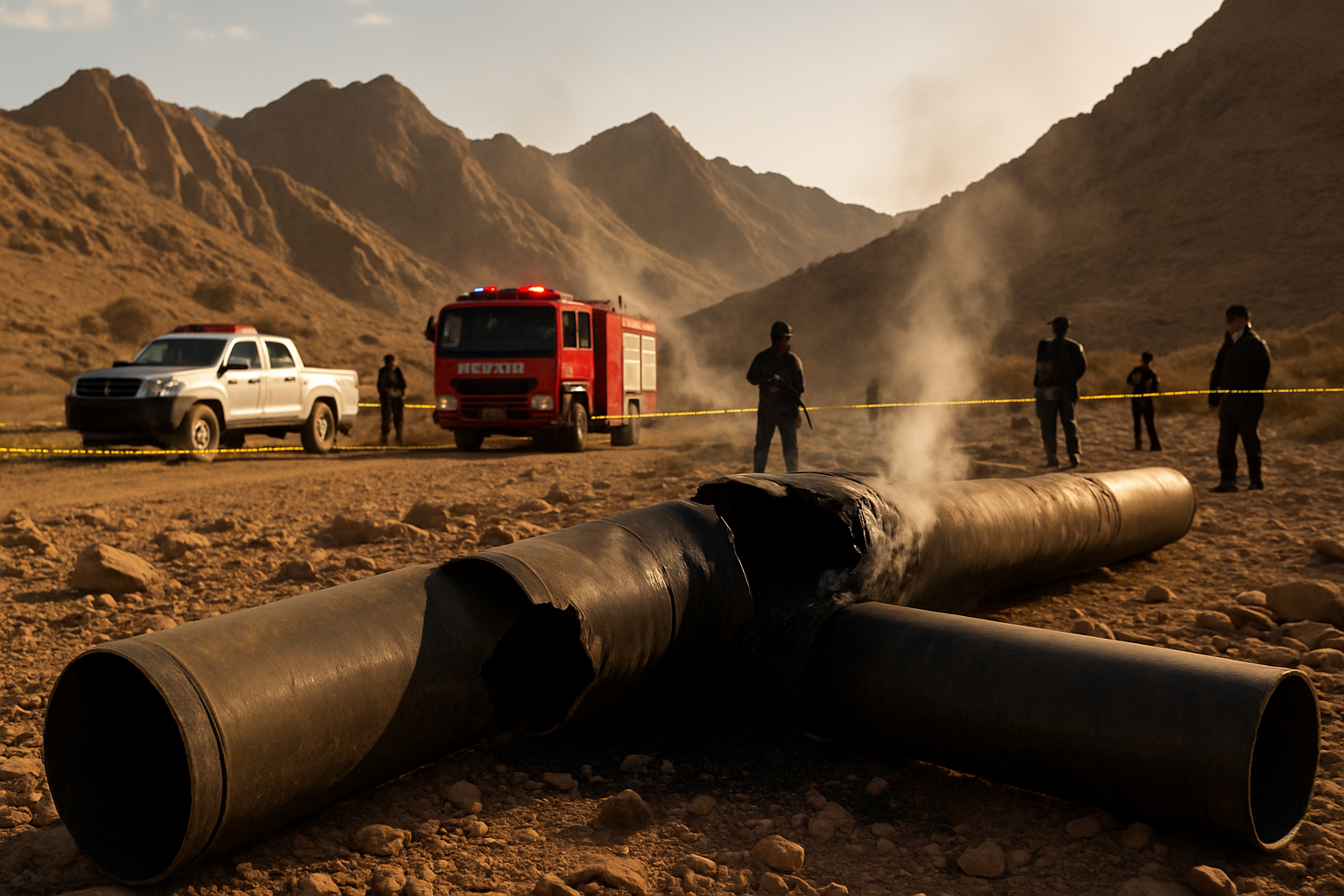
A major explosion rocked Pakistan's Balochistan province on Monday evening, destroying an 18-inch diameter gas pipeline on the outskirts of Quetta and cutting gas supplies to several districts, raising fresh concerns about the security of the region's critical energy infrastructure.
The attack, carried out by unidentified armed militants, targeted the main natural gas pipeline in the Akhtarabad area near Pakistan's southwestern city of Quetta, the provincial capital. Officials from Sui Southern Gas Company (SSGC) confirmed that the explosion suspended gas supply to multiple parts of the city and at least five additional districts.
According to police reports, the militants planted an explosive device beneath the pipeline before detonating it in the evening hours. The blast ignited a massive fire that destroyed a significant portion of the pipeline infrastructure, creating a dramatic scene visible for miles across the region.
Infrastructure Impact and Service Disruption
"An 18-inch diameter main gas supply pipeline was blown up by unknown people," an SSGC spokesman told Reuters, detailing the extent of the damage. The explosion affected gas distribution to several key areas including Hazara town, Hazarganji, Khaizi, Nohsar, Pishin, Ziarat, Kalat, Mastung, and Kuchlak.
The attack represents a significant blow to energy infrastructure in a region already struggling with security challenges. SSGC officials confirmed that "a big portion of the gas pipeline was destroyed by the blast," requiring extensive repair work to restore service to affected communities.
Engineering teams were quickly deployed to the site to begin emergency repairs, though officials have not provided a timeline for when gas supplies will be fully restored to the impacted areas.
Regional Security Context
The pipeline bombing occurs against a backdrop of persistent insurgency in Balochistan province, where separatist groups have long operated alongside various militant organizations. These groups frequently target government infrastructure and military installations as part of their campaign against what they perceive as exploitation by the central government in Islamabad.
Separatist insurgents in the region have consistently accused the federal government of depriving local populations of their fair share of the province's substantial mineral wealth and natural resources. Balochistan, despite being Pakistan's largest province by area and richest in natural resources, remains one of the country's most underdeveloped regions.
No group has claimed immediate responsibility for Monday's attack, though such incidents typically follow the operational patterns of local militant organizations that view energy infrastructure as legitimate targets in their struggle against the state.
Broader Infrastructure Vulnerability
This latest attack highlights the ongoing vulnerability of Pakistan's energy infrastructure, particularly in regions experiencing active insurgency. The targeting of gas pipelines has become a recurring tactic used by militant groups to demonstrate their operational capabilities while causing maximum disruption to civilian populations and economic activity.
The timing and execution of the attack suggest a level of planning and local knowledge that raises concerns about security gaps in protecting critical energy assets. The ability of militants to plant explosives on major pipeline infrastructure without detection underscores the challenges facing Pakistani security forces in the region.
"The blast took place on the outskirts of Quetta city, the capital of restive Balochistan province."
— SSGC Spokesman
Government Response and Security Measures
Pakistani authorities have yet to announce specific measures in response to the latest attack, though the incident is likely to prompt renewed discussions about enhancing security for critical infrastructure. The targeting of gas pipelines represents not just an economic threat but also a challenge to the state's ability to provide basic services to its citizens.
The attack comes at a time when Pakistan is already grappling with significant energy challenges, including shortages and distribution problems that affect both industrial operations and household consumers. Any disruption to gas supplies in Balochistan compounds these existing difficulties and impacts regional economic activity.
Security analysts note that protecting extensive pipeline networks across Balochistan's rugged terrain presents enormous logistical challenges, requiring substantial resources and coordination between multiple security agencies.
Economic and Social Impact
The disruption of gas supplies affects not only residential consumers but also industrial facilities, power generation plants, and commercial establishments that depend on natural gas for their operations. In winter months, such disruptions can be particularly severe, affecting heating systems in schools, hospitals, and homes.
Local businesses and manufacturers in the affected districts face immediate operational challenges, with some forced to suspend production or seek alternative energy sources at higher costs. The ripple effects of such infrastructure attacks extend beyond immediate supply disruptions to broader economic uncertainty in the region.
Ongoing Insurgency Challenges
The Balochistan conflict has persisted for decades, with various separatist groups conducting armed campaigns against Pakistani state authority. These organizations typically target government installations, security forces, and infrastructure projects they view as exploitative of local resources.
The province's strategic importance extends beyond its natural resource wealth to its location along key trade routes, including the China-Pakistan Economic Corridor (CPEC) projects. This adds another layer of complexity to security challenges, as infrastructure attacks can have regional and international implications.
Despite repeated military operations and development initiatives, the underlying grievances that fuel the insurgency remain largely unresolved, contributing to the persistence of such attacks on critical infrastructure.
Looking Forward
As repair work begins on the damaged pipeline, Pakistani authorities face the ongoing challenge of balancing infrastructure development with security concerns in Balochistan. The latest attack serves as a reminder of the fragility of energy systems in conflict-affected regions and the need for comprehensive approaches that address both security and underlying political grievances.
The incident underscores the critical importance of energy security in Pakistan's overall stability and development efforts, particularly in provinces like Balochistan where natural resource wealth contrasts sharply with ongoing security challenges and development needs.