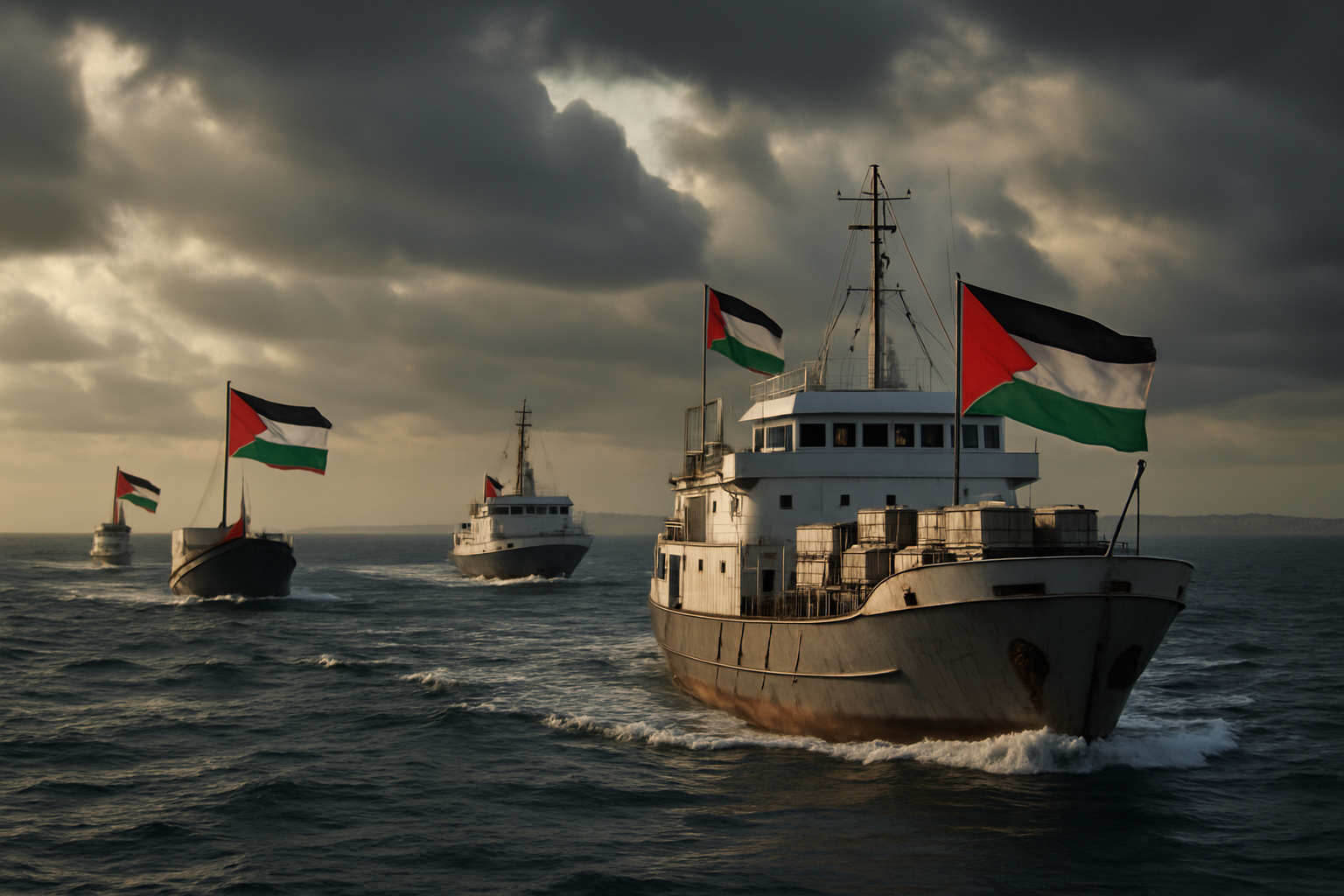
The Global Sumud Flotilla has departed from Barcelona's port bound for Gaza, carrying humanitarian supplies in the latest international attempt to challenge Israel's naval blockade of the Palestinian enclave, though organizers delayed their departure into international waters due to adverse weather conditions.
The Freedom Flotilla Coalition confirmed that the mission left Barcelona symbolically on Sunday, but coordinator Thiago Avila announced that adverse weather conditions forced a delay in the actual departure into international waters.
"Due to weather conditions, our mission will sail from this port today, but will not be sailing to international waters because we cannot make this journey safely today," Avila told Spanish public broadcaster RTVE. He stressed that the convoy would proceed toward Gaza in phases, with possible delays depending on weather conditions along the route.
Mission Aims to Open Humanitarian Corridor
The Global Sumud Flotilla aims to "open a humanitarian corridor" to Gaza, according to statements from organizers. The mission represents the latest in a series of international civilian efforts to break Israel's blockade, though all recent attempts have been intercepted by Israeli forces.
The flotilla departed from Barcelona amid widespread support from Spanish citizens, who gathered at the port waving Palestinian flags and chanting "Free Palestine" according to reports from the Palestinian Information Center. The departure was marked by warm applause and solidarity demonstrations.
However, the mission faces significant challenges beyond weather conditions. Previous flotilla attempts, including the October 2025 Global Sumud Flotilla involving environmental activist Greta Thunberg and over 450 participants, were intercepted by Israeli military forces, resulting in arrests and the seizure of vessels.
Gaza Crisis Deepens Amid Systematic Violations
The flotilla's mission comes against the backdrop of an escalating humanitarian crisis in Gaza, where systematic ceasefire violations have been documented despite an October 2025 truce agreement. Over 1,600 documented violations since the ceasefire have resulted in more than 680 Palestinian deaths during what was supposed to be a peace period.
Gaza's Civil Defense has completely shut down due to fuel shortages, severely hampering emergency response capabilities. The Rafah crossing, Gaza's main gateway to the outside world, operates at severely restricted capacity with only 27 people crossing daily compared to a quota of 200, amid what Hamas condemns as "systematic harassment" by Israeli security forces.
"We are leaving here, going to Gaza in different steps, maybe sometimes having to stop a little bit to wait for the weather."
— Thiago Avila, Freedom Flotilla Coalition Coordinator
More than 20,000 Palestinians currently await medical evacuation from Gaza, with Health Ministry Director Zaher al-Wahidi reporting that between 6-10 critically ill patients die daily due to blocked access to treatment abroad. This represents a complete breakdown of the humanitarian medical corridor via Egypt.
International Legal and Political Context
The flotilla's mission occurs amid unprecedented international condemnation of Israeli actions in Gaza and the West Bank. Eighty-five UN member states have issued joint condemnations of Israeli policies, while eight Arab nations including Saudi Arabia, UAE, and other countries with normalized relations with Israel have condemned what they term systematic international law violations.
The Euro-Mediterranean Human Rights Observatory has accused Israel of exploiting international attention focused on the Iran crisis to intensify civilian punishment policies in Gaza. This timing appears calculated to advance territorial and political objectives at the expense of civilian populations while global focus remains divided.
The systematic nature of ceasefire violations has raised serious questions about international law enforcement mechanisms. Dr. Mohamed Abu Selmiya, Director of Al-Shifa Hospital, has repeatedly questioned "Where is the ceasefire?" as violations continue daily.
Historical Context of Flotilla Campaigns
The Global Sumud Flotilla follows a long history of international civilian attempts to challenge Israel's blockade of Gaza. The Freedom Flotilla Coalition has organized multiple missions over recent years, with varying degrees of international participation and media attention.
The February 2026 planning session at the Nelson Mandela Foundation in Johannesburg, which included Mandla Mandela (Nelson Mandela's grandson) among organizers, initially envisioned over 100 boats carrying more than 1,000 medics and humanitarian workers in what would have been the largest civilian humanitarian mission to Gaza in history.
However, the current mission appears more modest in scale, though organizers maintain their commitment to challenging what they characterize as an illegal blockade of the Palestinian enclave.
Regional and Global Implications
The flotilla mission takes place within the broader context of the most serious Middle Eastern humanitarian crisis since the Cold War, affecting over 15 million people across multiple countries. The ongoing Iran-Israel conflict, Lebanon ceasefire collapse, and systematic violations in Gaza have created what UN Secretary-General António Guterres has called "the greatest test of multilateral cooperation in the modern era."
The international community faces a critical test of its commitment to civilian protection and humanitarian principles. The systematic breakdown of ceasefire agreements demonstrates the challenges of maintaining peace without addressing underlying political and security issues.
French President Emmanuel Macron has offered to host direct Israel-Lebanon talks in Paris, representing one of the few remaining diplomatic initiatives as the window for negotiated solutions continues to narrow with expanding military operations.
Looking Ahead
As the Global Sumud Flotilla continues its journey toward Gaza, the mission represents more than just an attempt to deliver humanitarian supplies. It symbolizes international civil society's determination to challenge what activists view as collective punishment of Gaza's 2.3 million residents.
The success or failure of this latest flotilla attempt will likely influence future civilian humanitarian interventions in territorial disputes. The mission occurs at a template-setting moment for international humanitarian law enforcement, with implications extending far beyond the immediate crisis.
Whether diplomatic intervention can succeed in containing the broader regional crisis versus descent into wider warfare remains an open question. The coming weeks will be crucial in determining the international community's capacity to respond to systematic violations affecting millions of civilians across the region.