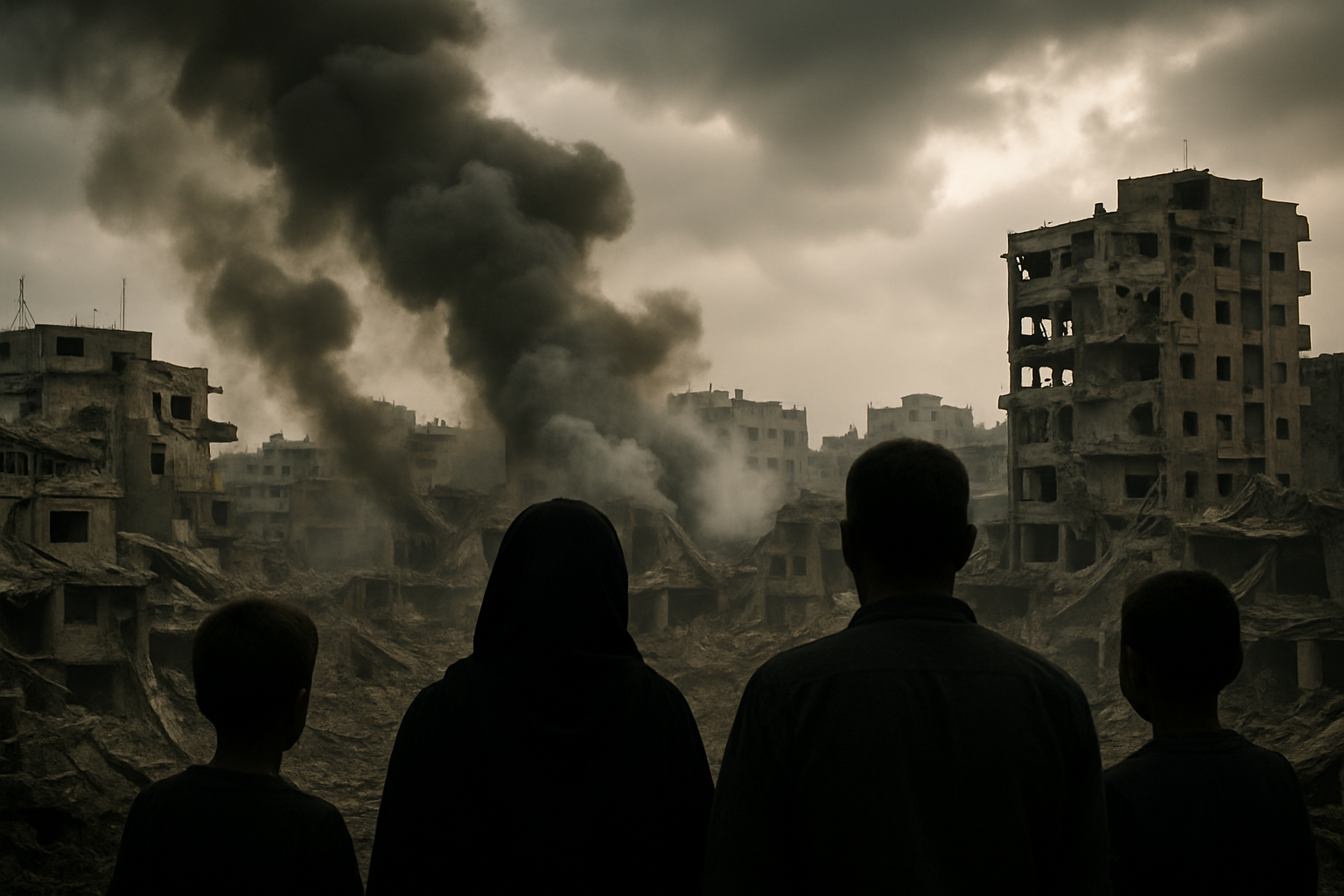
Israeli military operations killed at least five Palestinians in Gaza on Thursday, marking another deadly breach of the October 2025 ceasefire agreement as systematic violations threaten to collapse international peace efforts and undermine the Trump administration's historic $17 billion reconstruction initiative.
According to Gaza health officials, two Palestinians were killed in an airstrike targeting Gaza City's Tuffah neighborhood, while three others died in separate drone strikes on police checkpoints in Khan Younis and near Bureij camp. The Israeli military justified the operations, claiming they "killed a militant posing a threat" to security forces.
The deadly strikes represent the latest in what Palestinian authorities describe as systematic ceasefire violations that have persisted since the October 10, 2025 truce took effect. The Gaza Government Media Office has documented over 1,600 violations since the ceasefire began, resulting in more than 614 Palestinian deaths during what was supposed to be a period of peace.
Pattern of Systematic Violations
International observers and Palestinian officials describe the violations as "systematic implementation failures" rather than isolated incidents. Dr. Mohamed Abu Selmiya, Director of Al-Shifa Hospital, has repeatedly questioned "Where is the ceasefire?" as medical facilities continue to receive casualties from ongoing military operations.
The violations include 560 documented gunfire incidents, targeted killings, building demolitions, and restrictions on humanitarian access. Palestinian sources report that Israeli forces have continued operations including artillery targeting of residential areas, unexploded ordnance incidents, and systematic demolitions in violation of the ceasefire terms.
Hamas leadership has condemned what they describe as "systematic harassment" at border crossings and continued military presence in areas that should be under civilian control. The organization maintains that Israeli actions demonstrate "blatant disregard for the efforts of mediators" and international peace initiatives.
Humanitarian Crisis Deepens
The ongoing violations have created a severe humanitarian crisis that undermines the ceasefire's core objectives. Gaza's Civil Defense has completely shut down due to fuel shortages, hampering emergency response capabilities when they are most needed.
The Rafah crossing with Egypt, reopened in February 2026 after nearly two years of closure, operates under severe restrictions. Only 27 Palestinians crossed on the opening day versus the agreed quota of 200 daily crossings. Israeli security forces have denied passage to 38 of 50 planned returnees, leading to accusations of systematic harassment of Palestinian civilians.
An estimated 20,000 Palestinians continue to await medical evacuation, while Egypt maintains 150 hospitals on alert and has deployed 300 ambulances to handle potential evacuees. The limited crossing operations have severely constrained the humanitarian response to Gaza's medical crisis.
International Response and Condemnation
The violations have triggered unprecedented international condemnation, with eight Arab and Muslim nations—Saudi Arabia, Jordan, Egypt, UAE, Qatar, Indonesia, Pakistan, and Turkey—issuing joint statements calling the Israeli actions violations of international law.
The Organization of Islamic Cooperation (OIC) has condemned what it terms "continuing massacres," describing the situation as a "dangerous escalation." Over 400 European Union diplomats have called for increased pressure on Israeli authorities to comply with ceasefire terms.
A European Left Coalition petition against EU-Israel partnerships has exceeded 400,000 signatures, reflecting growing public concern about the systematic nature of the violations. UN Secretary-General António Guterres has expressed "grave concern" about the deteriorating situation, warning of threats to regional stability.
Trump Peace Initiative Under Threat
The systematic ceasefire violations pose a direct threat to the Trump administration's ambitious $17 billion Gaza reconstruction initiative, announced at the February 19, 2026 Board of Peace summit in Washington. The historic financial commitment from 27 member nations represents the largest international Gaza reconstruction pledge in history.
However, traditional reconstruction models require stable security conditions and often include demilitarization requirements. Hamas has categorically rejected disarmament demands, with political bureau leader Khaled Meshaal declaring that armed resistance is justified "while occupation exists."
The implementation challenges are severe: ongoing violations have created donor confidence concerns, while Hamas maintains an estimated 20,000 fighters according to Israeli intelligence assessments. This creates a fundamental obstacle to conventional post-conflict reconstruction frameworks.
West Bank Complications
The Gaza crisis occurs alongside unprecedented Israeli expansion in the West Bank, where the government has approved the most comprehensive land registration since the 1967 occupation began. Finance Minister Bezalel Smotrich has openly declared policies designed to "kill the idea of a Palestinian state."
This parallel crisis has drawn condemnation from 85 UN member states, representing the most comprehensive international opposition since the occupation began. The combination of Gaza ceasefire violations and West Bank expansion creates what critics describe as a systematic challenge to Palestinian statehood.
Regional and Global Implications
The deteriorating situation has broader implications for regional stability and international conflict resolution mechanisms. The failure to maintain the Gaza ceasefire undermines confidence in negotiated peace agreements and raises questions about the effectiveness of current international law enforcement mechanisms.
Regional powers, including Egypt and Qatar, which served as key mediators in achieving the original ceasefire, continue diplomatic efforts to salvage the agreement. However, the systematic nature of the violations suggests fundamental challenges in implementing negotiated solutions without addressing underlying political and security issues.
The crisis also tests the credibility of the Trump administration's "business approach" to diplomacy, which departs from traditional UN frameworks in favor of direct leader engagement and economic incentives. The success or failure of this approach could influence international conflict resolution strategies beyond the current administration.
Voices from the Ground
"Where is the ceasefire? Our hospitals continue to receive casualties daily from what should be a period of peace."
— Dr. Mohamed Abu Selmiya, Al-Shifa Hospital Director
Palestinian civilians describe living in constant uncertainty, with the promise of peace repeatedly shattered by renewed violence. The psychological impact extends beyond immediate casualties to affect Gaza's entire 2.3 million population, who had hoped the ceasefire would bring lasting relief after years of conflict.
Legal and Institutional Challenges
International legal experts cite violations of UN Security Council resolutions and Geneva Conventions governing occupied territories. The systematic nature of the violations raises questions about whether current international law enforcement mechanisms are adequate for ensuring compliance with negotiated agreements.
The crisis occurs during a sensitive period for global governance, with the New START nuclear treaty having expired in February 2026 for the first time in over 50 years, creating broader challenges for international cooperation and conflict prevention.
Looking Forward
The coming weeks are expected to be decisive for the ceasefire's survival and the broader peace process. International mediators continue efforts to restore compliance, while the Trump administration faces pressure to demonstrate that its alternative diplomatic approach can succeed where traditional frameworks have struggled.
The stakes extend beyond the immediate humanitarian concerns to fundamental questions about international law enforcement, territorial sovereignty principles, and conflict resolution mechanisms in the 21st century. Success in restoring the ceasefire could provide a template for innovative peace-building approaches, while failure may accelerate military solutions to complex international disputes.
As systematic violations enter their fifth month, the international community faces a critical test of its capacity to enforce negotiated agreements and protect civilian populations caught in the crossfire of unresolved political conflicts.