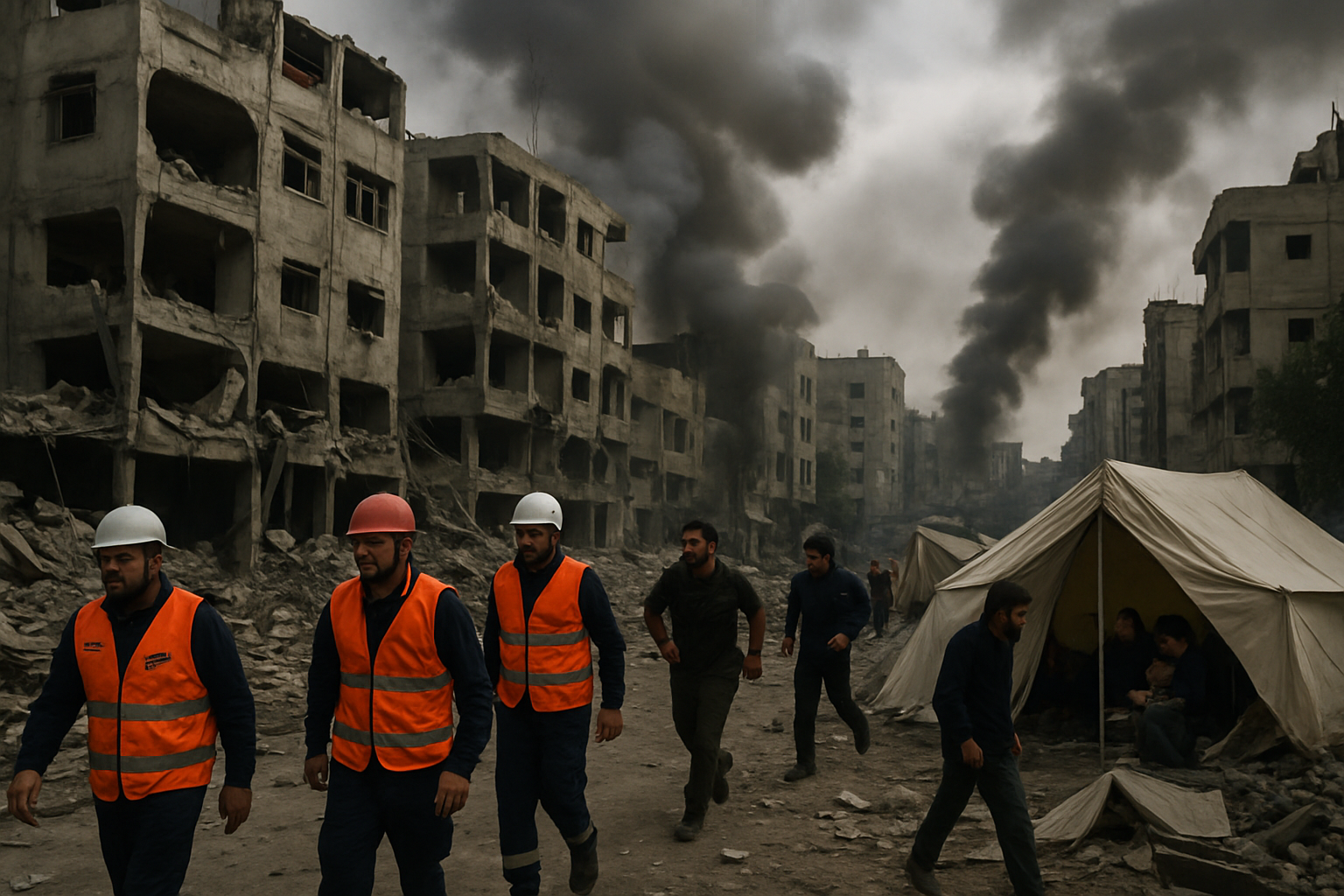
Israeli airstrikes across the Gaza Strip killed at least 12 Palestinians on February 15, 2026, in what the Israeli military described as a response to ceasefire violations by Hamas, marking the latest escalation in systematic violations of the October 2025 truce agreement.
The strikes targeted multiple locations including a tent encampment housing displaced families in northern Gaza, where four Palestinians were killed, and the southern city of Khan Younis, according to Palestinian Civil Defense officials. The Israeli Defense Forces (IDF) justified the attacks as "precise operations" against what they termed Hamas "terrorists" following alleged violations in Beit Hanoun.
Among the casualties was a senior Islamic Jihad commander, according to Israeli sources, while Palestinian officials reported that one strike hit displaced civilians in temporary housing facilities established for families who have lost their homes during the prolonged conflict.
Pattern of Systematic Violations
The February 15 strikes continue a documented pattern of ceasefire violations that international observers increasingly describe as "systematic implementation failures" rather than isolated incidents. The Gaza Government Media Office has documented over 1,600 violations since the October 10, 2025 ceasefire agreement, resulting in more than 601 Palestinian deaths during what was supposed to be a period of truce.
Dr. Mohamed Abu Selmiya, Director of Al-Shifa Hospital, encapsulated the frustration felt by many Palestinians when he asked simply: "Where is the ceasefire?" His question reflects a broader sentiment among Gaza's 2.3 million residents who have experienced continued military operations despite international ceasefire agreements.
"This represents a systematic violation of the ceasefire agreement that threatens all international peace initiatives in the region."
— Gaza Government Media Office Statement
The current death toll since the October ceasefire now exceeds 601 Palestinians, with the Gaza Government Media Office reporting 1,553 additional injuries. These figures represent casualties that have occurred during what international mediators had hoped would be a period of de-escalation and humanitarian recovery.
International Condemnation Mounts
The continued violations have drawn unprecedented international criticism from multiple quarters. Eight Arab and Muslim nations - Saudi Arabia, Jordan, Egypt, UAE, Qatar, Indonesia, Pakistan, and Turkey - have issued joint condemnations calling the Israeli actions violations of international law "aimed at imposing unlawful Israeli sovereignty" while undermining prospects for a two-state solution.
The Organization of Islamic Cooperation (OIC) has condemned what it terms "continuing massacres," describing the situation as a dangerous escalation that threatens regional stability. Over 400 European Union diplomats have called for increased pressure on Israeli authorities, while a European Left Coalition petition against EU-Israel partnerships has exceeded 400,000 signatures.
The violations are occurring against the backdrop of broader diplomatic efforts, including President Trump's Board of Peace initiative scheduled for February 19, 2026, which aims to secure over $5 billion in Gaza reconstruction commitments from 27 member nations.
Humanitarian Crisis Deepens
The continued military operations have severely hampered humanitarian recovery efforts in Gaza. The Civil Defense agency, responsible for emergency response and rescue operations, has been forced to shut down completely due to fuel shortages, leaving the population without adequate emergency services.
The Rafah crossing with Egypt, which reopened in early February after nearly two years of closure, continues to operate with severe restrictions. Only 27 Palestinians crossed on the opening day versus a stated quota of 200, with Hamas condemning what it terms "systematic harassment" by Israeli security forces who denied passage to 38 of 50 planned returnees.
Approximately 20,000 Palestinians remain on waiting lists for medical evacuation, many requiring urgent treatment that is unavailable in Gaza's devastated healthcare system. The total Gaza death toll has now reached 71,800 since the conflict escalation began.
Military Justifications and Allegations
Israeli military sources have consistently justified the strikes as responses to alleged Hamas violations of the ceasefire agreement. The IDF claims that Saturday's operations in Beit Hanoun involved Hamas militants emerging from tunnels east of the "yellow line" ceasefire demarcation, representing what they characterized as a "blatant" violation of the truce terms.
However, Palestinian officials and international observers question the proportionality of the response and note that the strikes frequently target civilian areas and infrastructure. The pattern includes attacks on residential buildings, tent encampments for displaced families, and areas housing vulnerable populations.
The ongoing tensions are complicated by broader regional issues, including Israel's recent announcement of expanded West Bank settlement policies that international observers view as systematic attempts to undermine Palestinian statehood prospects.
Regional Diplomatic Implications
The escalating violations pose significant challenges to multiple international peace initiatives currently underway in the region. The Trump administration's Board of Peace summit, scheduled for February 19 at the Donald Trump Institute of Peace in Washington, brings together 27 nations to discuss Gaza reconstruction with commitments exceeding $5 billion.
However, the continued violations threaten donor confidence and complicate efforts to establish the stable security environment traditionally required for major reconstruction investments. International observers note that traditional post-conflict reconstruction models assume cessation of military operations, a condition that remains elusive in Gaza.
Egypt continues to maintain 150 hospitals on alert with 300 ambulances deployed to support potential medical evacuations through the limited Rafah crossing operations. The crossing represents Gaza's primary gateway to the outside world for its 2.3 million residents.
Looking Forward
The systematic nature of the ceasefire violations has led international observers to call for fundamental changes to enforcement mechanisms. The current framework appears insufficient to ensure compliance from all parties, with documented violations exceeding 1,600 over a four-month period.
As regional and international diplomatic efforts continue, the challenge remains bridging the gap between ceasefire agreements on paper and their implementation on the ground. The success or failure of these enforcement efforts will have implications far beyond Gaza, potentially affecting international credibility in conflict resolution and regional stability throughout the Middle East.
The February 15 strikes underscore the urgent need for more effective ceasefire monitoring and enforcement mechanisms if diplomatic solutions are to succeed in ending the cycle of violence that has devastated Gaza and claimed thousands of civilian lives.