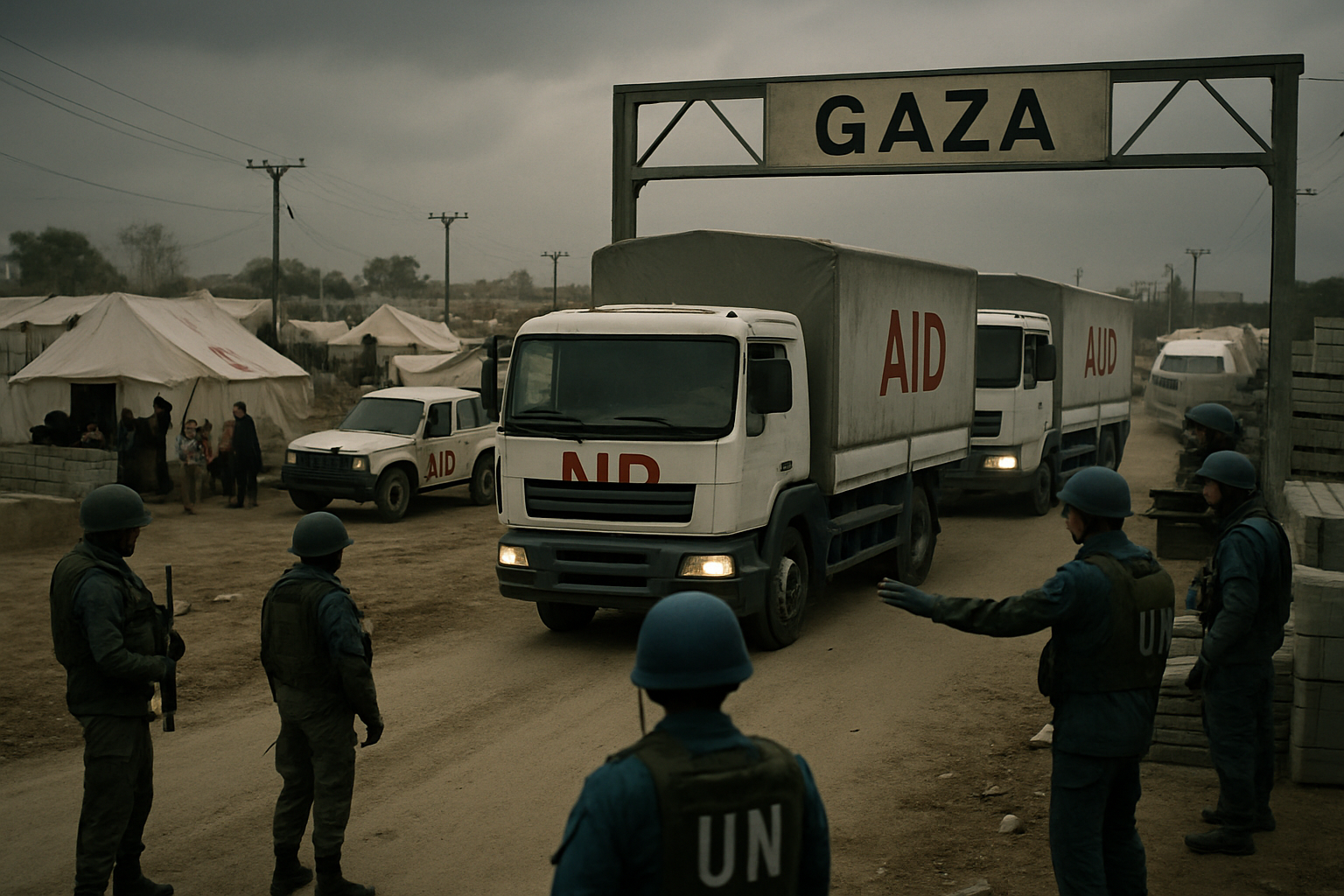
The Trump administration's Board of Peace Initiative convened its inaugural summit in Washington on February 19, 2026, securing an unprecedented $17 billion commitment for Gaza reconstruction, even as the humanitarian crisis in the Palestinian territory continues to deteriorate amid systematic ceasefire violations and political deadlock.
President Trump announced a $10 billion US contribution alongside $7 billion in additional pledges from 27 member nations at the Donald Trump Institute of Peace, representing the largest international financial commitment to Gaza reconstruction in history. The summit occurred against a backdrop of severe humanitarian challenges, with over 1,600 documented ceasefire violations since October 2025 resulting in 573+ Palestinian deaths during what was supposed to be a truce period.
Historic Financial Commitment Amid Crisis
The Board of Peace, described by the Trump administration as a "business approach" to conflict resolution departing from traditional UN frameworks, brought together leaders from 27 nations including Hungarian Prime Minister Viktor Orbán, Pakistan's Prime Minister Shehbaz Sharif, and observers from Italy, Cyprus, and Romania. Notably absent were Vatican representatives, who declined participation through Cardinal Pietro Parolin citing that "the UN should manage crisis situations."
Argentina's President Javier Milei offered to deploy the country's "Cascos Blancos" (White Helmets) peacekeeping force to Gaza, declaring: "We are ready to contribute. We put at the disposal the collaboration of our White Helmets. Our trajectory in peace operations is a proven capital that we put at the service of the stabilization force."
"In this initial stage, Argentina is ready to contribute. We put at the disposal the collaboration of our White Helmets. Our proven track record in peace operations is capital we put at the service of the stabilization force."
— Javier Milei, President of Argentina
Systematic Ceasefire Violations Undermine Peace Efforts
Despite the massive financial pledges, implementation faces severe obstacles. Gaza's Government Media Office has documented over 1,600 systematic ceasefire violations since the October 10, 2025 truce, resulting in 573+ Palestinian deaths and 1,553 injuries. The total Gaza death toll now stands at 71,800, according to Palestinian health authorities.
The Rafah crossing with Egypt, reopened on February 2, 2026 after nearly two years of closure, operates under severe restrictions with only 27 Palestinians crossing on the opening day versus a planned quota of 200. Hamas condemns what it calls "systematic harassment" by Israeli security, with 38 of 50 planned returnees denied passage. Over 20,000 Palestinians await medical evacuation.
Gaza's Civil Defense has completely shut down due to fuel shortages, hampering emergency response capabilities during a period when humanitarian need is at its peak. The organization had previously recovered over 8,000 bodies from rubble throughout the Strip.
Hamas Rejects Disarmament Demands
A major obstacle to reconstruction efforts emerged when Hamas leader Khaled Meshaal delivered a categorical rejection of disarmament demands during a February 8 statement in Doha. Meshaal declared that "criminalizing resistance, weapons and those who carried it out" is unacceptable, maintaining that armed resistance is justified "while there is occupation."
Israeli sources estimate Hamas maintains approximately 20,000 fighters despite the ceasefire, challenging traditional post-conflict reconstruction models that typically require demilitarization before international aid can flow freely.
International Community Divided
The Board of Peace initiative has created diplomatic tensions, with European officials privately expressing concerns about undermining established UN frameworks. While Albania defended its participation citing a "special relationship with the US," Lithuania raised "fundamental questions" about the approach, and major European powers Germany, France, and the UK were notably absent from the summit.
Eight Arab nations - Saudi Arabia, Jordan, Egypt, UAE, Qatar, Indonesia, Pakistan, and Turkey - previously issued joint condemnation of Israeli ceasefire violations, calling them violations of international law "aimed at imposing unlawful Israeli sovereignty."
"Every day is worse than the one before for Gazans. The humanitarian situation continues to deteriorate despite international promises of aid and reconstruction."
— Emily Boyle, France 24 Correspondent
West Bank Crisis Complicates Peace Efforts
Simultaneously, the Israeli government approved the most comprehensive West Bank land registration as "Israeli territory" since 1967, targeting hundreds of thousands of dunams with a focus on the strategically vital Jordan Valley. Finance Minister Bezalel Smotrich declared the policies will "kill the Palestinian state idea," while Energy Minister Eli Cohen acknowledged implementing "factual sovereignty."
This unprecedented territorial seizure has prompted condemnation from 85 UN member states and threatens to make a two-state solution technically unfeasible through systematic demographic and geographic alteration.
Medical Crisis Reaches Breaking Point
The humanitarian situation has reached critical levels, with Doctors Without Borders suspending operations at Khan Younis citing security concerns. Philippe Ribeiro, head of the organization's mission in the Palestinian territories, warned of a "huge health void" if the organization is forced to leave Gaza entirely.
UNRWA, the UN agency for Palestinian refugees, has warned that humanitarian needs far exceed what it can currently provide, collecting 5,000 tons of solid waste across Gaza while struggling with access restrictions and funding shortages.
International Stabilization Force Plans
US Major General Jasper Jeffers, commander of the planned Gaza "International Stabilization Force," announced that forces will first deploy to Rafah. The National Committee for the Administration of Gaza, supported by the United States, has begun accepting applications for a new police force, with recruitment open to "qualified" men and women.
Questions remain about eligibility criteria, particularly for those who previously served under Hamas administration, highlighting the complex political and security challenges facing any international intervention.
Ramadan Observance Amid Restrictions
Palestinians in Gaza observed their first Ramadan since the October 2025 ceasefire amid continued hardships. Al-Aqsa Mosque was limited to 10,000 worshippers, and Israeli forces banned the distribution of iftar meals in mosque courtyards. The restrictions underscore the continued limitations on religious freedom and normal life in the territory.
Looking Forward: Implementation Challenges
Despite the unprecedented financial commitment, implementation faces severe challenges. Traditional reconstruction models require stable security conditions and demilitarization - conditions that remain absent given Hamas's rejection of disarmament and ongoing violations.
The "business approach" to diplomacy represents a test of whether economic incentives can overcome deep-rooted political and security challenges. Success could provide a template for 21st-century conflict resolution, while failure may undermine confidence in alternative approaches to established international frameworks.
The stakes extend beyond Gaza to fundamental questions about international cooperation, global governance evolution, and conflict resolution mechanisms in an increasingly multipolar world. As the humanitarian crisis deepens and political obstacles persist, the international community faces a critical test of its ability to transform financial pledges into meaningful relief for Gaza's 2.3 million residents.