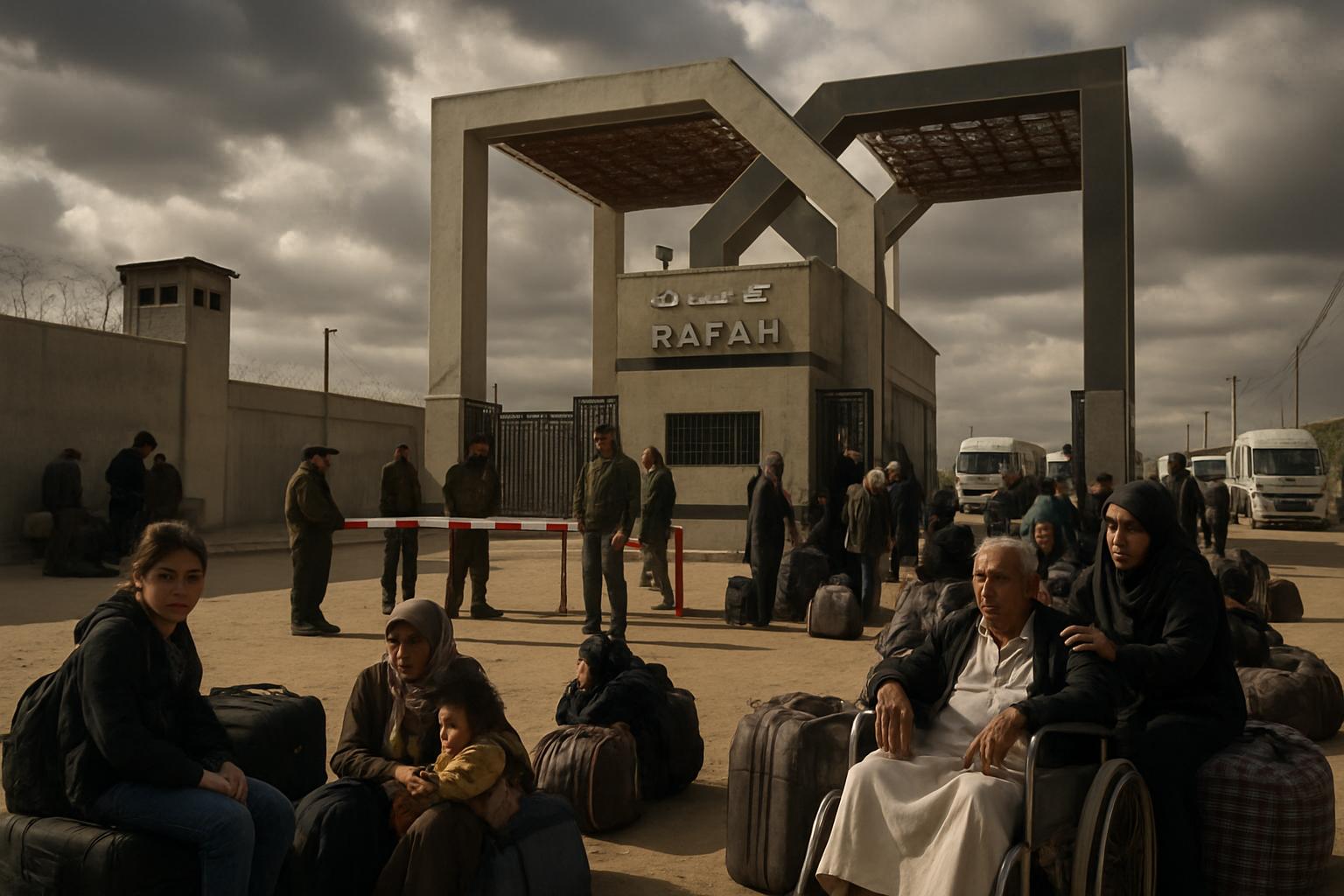
Gaza's vital Rafah border crossing with Egypt reopened Monday for limited pedestrian traffic, marking the first opening of Gaza's primary gateway to the outside world since Israeli forces seized control of the crossing in May 2024.
The reopening, confirmed by multiple international sources, allows only restricted movement with strict quotas - approximately 150 people permitted to exit Gaza daily and 50 to enter, according to reports from Al Jazeera and other media outlets. The crossing will operate for six hours daily under tight Israeli security control.
Thousands Await Medical Treatment
Gaza's Health Ministry reports that approximately 20,000 Palestinians are waiting to leave the territory for urgent medical care abroad. However, despite the symbolic reopening, no patients had actually crossed the border as of Monday afternoon, according to Dr. Atef al-Hout, director of Nasser Medical Complex in Khan Younis.
"Any delay in travel is tantamount to a death sentence," Gaza health officials stated, highlighting the critical situation facing thousands of wounded and sick Palestinians who have been unable to access specialized medical care during the prolonged closure.
"This is a historic moment, but the restrictions are still too severe for those desperately needing medical treatment."
— Palestinian Medical Official
Context of the Closure
The Rafah crossing, Gaza's sole land border with Egypt and effectively the only route in or out of the Palestinian territory of 2.3 million residents, has been closed to civilian traffic since Israeli forces captured it during military operations in May 2024. The last Palestinian medical evacuations through Rafah occurred in February 2025.
The crossing's reopening was included in the first phase of a US-brokered ceasefire agreement, contingent upon the return of all living and deceased hostages held by Hamas to Israel. The Vatican News reported that this condition has been met, enabling the partial reopening.
Limited Operations and Restrictions
Despite the reopening announcement, the crossing remains under full Israeli control on the Palestinian side, with significant restrictions in place. According to Canadian Broadcasting Corporation reports, the reopening is "mostly symbolic" as very few people will be allowed to travel in either direction, and crucially, no goods or humanitarian aid will pass through.
France24 reported that Israel continues to control the Palestinian side of the crossing, while humanitarian aid flows remain extremely restricted. The European Union monitoring mission that previously oversaw crossing operations has not been fully restored.
International Response and Concerns
International observers and humanitarian organizations have welcomed the reopening while expressing concerns about the severe limitations. French media outlet Mediapart noted that despite numerous restrictions, the news has been "favorably received by the Palestinian population" on both sides of the border.
The Austrian news outlet Der Standard reported that as long as the Israeli army alone decides who can pass and quotas remain severely limited, Gaza has not yet achieved "post-war normalcy."
Medical Emergency Cases
The partial reopening comes as Gaza faces a severe medical crisis. Reports from various sources indicate that wounded Palestinians, including children with rare diseases and cancer patients, are among those desperately waiting to cross for treatment unavailable in Gaza's damaged healthcare system.
Al Jazeera highlighted the case of teenagers and other critical patients who have been waiting for months for the opportunity to receive life-saving treatment abroad, with some cases becoming increasingly urgent as delays continue.
Regional Diplomatic Context
The crossing reopening occurs against a backdrop of broader regional tensions. Recent memory searches reveal that eight Arab and Muslim nations recently issued joint condemnation of alleged Israeli ceasefire violations in Gaza, with reports of over 1,000 Palestinian casualties since the ceasefire began.
South Africa recently expelled an Israeli envoy, while diplomatic pressure continues to mount for full implementation of ceasefire terms and unrestricted humanitarian access to Gaza.
Looking Forward
While the reopening of Rafah represents a significant symbolic step, the severe restrictions on movement and the continued ban on goods and humanitarian aid highlight the challenges facing Gaza's recovery. The crossing's limited operation schedule and stringent quotas mean that for many of the 20,000 Palestinians seeking medical treatment abroad, the wait continues.
The international community continues to monitor the situation closely, with particular attention to whether crossing operations will expand to allow meaningful humanitarian aid flows and broader civilian movement as ceasefire implementation progresses.
For now, the partial reopening offers a glimmer of hope to Gaza's 2.3 million residents, though the path to full restoration of normal border operations remains uncertain amid ongoing regional tensions and complex multi-party negotiations involving Israel, Egypt, the EU, and Palestinian authorities.