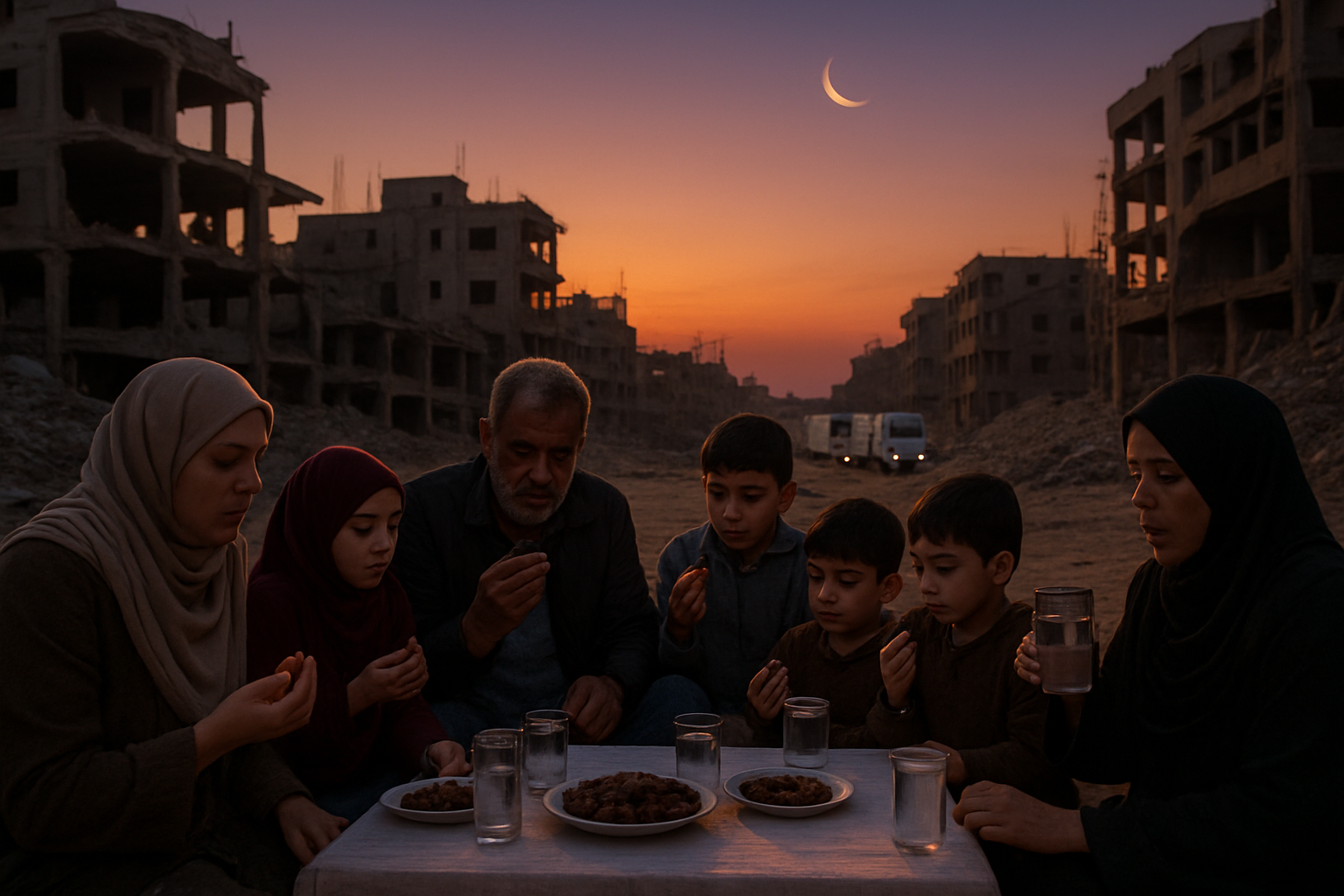
Palestinians in Gaza are observing their first Ramadan since the fragile ceasefire took hold in October 2025, attempting to revive traditional festivities amid devastating conditions and ongoing tensions that threaten the stability of the holy month.
As the crescent moon was sighted on Tuesday evening, marking the beginning of Ramadan 1447 AH, Gaza's 2.3 million residents entered the sacred month with a mixture of hope and uncertainty. The ceasefire, brokered by the United States in October 2025, has been marred by what Palestinian officials describe as systematic violations, with over 1,600 documented incidents resulting in more than 570 Palestinian deaths during what was supposed to be a period of peace.
Holy Month Under Siege
Despite the ceasefire agreement, Israeli forces have continued to impose severe restrictions on Palestinian religious observance. At the Al-Aqsa Mosque in Jerusalem, thousands of Palestinian Muslims gathered for Taraweeh prayers on the first night of Ramadan, but Israeli authorities limited entry to just 10,000 worshippers and banned the distribution of iftar meals to fasting Muslims within the mosque's courtyards.
"Israeli forces prevented the entry of iftar meals for fasting Muslims into the courtyards of the blessed Al-Aqsa Mosque, including meals designated for employees of the Islamic Endowments Department,"
— Jerusalem Governorate Statement
The restrictions extend beyond Jerusalem to Gaza itself, where the humanitarian crisis continues to deepen. The Gaza Civil Defense has completely shut down operations due to fuel shortages, hampering emergency response capabilities during a time when religious gatherings and increased community activities typically require enhanced safety measures.
Rafah Crossing Limitations
International aid efforts have been severely constrained by restrictions at the Rafah crossing with Egypt, which reopened in February 2026 after nearly two years of closure. Despite initial hopes for expanded humanitarian access, operations remain drastically limited with only 27 Palestinians crossing on the opening day versus the agreed quota of 200 daily.
Hamas officials have condemned what they describe as "systematic harassment" by Israeli security forces, who have denied passage to 38 of 50 planned Palestinian returnees. This has left approximately 20,000 Palestinians awaiting medical evacuation, many of whom had hoped to receive treatment abroad during the holy month.
International Aid Response
Egypt has mobilized a massive humanitarian response, deploying 150 hospitals on alert status and 300 ambulances to assist Palestinian medical evacuees. However, the limited crossing operations have severely constrained the effectiveness of these efforts.
Meanwhile, in Saudi Arabia, the Prophet's Mosque in Madinah presented scenes of spiritual unity as hundreds of thousands of worshippers gathered for iftar on the first day of Ramadan. The contrast with Gaza's situation has highlighted the disparity in religious freedom and security across the Muslim world.
"Hundreds of thousands of fasting worshippers—residents and visitors alike—gathered to share in the iftar meal within the sacred precincts of the mosque, in a scene suffused with the profound spirituality of this blessed time,"
— Saudi Gazette Report
Prisoner Releases and Diplomatic Gestures
In a Ramadan diplomatic gesture, Israeli authorities released 13 Palestinian prisoners from Gaza who had been detained during recent military operations. However, Palestinian sources report that the released prisoners showed signs of deteriorating health conditions and potential mistreatment during their detention.
The releases come as part of broader regional diplomatic efforts, with Saudi Arabia playing a mediating role in various conflicts across the Muslim world. The Kingdom has also launched an unprecedented international Ramadan program, distributing 2.2 million Quran copies to 120 countries and deploying 91 imams to 49 nations to support global Muslim communities.
Ceasefire Violations Continue
The Gaza Government Media Office has documented systematic violations of the ceasefire agreement, with Israeli forces conducting operations that have resulted in significant Palestinian casualties. These violations threaten not only the immediate peace but also upcoming diplomatic initiatives, including the Trump administration's Board of Peace summit scheduled for February 19, 2026.
Eight Arab nations—Saudi Arabia, Jordan, Egypt, UAE, Qatar, Indonesia, Pakistan, and Turkey—have issued joint condemnations of the ongoing violations, calling them breaches of international law that undermine the two-state solution.
Community Resilience
Despite the challenges, some Palestinians in Gaza are working to restore traditional Ramadan celebrations. Community leaders are organizing iftar gatherings and religious programs, attempting to maintain the spiritual essence of the holy month even under difficult circumstances.
The broader Muslim world is also observing Ramadan, with nearly 2.5 billion believers worldwide entering the sacred season. In Egypt, charitable organizations like the Misr ElKheir foundation are preparing aid packages for residents living in poverty, demonstrating the global spirit of charity and solidarity that defines the holy month.
Looking Ahead
As Palestinians in Gaza navigate their first Ramadan under the fragile ceasefire, the international community faces mounting pressure to ensure the protection of religious rights and humanitarian access. The systematic violations documented since October 2025 have created what observers describe as "implementation failures" rather than isolated incidents.
The coming weeks will test whether the spirit of Ramadan—emphasizing compassion, charity, and peace—can influence regional dynamics and encourage genuine adherence to ceasefire agreements. With over 400 EU diplomats demanding increased pressure on Israeli authorities and a European Left Coalition petition against EU-Israel partnerships exceeding 400,000 signatures, international diplomatic pressure continues to build.
For Gaza's residents, this Ramadan represents both a test of faith and a hope for genuine peace, as they observe the holy month while working to rebuild their shattered communities and maintain their spiritual traditions despite ongoing restrictions and uncertainty.