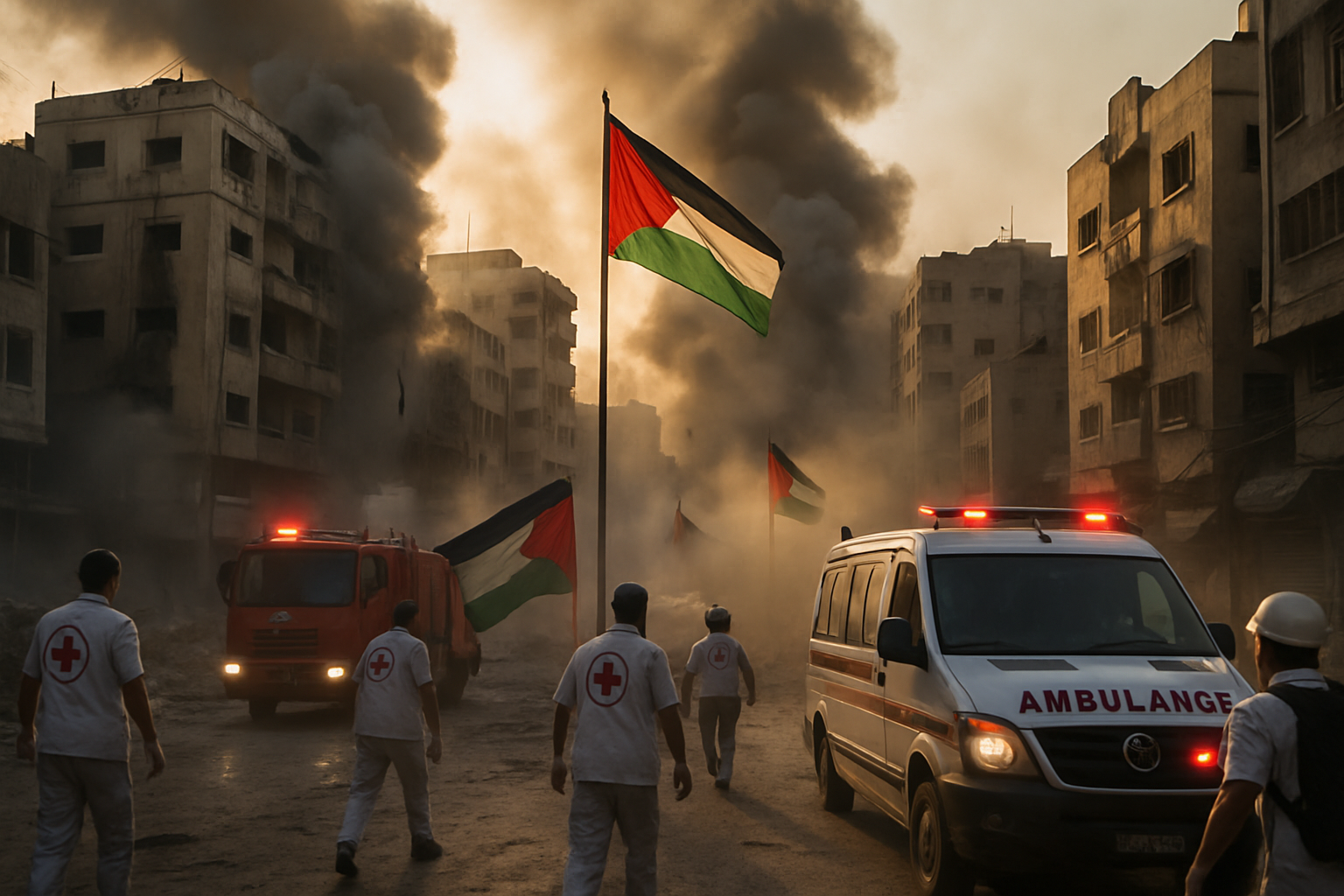
Israeli military strikes across the Gaza Strip killed at least 10 Palestinians, including four children, on Wednesday morning, according to Palestinian officials, as international observers report continued violations of the ceasefire agreement that was supposed to bring peace to the embattled territory.
The Gaza Civil Defense Agency confirmed that nine people, including three children, were killed in Israeli airstrikes following what the Israeli Defense Forces (IDF) described as gunfire directed at its troops. Palestinian medical sources reported the death toll had risen to ten, with four children among the victims.
Latest Casualties in Eastern Gaza
The deadliest incident occurred in the al-Tuffah neighborhood east of Gaza City, where Israeli tanks shelled an apartment building belonging to the Haboush family. Palestinian sources confirmed that four family members were killed, including two children: 13-year-old Rital Mahmoud Haboush and 40-year-old Youssef Mohammed Haboush.
Among the other victims identified by Palestinian authorities were Ahmed Talaat Haboush and additional family members whose identities were still being confirmed by local officials. The strikes occurred around 2:00 PM local time, according to witnesses who reported heavy artillery fire from Israeli positions.
Separately, Israeli forces killed a 24-year-old Palestinian man, Saeed Na'el al-Sheikh, during a military raid in the city of Jericho in the occupied West Bank on Tuesday evening, according to the Palestinian Ministry of Health.
Ceasefire Violations Continue for 116th Day
The Palestinian Information Center reported that these killings mark the 116th consecutive day of what Palestinian officials characterize as Israeli ceasefire violations since the truce agreement went into effect. The ongoing strikes have drawn condemnation from multiple Arab and Muslim nations who have accused Israel of systematically undermining the peace agreement.
"Israeli occupation forces continue their violations of the ceasefire for the 116th day in a row, targeting civilians in eastern Gaza Strip."
— Palestinian Information Center Statement
According to Palestinian health authorities, over 1,000 Palestinian casualties have been reported from Israeli strikes since the ceasefire began, despite the agreement's provisions for ending hostilities. Eight Arab nations, including Saudi Arabia, Jordan, Egypt, UAE, Qatar, Indonesia, Pakistan, and Turkey, issued a joint condemnation on February 1, warning that continued violations threaten the implementation of broader peace initiatives.
International Response and Diplomatic Pressure
The Organization of Islamic Cooperation (OIC) separately condemned what it termed "continuing massacres," citing 31 recent deaths as evidence of "dangerous escalation." The joint statement from Muslim nations warned that ceasefire violations could undermine the second phase of President Trump's Gaza peace plan and threaten the implementation of UN Resolution 2803.
The European Union, which maintains monitoring teams at border crossings, has called for full compliance with ceasefire terms. However, international observers have expressed concern about the limited mechanisms for enforcing the agreement and preventing further escalation.
Rafah Crossing Restrictions Continue
Meanwhile, Palestinian women have reported what they describe as a "journey of horror" at the recently reopened Rafah crossing between Gaza and Egypt. Despite the crossing's reopening after nearly two years of closure, severe restrictions remain in place that limit Palestinian movement.
Hamas officials condemned what they characterized as "systematic harassment" of Palestinians attempting to return to Gaza through the crossing. Of 50 planned returnees on recent days, Israeli security forces reportedly denied passage to 38 Palestinians, with operations taking over 10 hours for minimal crossings.
The Gaza Health Ministry reports that approximately 20,000 Palestinians still await medical evacuation through the crossing, but current capacity allows only a fraction of those in need to receive treatment abroad.
Military Response and Justifications
The Israeli Defense Forces stated that Wednesday's strikes were conducted in response to gunfire that injured an Israeli officer during operations in eastern Gaza. Military officials said the airstrikes targeted what they described as "terrorist positions" following the attack on their forces.
Israeli military sources indicated that one officer was wounded in the initial shooting incident, prompting the retaliatory strikes. The IDF maintained that its operations were conducted within the framework of self-defense provisions outlined in the ceasefire agreement.
However, Palestinian officials dispute this characterization, arguing that the strikes targeted civilian areas and violated the spirit and letter of the ceasefire accord. They point to the presence of women and children among the casualties as evidence that the attacks were disproportionate.
Humanitarian Crisis Deepens
The ongoing violence occurs against the backdrop of a severe humanitarian crisis in Gaza, where 2.3 million residents continue to face shortages of basic necessities. The Gaza Civil Defense announced a complete operational shutdown due to fuel shortages, severely hampering emergency response capabilities.
Egypt has maintained 150 hospitals on alert with 300 ambulances deployed to assist with medical evacuations from Gaza, but the limited crossing capacity means most patients requiring urgent care cannot access treatment. Medical facilities within Gaza remain overwhelmed, operating with minimal resources and facing regular disruptions from military operations.
The death toll in Gaza has reached 71,800 according to local health authorities, a figure that includes casualties from both the current ceasefire period and the preceding months of intense conflict.
Regional Implications
The continued violence in Gaza threatens broader regional stability initiatives, including diplomatic efforts involving Iran, Turkey, and other Middle Eastern nations. Regional observers warn that sustained ceasefire violations could undermine confidence in negotiated solutions to regional conflicts.
The situation also complicates international efforts to rebuild Gaza's infrastructure and restore normal civilian life. Humanitarian organizations have expressed concern that ongoing military operations make it dangerous to deploy aid workers and implement reconstruction projects.
As diplomatic pressure mounts from Arab and Muslim nations, the international community faces growing challenges in maintaining the fragile ceasefire arrangement. The contrast between the formal peace agreement and daily reality on the ground highlights the difficulties in translating diplomatic accords into lasting peace for Palestinian civilians.