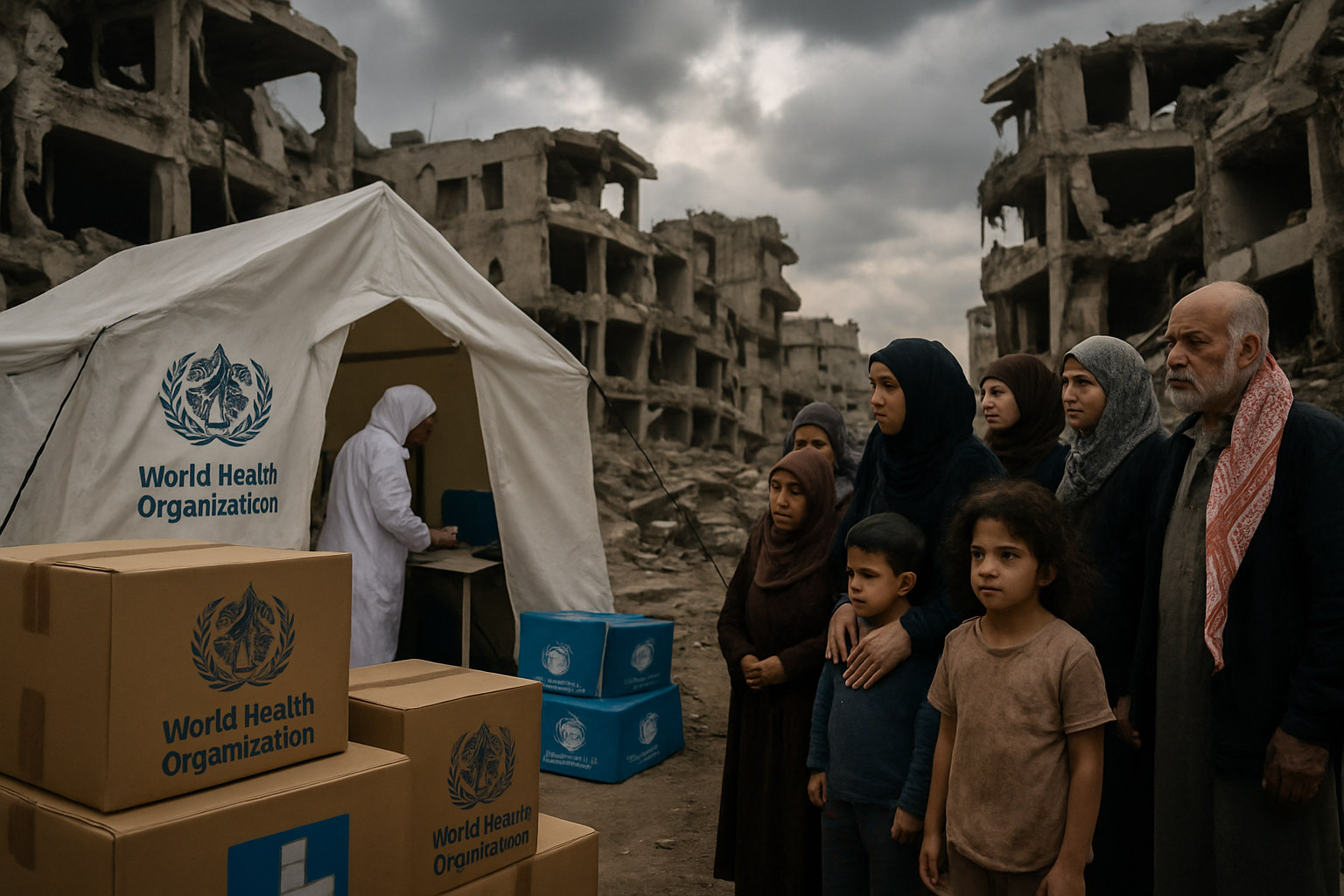
Israeli airstrikes killed at least 10 Palestinians near a school housing displaced families in Gaza's Maghazi refugee camp on Monday, while the World Health Organization suspended vital medical evacuations, creating a catastrophic convergence of violence and humanitarian breakdown affecting 2.3 million residents.
The deadly strikes occurred outside a school facility that had been converted to shelter Palestinians displaced by the ongoing conflict, according to Palestinian health officials. The attack represents the latest in what has become a systematic pattern of violence despite an October 2025 ceasefire agreement that was meant to bring peace to the region.
Simultaneously, WHO announced the suspension of medical evacuations from Gaza, dealing a devastating blow to Palestinian civilians who depend on these lifelines for critical medical care. The decision comes as over 20,000 Palestinians currently await medical evacuation, with health officials reporting that 6-10 critically ill patients die daily due to blocked access to treatment abroad.
Systematic Ceasefire Violations Reach Crisis Point
Monday's violence adds to an alarming pattern that has emerged since the October 2025 truce agreement. International monitoring organizations have now documented over 1,600 systematic ceasefire violations, resulting in more than 680 Palestinian deaths during what was supposed to be a peace period.
"Where is the ceasefire?" questioned Dr. Mohamed Abu Selmiya, Director of Gaza's Al-Shifa Hospital, echoing the frustration of medical professionals struggling to treat casualties under impossible conditions. His repeated queries have become a symbol of the international community's failure to enforce agreed-upon peace terms.
The Euro-Mediterranean Human Rights Observatory has accused Israel of exploiting international attention focused on the Iran crisis to intensify what they term "Gaza civilian starvation policies." This calculated timing, according to Palestinian officials, demonstrates a systematic strategy of using global distractions to advance territorial and political objectives at the expense of civilian populations.
WHO Medical Evacuation Crisis
The WHO's suspension of medical evacuations represents a humanitarian catastrophe within the broader crisis. Gaza Health Ministry Director Zaher al-Wahidi reports that since Israeli forces occupied the Rafah crossing in May 2024, approximately 1,400 patients out of 20,000 awaiting treatment have died.
The Rafah crossing, Gaza's only non-Israeli controlled access point, operates under severe restrictions with only 27 Palestinians crossing daily versus a 200-person quota. Hamas officials have condemned what they describe as "systematic harassment" by Israeli security forces, who have denied passage to 38 out of every 50 planned returnees.
Egyptian authorities maintain 150 hospitals on alert with 300 ambulances deployed, but the crossing limitations severely constrain the effectiveness of these medical interventions. The situation has created a medical emergency where treatable conditions become fatal due to access restrictions.
Infrastructure Collapse and Emergency Response Breakdown
Gaza's Civil Defense has completely shut down due to fuel shortages, hampering emergency response capabilities precisely when they are most needed. This systematic degradation of emergency services affects everything from ambulance responses to body recovery operations.
The Palestinian NGO Network Director, Amjad al-Shawa, has warned of an approaching "environmental and public health emergency" due to waste accumulation and untreated wastewater. Rising temperatures in displacement camps create disease outbreak risks affecting hundreds of thousands living in overcrowded conditions with minimal sanitation.
Recent reports describe rat and insect infestations in displacement camps, highlighting the deteriorating conditions that threaten to trigger disease outbreaks among Gaza's most vulnerable populations.
International Response and Diplomatic Implications
The escalating crisis has prompted unprecedented international condemnation. Eighty-five UN member states have issued a joint statement condemning Israeli actions, representing the most comprehensive diplomatic opposition since the 1967 occupation began.
Eight Arab nations, including countries with normalized relations with Israel such as the UAE and Saudi Arabia, have issued joint condemnations calling the systematic violations breaches of international law. Over 400 European Union diplomats have demanded increased pressure on Israeli authorities, while a European petition against EU-Israel partnerships has exceeded 400,000 signatures.
UN Secretary-General António Guterres has called the overall regional situation "the greatest test of multilateral cooperation in the modern era," highlighting the stakes extending far beyond Gaza to global governance credibility.
Failed Peace Initiatives and Regional Context
The mounting violations threaten to completely undermine the Trump administration's February 2026 "Board of Peace" initiative, which secured $17 billion in reconstruction pledges from 27 nations. This business-oriented approach to diplomacy faces fundamental obstacles from ongoing military operations and the humanitarian crisis deepening daily.
Hamas has categorically rejected international disarmament demands, with spokesman Abu Obeida declaring such calls "not acceptable" while Israel continues military operations. The organization maintains an estimated 20,000 fighters and substantial weapons stockpiles, complicating traditional post-conflict reconstruction models.
The crisis occurs within the broader Middle East war that began following the death of Iran's Supreme Leader Khamenei in March 2026. Palestinian officials warn that Israel is systematically exploiting diverted international focus to intensify restrictions and operations against Gaza's civilian population.
Legal and Humanitarian Implications
International legal experts cite multiple violations of UN Security Council resolutions and Geneva Conventions. The systematic restrictions on movement, medical care, and basic services constitute collective punishment prohibited under international humanitarian law.
A landmark Lancet study revealed that Gaza's death toll has been systematically undercounted by approximately 35%, with actual casualties exceeding 75,000 people—representing 3-4% of Gaza's total population. This peer-reviewed research provides definitive evidence of the conflict's unprecedented scale and severity.
The targeting of schools, medical facilities, and civilian infrastructure during the latest escalation raises serious questions about compliance with international humanitarian law. Medical facilities treating the latest casualties operate under constant threat, with systematic targeting of healthcare infrastructure documented throughout the conflict.
Regional and Global Implications
The Gaza crisis serves as a critical test case for 21st-century international law enforcement and civilian protection mechanisms. Success or failure of the international response will influence territorial sovereignty disputes globally and set precedents for occupied territories worldwide.
The current pattern represents what experts describe as "systematic implementation failures" rather than isolated incidents. This systematic breakdown demonstrates the challenges of maintaining negotiated peace without addressing underlying political and security issues.
For the 2.3 million Palestinians in Gaza, the daily medical evacuation deaths and continued strikes highlight the human cost of international law enforcement failures in protecting vulnerable populations under occupation. The convergence of military violence and humanitarian system collapse creates conditions that international experts warn could lead to a historic catastrophe requiring immediate coordinated action beyond diplomatic statements.
As the international community grapples with multiple global crises, the Gaza situation represents a watershed moment for humanitarian principles, conflict resolution credibility, and the international community's commitment to civilian protection in the modern era.