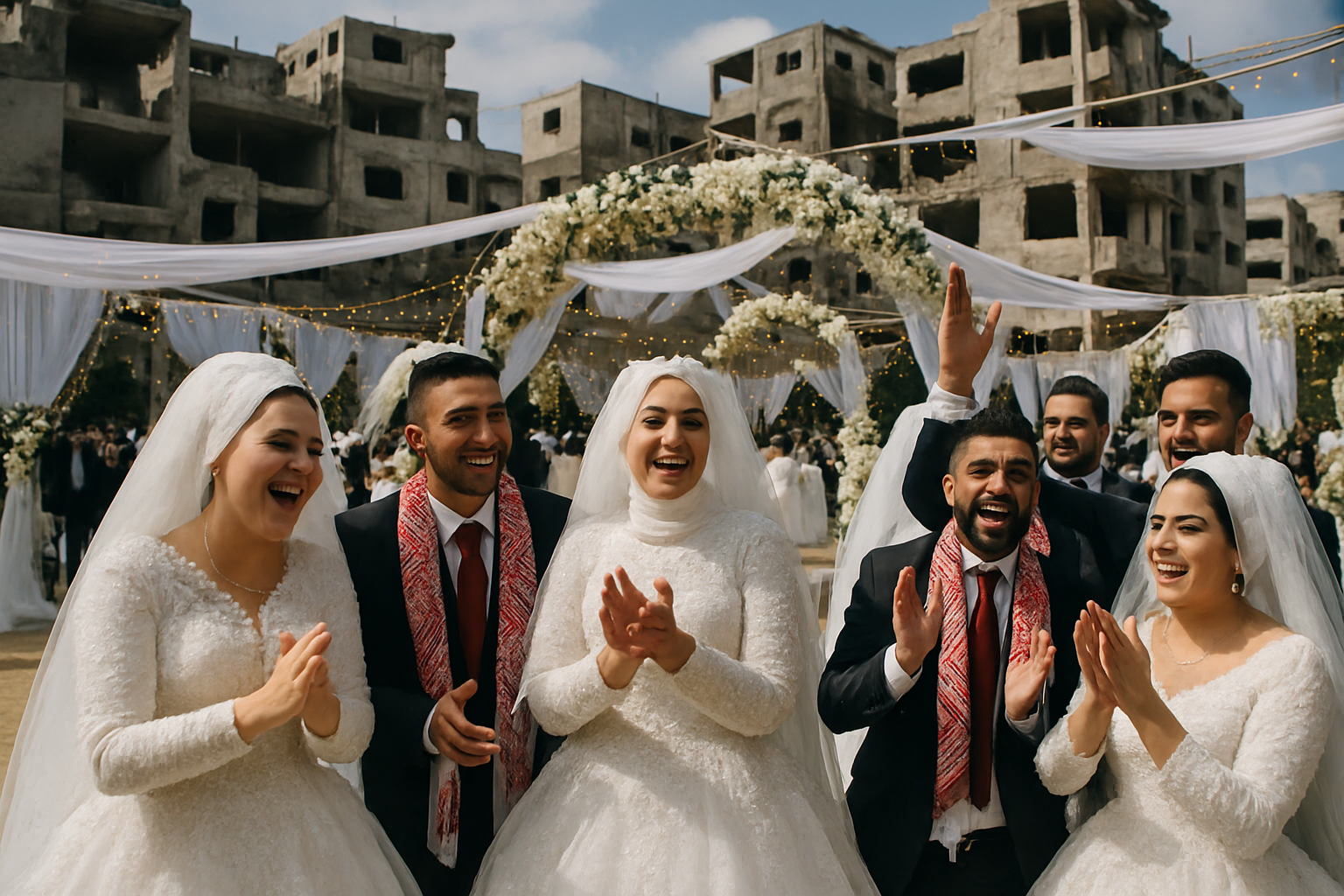
In a remarkable display of resilience and hope, approximately 300 Palestinian couples gathered for a mass wedding ceremony in the war-scarred city of Deir al-Balah, Gaza, while elsewhere in the same city, residents participated in municipal elections—the first democratic exercise in Gaza in nearly two decades.
The dual events on April 26, 2026, provided rare moments of normalcy and political participation amid what international observers describe as ongoing systematic ceasefire violations and a deepening humanitarian crisis affecting 2.3 million Gaza residents.
Mass Wedding Transforms Desolate Landscape
Against the backdrop of destroyed buildings and displacement camps, hundreds of couples exchanged vows in Deir al-Balah, transforming a landscape marked by devastation into a celebration of love and life. The ceremony, organized by local community groups and humanitarian organizations, provided wedding attire, decorations, and celebration facilities for families who had lost everything during the conflict.
"We wanted to show that life continues despite everything we've endured," said Ahmad Al-Masri, one of the grooms whose family had been displaced multiple times since October 2023. "This wedding gives hope not just to us, but to our entire community."
The mass wedding format has become increasingly common in Gaza as families struggle with economic hardship and the destruction of traditional celebration venues. Community leaders report that many couples had delayed their weddings for years due to the ongoing crisis, making this celebration particularly significant for participants and their extended families.
Historic Electoral Participation
Simultaneously, residents of Deir al-Balah made history by participating in Palestinian municipal elections—the first electoral process in Gaza since 2006 and the first Palestinian vote since the war began in October 2023. According to Palestinian Authority officials, the inclusion of this Gaza city was intended to demonstrate that the enclave remains part of future Palestinian state plans.
Voter turnout in Deir al-Balah reached 21.2%, significantly lower than the West Bank's 25.3%, reflecting the challenging conditions under which the election was conducted. The Palestinian Electoral Commission confirmed that voting was only possible in this central Gaza location due to extensive war damage elsewhere and ongoing security constraints.
"This election represents an important first step in a broader national process aimed at strengthening democratic life and ultimately achieving the unity of Palestinian territories."
— Prime Minister Mohammad Mustafa, Palestinian Authority
Loyalists of President Mahmoud Abbas won most races across Palestinian territories, officials confirmed Sunday, with the ballot marking the first elections of any kind in Gaza since 2006. The electoral process faced significant limitations, with Hamas excluded from participation and only PLO-recognized candidates permitted to run.
Limited but Symbolic Democratic Exercise
The elections occurred under what political observers describe as "extraordinarily difficult circumstances," with voting conducted in temporary facilities and damaged buildings. Most electoral lists aligned with the Fatah party or independent candidates, as Hamas-affiliated candidates were not permitted on ballots.
Hussein Ibish of the Arab Gulf States Institute described the vote as a "barometer" of Palestinian public opinion, while former Elections Committee member Hassan Abu Lebda warned that the absence of genuine competition "fundamentally undermines the democratic process." The narrow political field reflected ongoing divisions that have paralyzed Palestinian governance for two decades.
Context of Ongoing Crisis
Both celebrations occurred against the backdrop of what international monitors describe as systematic ceasefire violations. Over 1,600 documented violations have occurred since the October 2025 truce, resulting in more than 600 Palestinian deaths during what was supposed to be a peace period, according to the Gaza Government Media Office.
The humanitarian situation remains critical, with Gaza Civil Defense completely shut down due to fuel shortages and the Rafah crossing severely restricted to 27 daily crossings versus a 200-person quota. More than 20,000 Palestinians await medical evacuation, with health officials reporting that 6-10 critically ill patients die daily from blocked medical access.

International Response and Reconstruction Efforts
The electoral milestone comes as international reconstruction efforts face significant obstacles. The $17 billion in Gaza reconstruction commitments secured at the February 2026 Board of Peace summit—the largest international pledge in Gaza's history—remain threatened by ongoing violations and Hamas's categorical rejection of disarmament demands.
An unprecedented coalition of 85 UN member states has condemned what they describe as systematic violations of international law, while eight Arab nations, including normalized relations countries like the UAE and Saudi Arabia, have issued joint condemnations of the ongoing crisis.
"We want to make our voices heard to begin a new life. Despite everything we've suffered, we still believe in the possibility of democracy and normal life."
— Fatima Al-Zahra, Deir al-Balah resident and voter
Template for Democratic Development
Political analysts view the election as a template for potential democratic development under occupation conditions, though they emphasize the substantial constraints that limit meaningful political competition. The vote serves as a test case for international community support of Palestinian political normalization efforts.
European observers noted that while the election demonstrates resilience of democratic aspirations, it also highlights the complex relationship between democratic participation and sovereignty under systematic occupation policies that international law experts argue constitute de facto annexation.
Broader Regional Implications
The events in Deir al-Balah occur within a broader regional context of escalating tensions. The November 2024 Israel-Hezbollah ceasefire has collapsed, displacing 1.2 million Lebanese civilians—25% of Lebanon's population. Meanwhile, systematic West Bank expansion policies described by Israeli Finance Minister Bezalel Smotrich as designed to "kill the Palestinian state idea" continue despite international condemnation.
The dual celebrations of matrimony and democracy in Gaza represent what observers describe as acts of resistance through normal life—assertions of Palestinian identity and political aspirations despite unprecedented challenges to basic survival and self-governance.
Challenges Ahead
Despite the symbolism of Saturday's events, significant obstacles remain to broader democratic normalization and reconstruction efforts. Hamas maintains an estimated 20,000 fighters and has rejected disarmament conditions tied to international reconstruction funding, complicating traditional post-conflict recovery models.
The Palestinian Electoral Commission confirmed that voting remains impossible throughout the remainder of Gaza due to widespread destruction, with more than half the enclave under direct Israeli military control and the rest managed by Hamas authorities.
Municipal Union officials warn of an approaching "comprehensive collapse" of vital services, with cooking gas supplies suspended affecting over 2 million residents and essential infrastructure systems on the verge of complete breakdown.
Looking Forward
The mass wedding and electoral participation in Deir al-Balah represent what many Palestinians describe as acts of hope and determination to maintain normal life despite extraordinary circumstances. For the 300 couples who exchanged vows and the thousands who cast ballots, these events symbolized a refusal to allow political conflict to completely eclipse human aspirations for love, family, and democratic participation.
As international mediators continue efforts to expand the electoral process and implement reconstruction programs, the events of April 26 serve as both inspiration and reminder of what remains possible even in the most challenging circumstances—and what is at stake in the ongoing struggle for Palestinian self-determination and regional stability.
The success or failure of building upon these initial democratic exercises will likely influence approaches to conflict resolution and democratic development under occupation conditions for decades to come, with implications extending far beyond the Palestinian territories to other contested regions worldwide.