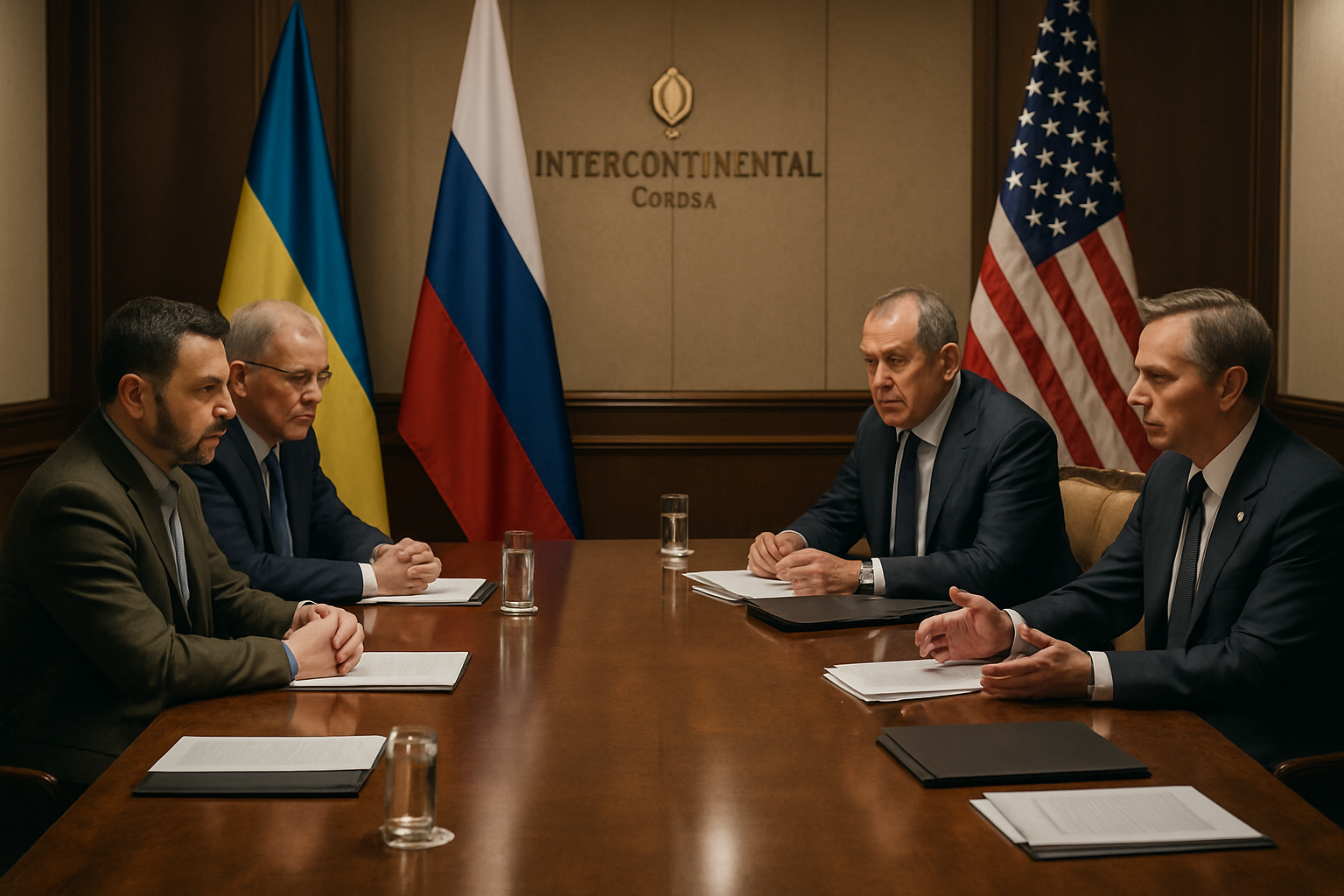
Two days of high-stakes trilateral peace talks between Ukraine, Russia, and the United States concluded in Geneva on Wednesday with mixed results, as delegates made progress on military issues while fundamental disagreements over territorial control and ceasefire monitoring remained unresolved.
The negotiations, held at the InterContinental Hotel Geneva, represented a significant evolution from the successful Abu Dhabi framework to European neutral territory. Ukrainian President Volodymyr Zelensky acknowledged meaningful advances on ceasefire monitoring mechanisms while noting that "positions remain divergent on political matters, including territories, the Zaporizhzhia Nuclear Power Plant, and other sensitive issues."
Delegation Composition and Diplomatic Framework
The Ukrainian delegation was led by Defense Minister Rustem Umerov, while Russia sent Vladimir Medinsky, a key advisor to President Putin who has served as Moscow's chief negotiator. US mediation continued under Special Envoy Steve Witkoff, who had previously facilitated the groundbreaking Abu Dhabi talks in February.
For the first time in the trilateral format, European "Big Five" officials from Germany, France, Italy, the United Kingdom, and Poland participated as observers, signaling growing international commitment to the peace process. This European engagement marks a significant diplomatic evolution from the UAE-hosted talks to institutionalized Swiss mediation.
Building on Abu Dhabi Success
The Geneva talks leveraged unprecedented momentum from the February Abu Dhabi breakthrough, which achieved a historic 314-prisoner exchange—the first in five months—and restored US-Russia military communications after a four-year suspension. Pentagon deconfliction protocols now cover Syria, Arctic, and Africa operations globally, representing the most significant US-Russia military agreement since the conflict began.
Ukrainian Defense Minister Umerov had described the earlier Abu Dhabi discussions as "substantial and productive," establishing a foundation for the more complex territorial and political negotiations that took place in Geneva.
Progress on Military Matters
According to President Zelensky's post-talks assessment, the most concrete progress was achieved on military technical issues, specifically regarding mechanisms for monitoring a potential ceasefire. Sources familiar with the negotiations indicated that working groups made headway on verification procedures and incident response protocols.
US Special Envoy Steve Witkoff reportedly described the talks as showing "significant progress," though he did not elaborate on specific areas of advancement. The restoration of US-Russia military communications has provided a crucial foundation for discussing deconfliction measures and transparency mechanisms.
Territorial Sticking Points Unchanged
Despite progress on technical military issues, the core territorial disputes that have defined this nearly four-year conflict remain unresolved. Eastern Ukrainian territories currently under Russian control continue to represent the fundamental disagreement between the parties.
Russia maintains its position demanding territorial recognition of its gains, insisting that any Putin-Zelensky summit must occur in Moscow. Ukraine continues to uphold its territorial integrity position while seeking comprehensive long-term security guarantees that Zelensky has indicated should span 20-30 years, compared to a reported US proposal of 15 years.
The territorial dimension has been complicated by accelerating Russian military gains—481 square kilometers captured in January 2026 compared to 260 square kilometers in December 2025, according to military analysts. This acceleration potentially strengthens Moscow's bargaining position while Ukraine maintains historic levels of international support.
Nuclear Crisis Backdrop
The Geneva negotiations unfolded against the critical backdrop of the New START treaty expiration on February 5, 2026—the first time in over 50 years that the United States and Russia operate without bilateral nuclear constraints. Both nations control more than 80% of global nuclear weapons, with Russia maintaining approximately 4,380 warheads (1,710 deployed) and the US holding 3,708 warheads (1,670 deployed).
UN Secretary-General António Guterres has characterized this as a "grave turning point" with nuclear risks at their "highest in decades." The restored military communications channel represents the only remaining major formal diplomatic link between the nuclear superpowers, adding extraordinary urgency to the Geneva peace process.
Escalation Amid Diplomacy
The talks proceeded despite a massive Russian attack launched just hours before negotiations began, involving 29 ballistic missiles and 396 drones targeting Ukrainian cities and energy infrastructure. Ukrainian air defenses successfully intercepted 25 missiles and 367 drones, though significant damage occurred in Odesa and central Ukraine with civilian casualties.
This pattern of major military escalations before diplomatic meetings has become a recurring feature of the peace process, with Russian forces appearing to use humanitarian pressure as a negotiating tactic. The systematic targeting of civilian infrastructure during extreme winter conditions—which has left over 1,170 Kyiv buildings without heating during temperatures reaching minus-30°C—represents what Ukrainian officials term "energy terrorism."
Civilian Cost and International Response
The human toll of the conflict continues to mount, with President Zelensky having disclosed that 55,000 Ukrainian soldiers have been officially confirmed killed, with a "large number" still missing in action. International estimates suggest actual casualties could be 2-3 times higher when including missing personnel and undocumented deaths.
Recent civilian casualties include the tragic February 11 Bohodukhiv drone strike that killed four civilians, including three children (two one-year-olds and one two-year-old) along with their father—the second deadly attack on the same town within three days, demonstrating the systematic targeting of families in residential areas.
The international community has responded with historic support measures. The European Union approved a €90 billion loan package—the largest ever provided to a single nation—though Slovakia, Czech Republic, and Hungary refused participation, showing persistent divisions within the bloc. Additional support includes Sweden-Denmark's €246 million air defense package and Germany's provision of 35 Patriot missiles.
June Deadline and Washington Evolution
The Geneva talks represent a crucial intermediate step toward the Trump administration's established June 2026 comprehensive peace deadline, with negotiations potentially moving to Washington for presidential-level engagement. This evolution from Abu Dhabi to Geneva to Washington suggests a deliberate diplomatic escalation designed to create unprecedented pressure for territorial compromise solutions.
The timeline creates extraordinary pressure for innovative resolution of challenges that have proven intractable through traditional diplomatic approaches. Success could end Europe's deadliest conflict since World War II and provide a template for 21st-century conflict resolution, while failure may lead to intensified military operations with global implications.
European Security Architecture Stakes
The broader implications extend far beyond Ukraine and Russia, affecting the fundamental architecture of European security. The conflict has prompted discussions of European strategic autonomy, including conversations about expanding France's nuclear deterrent beyond national scope—the first such discussions since the Cold War's end.
The Munich Security Conference, held under the sobering theme "Era of Disruptive Politics," saw German Chancellor Friedrich Merz declare that the "post-war order no longer exists," reflecting the profound transformation of international security structures.
Humanitarian Breakthroughs Amid Military Operations
The paradox of concrete humanitarian results—prisoner exchanges and communications restoration—achieved amid continued civilian targeting raises questions about genuine peace commitment versus humanitarian pressure tactics. The 71st prisoner exchange since the invasion demonstrates that sustained diplomatic engagement can produce tangible results even during active military operations.
The UAE methodology of working groups by topic followed by joint position synchronization has proven effective for addressing complex multi-dimensional challenges. This structured approach provides a tested framework for managing negotiations that involve military, political, territorial, and humanitarian dimensions simultaneously.
Looking Ahead
The Geneva talks represent the most significant diplomatic opportunity since the conflict began, testing whether innovative territorial compromise solutions can bridge positions that remain fundamentally far apart. The framework established through Abu Dhabi momentum and Swiss institutional mediation provides a pathway for continued negotiations despite persistent disagreements.
The success or failure of this diplomatic process will affect conflict prevention mechanisms worldwide, international law enforcement credibility, and territorial sovereignty principles for decades to come. As the international community watches for diplomatic innovation versus traditional limitations, the stakes extend to global security architecture and democratic resilience under authoritarian pressure.
With over 17.8 million Ukrainians now accessing winter support programs and systematic violations of Geneva Conventions documented through civilian infrastructure targeting, the urgent need for sustainable peace has never been greater. The coming weeks will determine whether the humanitarian breakthroughs achieved can translate into the territorial and security arrangements necessary for lasting resolution of this devastating conflict.