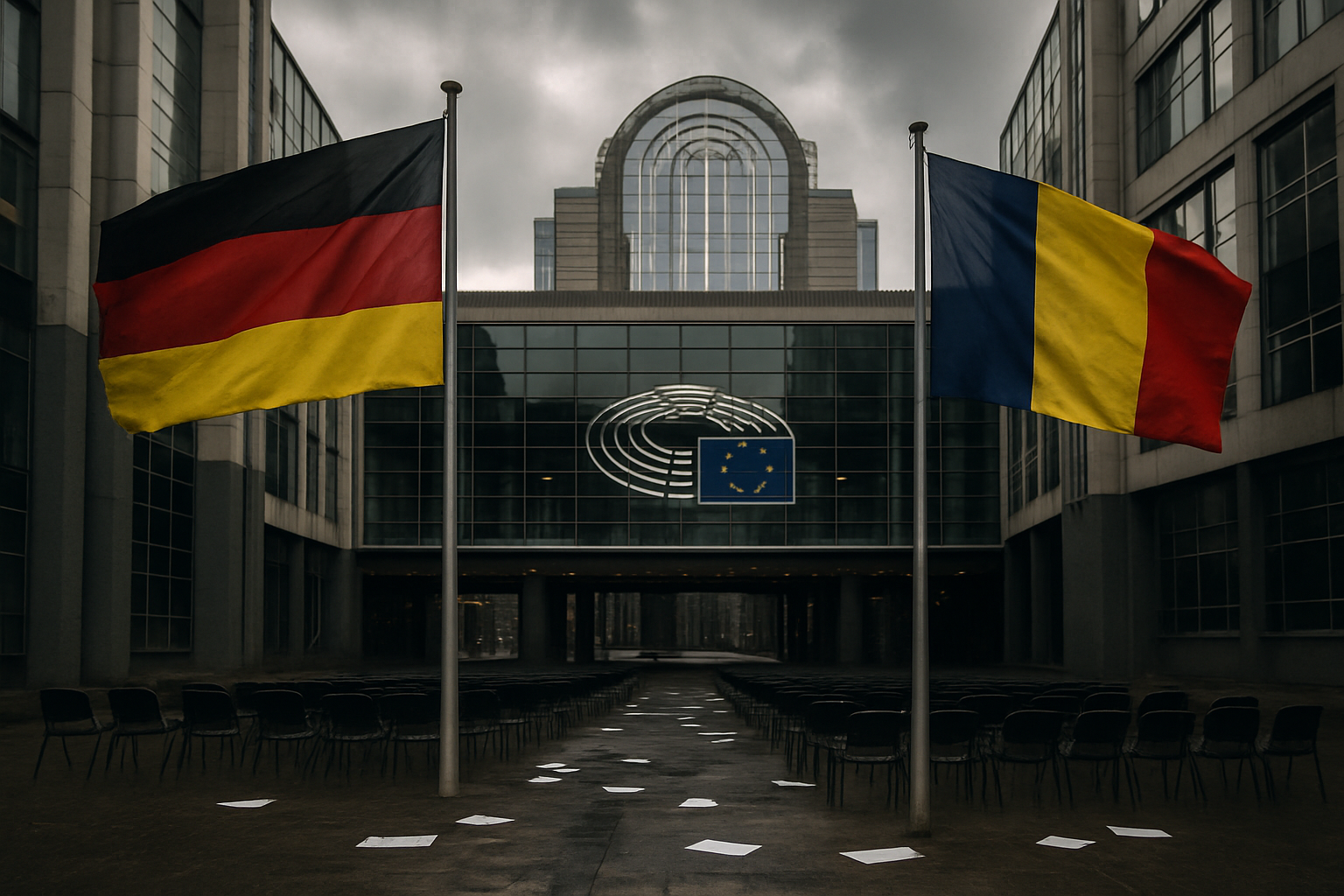
European political stability faces mounting pressures as German business leaders launch scathing attacks on government economic policy while Romania's fragile coalition government teeters on the brink of collapse amid budget disputes.
The latest developments underscore the continent's struggle with what European observers describe as "the most challenging period for continental democracy since World War II," with traditional coalition mathematics breaking down across multiple member states.
German Economic Competitiveness Under Fire
Rainer Dulger, President of the Confederation of German Employers' Associations (BDA), delivered a withering critique of Chancellor Friedrich Merz's economic policies, declaring that Germany's "production conditions are no longer competitive" on the international stage. The comments, made during a high-profile meeting in Munich, signal growing frustration within Germany's business community over the government's economic direction.
The criticism comes as Germany grapples with the aftermath of what analysts have described as approximately €940 billion in crisis costs since 2020, exposing structural weaknesses in Europe's largest economy. The export-driven model that powered German prosperity for decades now faces unprecedented challenges from global supply chain disruptions, energy security concerns, and intensifying international competition.
Dulger's remarks reflect broader business community concerns about regulatory burdens, energy costs, and infrastructure investments that have failed to keep pace with Germany's economic needs. The BDA chief's comments gain particular significance given the organization's influential role in shaping German economic policy through its close relationships with both government and trade unions.
Romanian Coalition Crisis Deepens
Meanwhile, in Bucharest, Romania's governing coalition faces its gravest threat yet as President Nicușor Dan confirmed he has signed the mass resignations of Social Democratic Party (PSD) ministers who withdrew from government in a dramatic bloc departure. The resignations represent a watershed moment for Romanian politics, potentially triggering the most significant governmental crisis in the country's recent democratic history.
The crisis stems from the PSD's withdrawal of political support from the ruling coalition, citing fundamental disagreements over budget priorities and the direction of economic policy. President Dan announced he would continue to serve as a mediator in efforts to resolve the political deadlock, though the path forward remains uncertain.
The timing of the Romanian crisis is particularly concerning given the country's strategic position in Eastern Europe and its role in supporting Ukraine amid ongoing regional security challenges. The governmental instability comes as Romania navigates complex relationships between EU fiscal requirements and domestic spending pressures, exposing the delicate balance required in modern European governance.
Broader European Democratic Strain
These developments occur against a backdrop of unprecedented political fragmentation across the European continent. Recent memory reveals a pattern of democratic institutions under severe strain, with 89% of Europeans demanding greater EU unity according to Eurobarometer polling, while political reality demonstrates increasing fragmentation across member states.
The pattern extends beyond Germany and Romania. Previous analysis has documented the emergence of what experts term "authoritarian innovation" – sophisticated far-right movements operating within democratic systems while gradually eroding liberal norms through electoral success rather than revolutionary violence. This phenomenon has proven more effective than traditional extremist strategies, maintaining democratic legitimacy while systematically undermining institutional safeguards.
In recent months, the continent has witnessed Sweden's Liberal Party abandoning decades of opposition to Sweden Democrats cooperation, Germany's Alternative for Deutschland nearly doubling support to 18% in Baden-Württemberg, and France grappling with the aftermath of political violence in Lyon. These developments collectively represent what senior EU officials describe as "writing the template for 21st-century crisis management."
Economic Policy Implications
The German business community's criticism reflects deeper concerns about Europe's economic competitiveness in an increasingly multipolar world. Traditional monetary policy tools have shown limited effectiveness against structural geopolitical disruptions, forcing governments to consider unprecedented market interventions.
Germany's economic challenges mirror broader European struggles with energy security, demographic changes, and the transition to sustainable technologies. The recent global energy crisis exposed dangerous over-dependence on strategic chokepoints, requiring fundamental restructuring of energy architecture that will take years or decades to implement effectively.
Romania's coalition breakdown illustrates the difficulty of managing competing domestic priorities while meeting European integration requirements. The tension between EU fiscal discipline and local political demands creates a complex balancing act that has proven challenging for governments across Eastern Europe.
International Coordination Challenges
The simultaneous crises in both Western and Eastern European capitals highlight the interconnected nature of contemporary political challenges. Success or failure in addressing these institutional strains will establish crucial precedents for democratic governance under complex global pressures.
European institutions have demonstrated fundamental resilience through maintaining free and fair elections, constitutional governance, and peaceful transitions despite unprecedented external and internal pressures. However, the coordination required for effective crisis management has become increasingly difficult as traditional coalition arrangements face pressure from changing voter preferences and external economic challenges.
The stakes extend far beyond immediate governance challenges. European responses to current political fragmentation will influence international cooperation mechanisms, regional stability frameworks, and democratic development trajectories worldwide. The continent's ability to channel political tensions through electoral competition while preserving institutional integrity could strengthen the European model globally.
Looking Forward
As German business leaders demand more competitive economic policies and Romanian political parties navigate coalition mathematics, the broader European project faces a critical test of institutional adaptation. The coming months will prove decisive in determining whether Europe can strengthen its democratic institutions through innovative governance approaches or will experience fragmentation that undermines the foundational cooperation principles underpinning European success since 1945.
The resolution of these crises will likely influence democratic governance models worldwide, as international observers monitor Europe's response to simultaneous economic, political, and institutional challenges. Success in managing current tensions while maintaining effective governance would provide valuable lessons for other democratic systems facing similar pressures in an increasingly complex global environment.