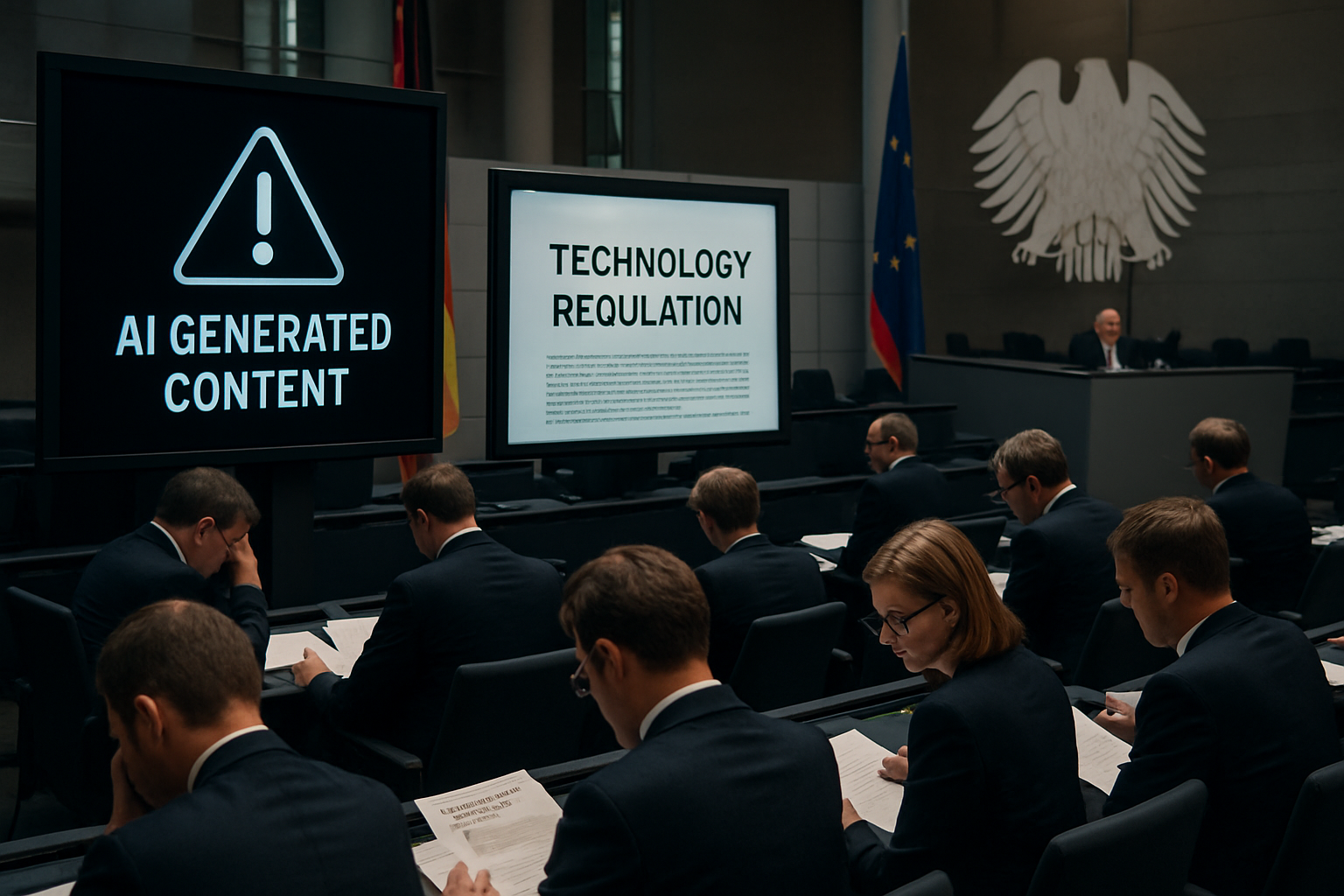
German lawmakers are preparing groundbreaking legislation to combat the surge in deepfake pornography, proposing stringent account restrictions and criminal penalties as part of a broader European crackdown on AI-generated sexual abuse content that has reached crisis proportions.
The proposed legislation comes as Germany joins an unprecedented international movement to address what experts are calling the "democratization of abuse" through artificial intelligence tools. The German measures would impose mandatory account restrictions on platforms hosting deepfake content and establish criminal liability frameworks similar to those already implemented in neighboring European countries.
The Scale of the Crisis
Recent investigations have revealed the disturbing prevalence of deepfake abuse across German-speaking communities. In online chat groups, men share photos of women from their immediate circles—colleagues, friends, ex-partners—and openly discuss how to transform these images into pornographic deepfakes using readily available AI tools.
The scope of the problem extends far beyond Germany's borders. UNICEF reports that 1.2 million children's images have been manipulated by AI systems globally, while research indicates that 96% of all deepfake videos online specifically target women. This represents what researchers describe as a systematic assault on digital dignity and personal autonomy.
"We are witnessing the industrialization of sexual violence through AI technology. What once required sophisticated technical skills can now be accomplished by anyone with a smartphone."
— Digital rights advocate cited in FAZ investigation
Germany's Legislative Response
The German government's proposed legislation addresses several critical gaps in current digital protection laws. Federal Justice Minister Stefanie Hubig has announced comprehensive measures that would criminalize the creation and distribution of non-consensual AI-generated intimate imagery, with penalties potentially reaching several years in prison.
Key provisions of the proposed legislation include:
- Mandatory account suspension mechanisms for platforms hosting deepfake abuse content
- Criminal penalties for individuals creating or distributing non-consensual AI-generated sexual imagery
- Enhanced victim protection measures and expedited content removal procedures
- Platform liability frameworks requiring proactive content monitoring and reporting
The legislation builds on the high-profile case of German actress Collien Fernandes, whose public advocacy against AI-generated sexual abuse following her experience with her ex-husband Christian Ulmen has galvanized public opinion and political action. Fernandes continues her advocacy work despite receiving death threats, becoming what Austrian media described as giving "a face to the fight against deepfake violence."
European Coordination and Global Leadership
Germany's initiative is part of a coordinated European response that represents the most sophisticated attempt at regulating AI-generated abuse content since the advent of deepfake technology. Latvia has already implemented the world's first comprehensive criminal penalties, with sentences up to seven years for non-consensual AI-generated intimate imagery, plus mandatory labeling requirements for all AI content.
Austria has launched major investigations into platforms enabling misogynistic deepfake content, while Spain has implemented the world's first criminal executive liability framework, creating personal legal risks for technology company executives who fail to adequately address harmful content on their platforms.
France has conducted cybercrime raids on major AI companies, and the European Commission is pursuing Digital Services Act violations against major platforms, with potential penalties reaching 6% of global revenue—potentially billions of dollars for companies like TikTok that have been found to use "addictive design" features that amplify harmful content.
The Technology Behind the Abuse
Investigators have documented how criminal networks are leveraging AI chatbots as "elite hackers," using automated systems for vulnerability detection, script writing, and coordinated data theft. The emergence of malware like "PromptSpy" demonstrates how AI algorithms can analyze user behavior in real-time to customize attack vectors for maximum effectiveness.
The current global semiconductor shortage, which has caused memory chip prices to surge sixfold, has created what experts describe as a "critical vulnerability window" lasting until 2027. This infrastructure crisis constrains the deployment of advanced security systems just as AI-enhanced criminal capabilities are expanding rapidly.
Impact on Victims and Society
Mental health professionals report unprecedented numbers of deepfake trauma cases, with symptoms consistent with severe psychological abuse. The targeting of women journalists, activists, and public figures has created a "chilling effect" on democratic participation, with many reducing their online presence due to fears of AI-enabled harassment.
Dr. Ran Barzilay's research at the University of Pennsylvania has documented the broader psychological impact of digital abuse, linking exposure to deepfake harassment with sleep disorders, cognitive decline, and social withdrawal—effects that can persist long after the initial abuse.
"The psychological impact of deepfake abuse is comparable to physical sexual assault. Victims report feeling violated, helpless, and fundamentally unsafe in digital spaces that have become essential for modern life."
— Mental health researcher studying deepfake trauma
Platform Accountability Revolution
The German legislation represents part of a broader "platform accountability revolution" sweeping Europe. Technology companies are facing mounting legal pressure across multiple jurisdictions, with governments arguing that voluntary self-regulation has proven inadequate to address the scale and sophistication of AI-enabled abuse.
Major platforms have experienced significant user trust erosion, with some seeing declines of over 3% in active users following high-profile security breaches and inadequate responses to deepfake abuse. The "SaaSpocalypse" of February 2026 eliminated hundreds of billions in technology market capitalization amid regulatory uncertainty and consumer confidence decline.
International Cooperation and Enforcement
The German initiative benefits from successful international cooperation models, including the LeakBase takedown that involved Dutch police, Europol, the FBI, and law enforcement agencies from 13 countries working together to dismantle the world's largest stolen data trading platform.
However, experts note that traditional enforcement mechanisms remain inadequate against digitally native criminal organizations that can instantly relocate operations across international borders and possess state-level technological resources.
Alternative Approaches and Global Perspectives
While Europe pursues regulatory enforcement, other regions have adopted alternative approaches. Malaysia emphasizes parental responsibility through digital safety campaigns, while Oman has implemented "Smart tech, safe choices" educational programs focusing on conscious digital awareness.
This philosophical divide between government intervention and individual agency in digital governance reflects broader questions about how democratic institutions can effectively regulate rapidly evolving technology while preserving innovation and individual rights.
Looking Forward: March 2026 as a Critical Inflection Point
Technology policy experts characterize March 2026 as a critical inflection point in the relationship between artificial intelligence and human rights. The success or failure of coordinated international responses like Germany's legislation will establish precedents for 21st-century governance of digital technologies that affect billions of people globally.
The stakes extend beyond individual privacy protection to fundamental questions about democratic participation, gender equality, and human dignity in digital societies. As one German policy expert noted, this represents a crucial test of whether democratic institutions can preserve human dignity in the age of artificial intelligence.
The window for effective coordinated action is narrowing as criminal capabilities advance faster than defensive measures. The decisions made in 2026 will likely establish the framework for human-AI relationships for decades to come, determining whether digital technologies serve human flourishing or become tools of systematic exploitation beyond democratic accountability.
Economic and Social Implications
The economic barriers created by deepfake abuse are particularly concerning for women's professional participation, as reputations become vulnerable to AI-generated attacks that can destroy careers and personal relationships. This creates a form of economic violence that extends far beyond the immediate psychological harm.
Consumer trust erosion is evident across the technology sector, with some major platforms experiencing significant user declines. The broader economic impact includes the "SaaSpocalypse" phenomenon, where hundreds of billions in traditional software market capitalization has been eliminated as AI demonstrates direct replacement capabilities for many digital services.
The German legislation represents not just a response to immediate harms, but an attempt to preserve the economic and social benefits of digital connectivity while establishing guardrails against abuse. Success will require unprecedented coordination between governments, technology companies, educational institutions, and civil society organizations.
As Germany prepares to implement these sweeping new protections against deepfake abuse, the international community watches closely. The outcome will likely determine whether democratic societies can effectively govern artificial intelligence or whether the technology will continue to serve as a tool for systematic harm against the most vulnerable members of society.