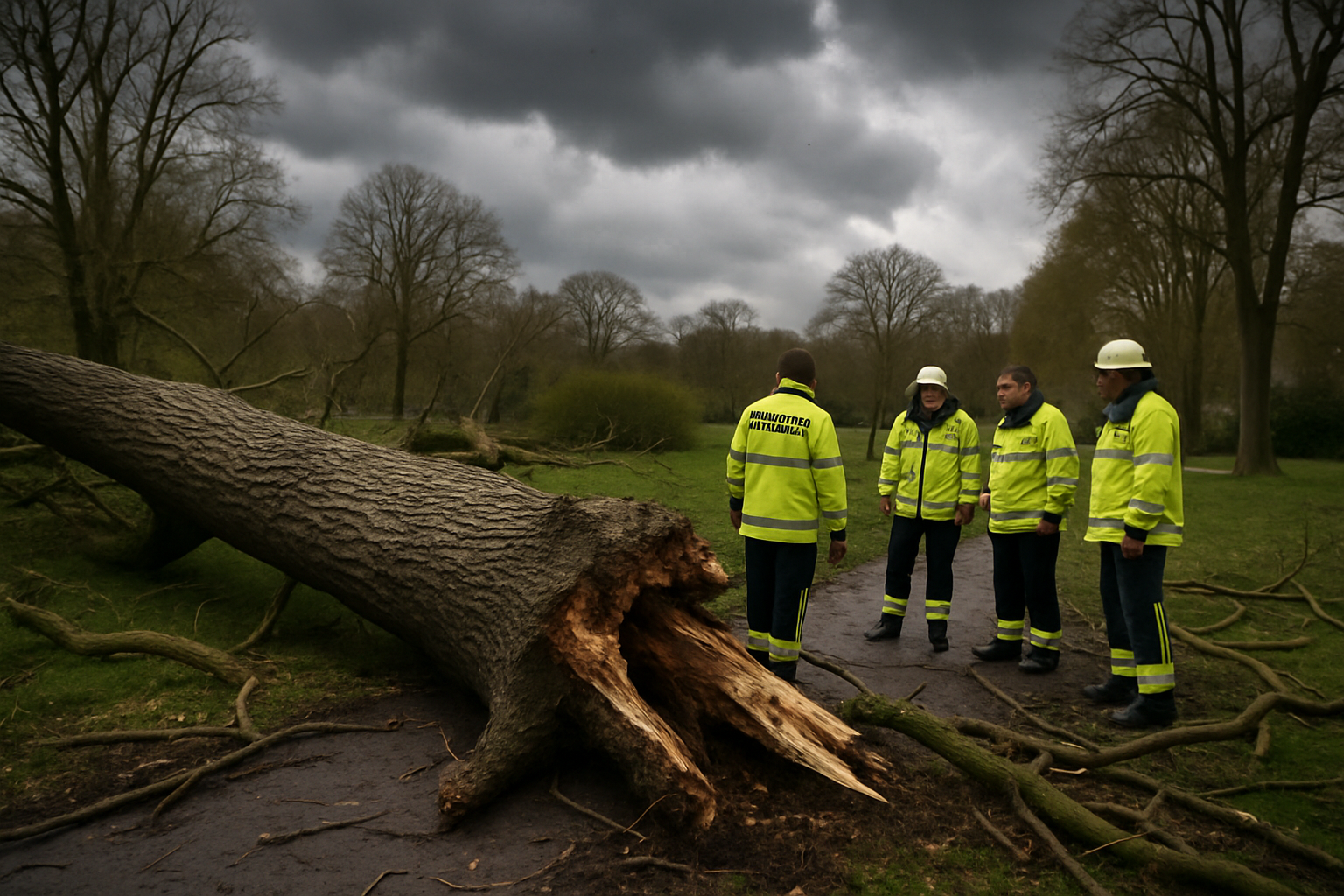
A tragic weather-related accident during Easter celebrations in northern Germany has claimed three lives, including a 21-year-old mother and her 10-month-old baby, when a large tree fell during an Easter egg hunt on Sunday.
The deadly incident occurred as families gathered for traditional Easter activities in a wooded area near Flensburg, northern Germany, during Storm Dave—the fourth named storm of 2026. Emergency responders rushed to the scene where approximately 50 residents and caregivers from a local residential facility were participating in the community Easter egg hunt when tragedy struck.
According to reports from German emergency services, the victims included a young mother and her infant, along with a teenage girl. The accident highlights the deadly risks posed by Storm Dave's hurricane-force winds, which have reached up to 90 mph across Northern Europe during what meteorologists describe as an extraordinarily dangerous Easter weekend.
Storm Dave's Devastating Impact
The tragedy in northern Germany represents one of the most heartbreaking casualties of Storm Dave, which has wreaked havoc across Northern Europe throughout Easter weekend. The storm has brought unprecedented conditions during what the World Meteorological Organization confirms is the 23rd consecutive month of global temperatures exceeding 1.5°C above pre-industrial levels—the longest sustained warming period in recorded human history.
Across the region, authorities have issued urgent warnings about the extreme danger posed by falling trees and debris. In Norway, 8,000 households lost power in southern regions, with authorities specifically warning residents to avoid parks and wooded areas due to the extreme risk of falling trees.
Swedish meteorological services reported similar hazards, with Nitzan Cohen of SMHI (Swedish Meteorological and Hydrological Institute) warning of "risk for stormbyar" (storm gusts) moving inland. The unusual severity of Easter weather conditions has forced many traditional outdoor celebrations indoors across Scandinavia.
Easter Celebrations Disrupted Across Europe
The German tragedy comes as Storm Dave has fundamentally disrupted Easter celebrations across Northern Europe. In Sweden, meteorologist Hilda Westberg described "low-pressure systems lining up," forcing Easter egg hunts indoors due to dangerous rain, cold, and snow conditions—highly unusual for this time of year.
Ireland's Met Éireann issued yellow wind warnings for all counties during the Easter weekend, with forecaster Gerry Murphy specifically warning that Donegal and northwest regions would be "worst hit" by very strong southerly winds veering westerly through the evening.
Denmark faced 11-meter waves that forced ferry cancellations to Norway, while the Storebælt Bridge implemented vehicle restrictions due to extreme winds. Transportation networks across the region have been severely disrupted during one of the busiest travel weekends of the year.
Climate Crisis Context
The deadly German incident occurs during what climate scientists describe as a "paradigm shift" in European weather patterns. Dr. Sarah Chen of the European Centre for Medium-Range Weather Forecasts has noted that sustained warming is enabling both temperature records and devastating regional extremes through disrupted atmospheric circulation and polar vortex instability.
Storm Dave represents the continuation of an unprecedented weather crisis that has plagued Europe throughout 2026. The current emergency builds on the devastating February 2026 Atlantic storm succession of Kristin-Leonardo-Marta-Nils-Pedro, which claimed 35+ lives across Portugal, Spain, and France and required 26,500 emergency personnel in Portugal's largest peacetime operation.
The European Union's Civil Protection Mechanism has been repeatedly activated, with Sweden and Denmark providing €246 million in assistance—the largest coordinated European weather response on record. However, experts warn that traditional mutual aid mechanisms are proving inadequate as simultaneous multi-national disasters overwhelm conventional emergency response frameworks.
Infrastructure Under Extreme Pressure
The tragic loss of life in northern Germany exemplifies the broader crisis facing infrastructure systems designed for historical rather than current climate conditions. Transportation networks, power grids, and communication systems across Northern Europe are operating beyond their design parameters as extreme weather repeatedly exceeds operational thresholds.
Emergency services throughout the region are operating at or beyond capacity limits. The frequency and intensity of severe weather events have fundamentally challenged traditional emergency response strategies, with authorities struggling to maintain adequate resources for simultaneous disasters across vast geographic areas.
"Building back better" with climate-resilient infrastructure has evolved from an optional enhancement to an essential survival strategy, according to emergency management experts. The traditional seasonal patterns that have guided infrastructure design, agricultural planning, and emergency preparedness for centuries are no longer reliable frameworks in this era of permanent climate volatility.
International Emergency Response
The German tragedy has prompted expressions of solidarity from across Europe as the continent grapples with the scale of Storm Dave's impact. Emergency services from multiple countries are sharing resources and expertise as traditional aid mechanisms strain under the pressure of simultaneous disasters.
Ibrahim Smajlović of the Bosnia Herzegovina Federal Hydrometeorological Institute warned that current conditions represent "just the introduction—the real storm is yet to come," highlighting the ongoing nature of this weather emergency across the continent.
The crisis demonstrates how environmental challenges transcend national boundaries, with atmospheric and ocean systems transporting effects globally regardless of borders. This reality is forcing unprecedented cooperation and enhanced coordination frameworks as traditional assumptions about stable regions assisting isolated emergencies break down.
A Watershed Moment for Climate Adaptation
April 2026 represents what experts describe as a watershed moment in the choice between reactive crisis management and transformative infrastructure adaptation. The German Easter tragedy, along with the broader Storm Dave crisis, underscores the critical need for fundamental changes in how societies prepare for and respond to extreme weather.
Climate scientists warn that current conditions provide a preview of routine circumstances expected in the 2030s without significant climate adaptation investment. The window for effective climate action continues to narrow as ecological systems approach critical thresholds that could trigger irreversible changes to global food security, climate stability, and human settlements.
Additional weather systems are developing in both Atlantic and Pacific regions, with authorities maintaining high alert levels across multiple continents. The persistence of such crisis conditions may establish a "new normal" of extreme weather frequency and intensity that permanently challenges traditional frameworks for emergency response and community safety.
Human Cost and Community Impact
Beyond the immediate tragedy of three lives lost, the German Easter incident represents the broader human cost of increasingly volatile weather patterns. Families across Northern Europe are facing the loss of generational properties, businesses are confronting extinction threats from repeated disruptions, and mental health services report increased demand related to climate anxiety and repeated weather trauma.
The psychological toll of ongoing climate volatility extends particularly to vulnerable populations, including elderly residents and children with respiratory conditions who are disproportionately affected by severe weather events. Recovery timelines have fundamentally shifted from traditional periods of weeks to months or years, representing a fundamental change in how communities must approach disaster response and resilience planning.
However, the crisis has also demonstrated remarkable community resilience, with neighbor assistance, volunteer mobilization, and local expertise playing crucial roles in emergency response operations. These examples provide templates for future preparedness that emphasize human adaptive capacity as essential to protecting environmental and social systems.
As authorities continue investigating the circumstances of Sunday's tragic accident, the incident serves as a stark reminder of the deadly serious nature of climate change's immediate impacts on daily life—transforming even cherished family traditions like Easter egg hunts into potential life-threatening situations in the era of extreme weather.