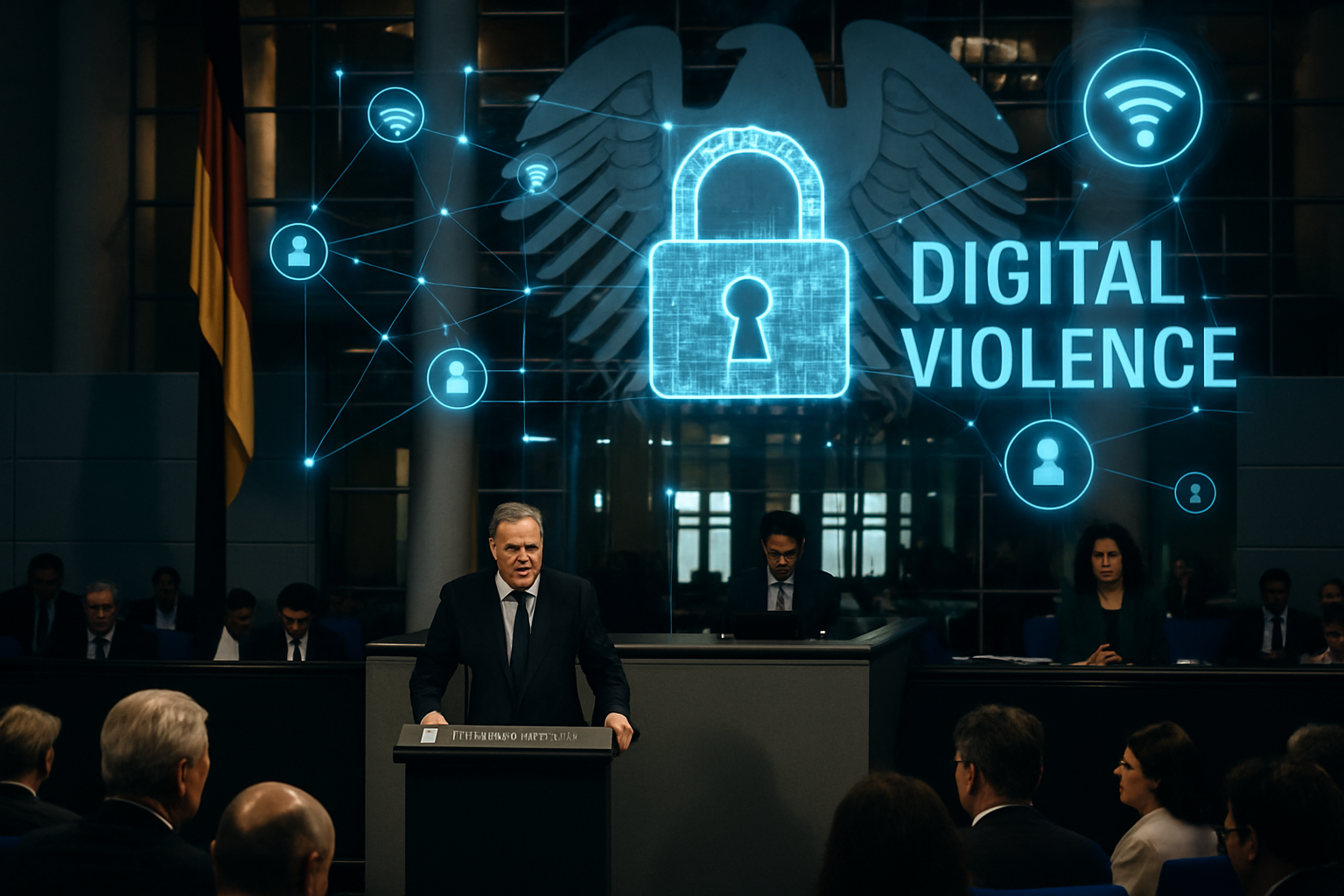
German politicians are intensifying calls for comprehensive legislation to combat digital violence and online harassment, following a series of high-profile cases that have exposed critical gaps in existing legal frameworks across Europe.
The push gained momentum after actress and presenter Collien Fernandes appeared on the ARD program "Caren Miosga" to discuss her experiences with digital harassment, including what she described as systematic online abuse. Federal Justice Minister Stefanie Hubig acknowledged significant "gaps in criminal law" during the broadcast, admitting that current German legislation fails to adequately address the evolving landscape of digital violence.
Growing Political Pressure for Reform
Fernandes' public testimony has galvanized political action across party lines, with lawmakers recognizing the urgent need for updated legislation that reflects the realities of digital-age harassment. The case has become symbolic of broader European struggles to address online safety, particularly as it affects women, minorities, and vulnerable populations.
"The current legal framework was not designed for the sophisticated forms of digital abuse we see today," explained a senior legislative aide familiar with the discussions. "What we're witnessing requires a fundamental rethinking of how we protect citizens in digital spaces."
The German government's response comes amid a broader European regulatory revolution targeting digital platforms and online safety. Spain has implemented the world's first criminal executive liability framework, creating personal imprisonment risks for technology executives who fail to adequately protect users. France has conducted major AI and cybercrime raids targeting platform inadequacies, while the European Commission is pursuing Digital Services Act violations worth billions in penalties.
European Coordination Against Digital Violence
Germany's push for stronger digital violence laws is part of unprecedented European coordination on technology regulation. The movement gained significant momentum following Australia's successful under-16 social media ban in December 2025, which eliminated 4.7 million teen accounts and proved that comprehensive age restrictions are technically feasible.
This success model has inspired coordinated European responses across multiple countries. Greece is implementing "Kids Wallet" under-15 restrictions, while France, Denmark, and Austria are conducting formal consultations on similar measures. The coordinated timing is designed to prevent "jurisdictional shopping," where platforms relocate operations to avoid oversight.
"We cannot allow the internet to become a lawless space where harassment and abuse flourish unchecked. The physical and digital worlds require equal protection under the law."
— Stefanie Hubig, German Justice Minister
The European approach reflects growing recognition that traditional reactive measures are insufficient against sophisticated digital harassment campaigns that can span multiple jurisdictions and platforms simultaneously.
Scientific Foundation for Policy Change
The legislative push is supported by mounting scientific evidence documenting the serious psychological and social impacts of digital violence. Recent research by Dr. Ran Barzilay at the University of Pennsylvania shows that 96% of children aged 10-15 use social media platforms, with 70% experiencing harmful content exposure and more than 50% encountering cyberbullying.
The study also reveals that early smartphone exposure before age 5 causes persistent sleep disorders, cognitive decline, and weight problems that can extend into adulthood. Children spending four or more hours daily on screens face a 61% increased risk of depression, primarily through sleep disruption and decreased physical activity.
These findings have influenced policy makers across Europe who are recognizing digital violence not just as a criminal justice issue, but as a public health crisis requiring comprehensive intervention strategies.
Industry Resistance and Implementation Challenges
The push for stronger digital violence laws faces significant resistance from technology companies, who argue that proposed regulations represent governmental overreach. Industry leaders including Elon Musk have characterized European measures as "fascist totalitarian" approaches, while Pavel Durov has warned of "surveillance state" implementations.
However, government officials are using this industry opposition as evidence supporting the regulatory necessity. The "SaaSpocalypse" of February 2026 eliminated hundreds of billions in technology market capitalization amid regulatory uncertainty, demonstrating the high stakes involved in these policy decisions.
Implementation faces significant technical challenges, particularly around age verification systems that require biometric authentication, raising legitimate privacy and surveillance concerns. The current global semiconductor shortage has created a "critical vulnerability window," with memory chip prices increasing sixfold, constraining the infrastructure needed for sophisticated verification systems until new fabrication facilities come online in 2027.
Alternative Approaches to Digital Safety
While European countries pursue regulatory enforcement models, other nations are experimenting with alternative approaches. Malaysia emphasizes parental responsibility through digital safety campaigns, with Communications Minister Datuk Fahmi Fadzil stressing that parents must control device access rather than using technology as "digital babysitters."
Similarly, Oman has implemented "Smart tech, safe choices" educational initiatives focusing on conscious digital awareness and teaching recognition of what officials call "digital ambushes" where attackers exploit security and curiosity.
This represents a fundamental philosophical divide in digital governance: government intervention versus individual agency, with different regions testing whether education-based or regulation-based approaches prove more effective in protecting citizens from digital violence.
International Cooperation Requirements
The transnational nature of digital violence requires unprecedented international cooperation mechanisms. Recent successful operations, including the LeakBase takedown coordinated by Dutch police, Europol, FBI, and 13 countries, demonstrate the potential for effective coordination against sophisticated criminal networks operating across borders.
However, traditional law enforcement approaches remain inadequate against digitally native criminal organizations that can instantly relocate operations across jurisdictions. Cross-border enforcement requires sophisticated legal frameworks that balance security needs with privacy protection and democratic oversight.
The German government is actively participating in efforts to establish comprehensive international frameworks for addressing digital violence, recognizing that national-level solutions alone cannot address the global scope of online harassment networks.
Economic and Social Implications
The digital violence crisis carries significant economic and social costs beyond immediate victim impact. Consumer trust erosion is evident, with companies like Coupang experiencing 3.2% user declines following data breaches and safety concerns.
Mental health professionals are reporting symptoms consistent with severe psychological abuse among victims of sophisticated digital harassment campaigns. Women are decreasing their online participation due to fears of AI-powered targeting, creating a "chilling effect" on democratic participation and economic opportunity.
Countries implementing prevention-focused digital safety strategies are demonstrating superior economic outcomes through reduced crisis intervention costs, improved community resilience, and enhanced workplace productivity. The economic benefits extend beyond healthcare savings to improved educational outcomes and decreased law enforcement involvement in mental health-related calls.
Critical Juncture for Digital Governance
March 2026 represents what experts are calling a critical inflection point for global digital governance. The convergence of high-profile cases like Fernandes', mounting scientific evidence, and coordinated international regulatory responses creates a unique window for comprehensive policy reform.
The success or failure of current legislative initiatives will establish precedents for 21st-century technology governance that could influence global approaches for decades. The stakes include fundamental questions about democratic accountability, individual rights protection, and national sovereignty in an increasingly connected world where digital and physical realities intersect in complex ways.
Success requires balancing technological innovation with safety governance, commercial interests with human welfare, and national competitiveness with international cooperation. The German government's commitment to addressing digital violence gaps represents a crucial test of whether democratic institutions can effectively regulate multinational technology platforms while preserving the digital connectivity benefits essential to modern economic and social life.
As Justice Minister Hubig acknowledged during the Miosga program, the challenge is not just legal but societal: creating frameworks that protect citizens from digital violence while preserving the open digital spaces that have become fundamental to democratic participation in the 21st century.