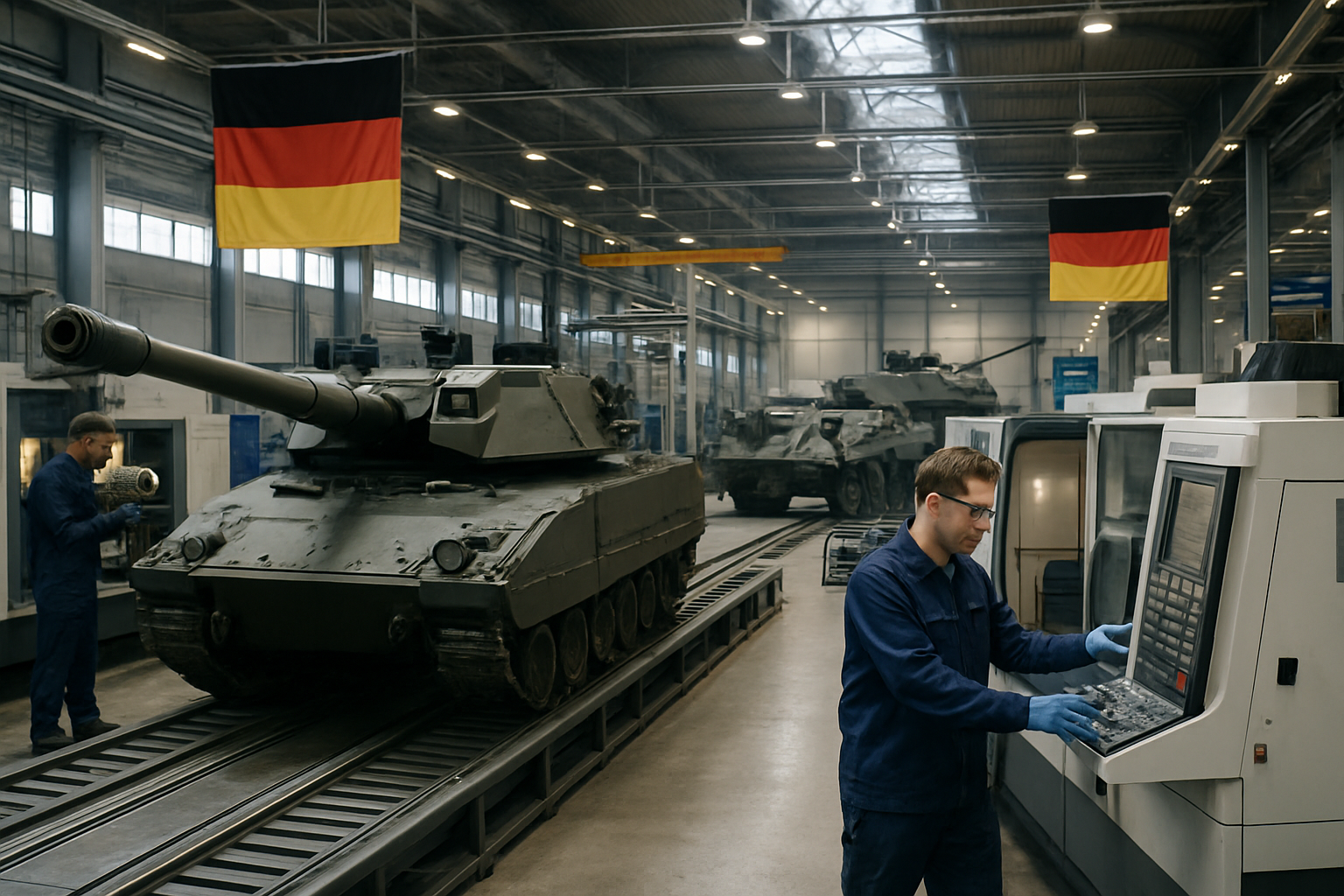
Germany is rapidly positioning itself as Europe's primary arms producer amid escalating regional security threats and unprecedented defense spending increases across the continent, marking a fundamental shift in the country's post-war military industrial policy.
The transformation comes as Europe faces its most complex security environment since the Cold War, with ongoing conflicts in Ukraine and the Middle East driving demand for advanced military equipment and forcing a reassessment of defense capabilities across NATO allies.
Germany's Military-Industrial Renaissance
According to recent data from the Stockholm International Peace Research Institute (SIPRI), Germany has surpassed China to become the world's fourth-largest arms exporter, a remarkable shift from its historically restrictive export policies. This dramatic rise reflects Germany's evolution from a reluctant defense contributor to a leading military technology provider.
The German defense giant Rheinmetall has announced the commencement of serial production of unmanned surface vessels at Hamburg port, representing a significant expansion into naval warfare technologies. This development follows the company's growing involvement in Ukraine's defense modernization program, where German companies have established multiple maintenance, repair, and overhaul (MRO) facilities.
Defense Minister Boris Pistorius has emphasized that "Germany must do considerably more for European security," signaling the government's commitment to expanding the country's defense industrial capacity beyond traditional limits.
European Defense Spending Reaches Historic Levels
The push for increased arms production occurs against the backdrop of record European defense spending. All 32 NATO members have achieved the alliance's 2% GDP defense spending target for the first time in the organization's 75-year history, representing combined spending of $1.4 trillion—a 6% increase from previous levels.
Europe has more than tripled its arms imports between 2021 and 2025, driving global weapons exports to a decade-high. This unprecedented demand is primarily driven by the ongoing conflict in Ukraine and rising tensions with Russia, which have fundamentally altered European threat perceptions.
Finland and Denmark are leading European procurement efforts, focusing particularly on air defense systems, artillery capabilities, and maritime defense technologies. Even traditionally neutral Austria is participating in collaborative military communication system development with Germany and other EU partners, describing it as a "Starlink alternative" for military communications.
Strategic Partnerships and Technology Transfer
Germany's transformation extends beyond domestic production to encompass comprehensive international partnerships. Recent agreements with Ukraine have established what officials describe as potentially "one of the largest drone production partnerships in Europe," combining German manufacturing expertise with Ukrainian battlefield experience.
These partnerships represent an evolution from traditional arms sales to comprehensive defense cooperation agreements involving joint development, technology transfer, and shared manufacturing capabilities. The model provides sustainable revenue streams while reducing European dependence on non-European defense suppliers.
"Ukrainian defense industry is the most innovative globally through battlefield necessity, and these partnerships leverage that experience with German manufacturing capabilities."
— Chancellor Friedrich Merz
Germany has also signed historic defense cooperation agreements with other European partners, including comprehensive frameworks covering security, defense, and economic recovery that extend beyond immediate military aid to encompass long-term strategic partnerships.
Response to Regional Crises
The acceleration of German arms production is directly linked to ongoing regional conflicts that have exposed European defense vulnerabilities. The suspension of Ukraine-Russia peace talks due to the Iran crisis has highlighted the interconnected nature of contemporary security challenges.
Germany's position as Europe's largest Ukraine aid provider—having delivered €55 billion since the invasion began—has established the country as a critical defense partner. This support includes not only financial assistance but also the establishment of military infrastructure, with four operational MRO facilities in Ukraine and a fifth planned.
The country's defense industrial expansion also responds to broader European strategic autonomy initiatives. Following Trump's criticism of NATO allies and demands for increased defense spending to 5% of GDP—more than double the current 2% requirement—European nations are accelerating independent defense capabilities.
Nuclear Policy and Extended Deterrence
Germany's defense transformation occurs amid unprecedented nuclear governance challenges. The expiration of the New START treaty in February 2026 created the first nuclear arms control void in over 50 years between the United States and Russia, who together control 80% of global nuclear weapons.
This crisis has prompted the first serious European nuclear deterrence discussions since the Cold War's end. Chancellor Merz has confirmed direct negotiations with French President Emmanuel Macron about expanding French nuclear deterrence beyond national scope—a historic policy development that could fundamentally reshape European security architecture.
These discussions reflect growing European concerns about the reliability of American security guarantees, particularly following repeated threats by President Trump to withdraw from NATO or fundamentally restructure alliance obligations.
Industrial Cooperation and Innovation
Germany's arms production expansion emphasizes collaborative development and joint manufacturing initiatives rather than traditional supplier-recipient relationships. This approach creates opportunities for European defense industrial integration while building competitive advantages in advanced military technologies.
The focus extends to emerging technology sectors including artificial intelligence, cyber warfare capabilities, and space-based defense systems. These represent priority areas for modern defense cooperation, moving beyond conventional weapons to encompass the full spectrum of 21st-century military requirements.
Joint development programs are becoming central to modern defense relationships, with civilian-military technology integration creating dual-use innovation opportunities that benefit both military and commercial sectors.
Economic and Political Implications
The expansion of German arms production carries significant economic implications beyond the immediate defense sector. The transformation is creating substantial employment opportunities and driving technological innovation across multiple industries.
However, this shift also represents a fundamental departure from Germany's post-war reluctance to become a major arms exporter. The change reflects the harsh reality of contemporary European security threats and the need for enhanced continental defense capabilities.
The success of German-led defense industrial cooperation could influence broader European Union defense policies and provide a template for enhanced cooperation mechanisms that bypass traditional unanimity requirements when faced with security emergencies.
Future Challenges and Opportunities
Germany's emergence as Europe's key arms producer faces several implementation challenges, including substantial investment requirements, regulatory approvals, and coordination within NATO and EU frameworks. Success requires navigating complex political sensitivities while maintaining alliance solidarity.
The long-term sustainability of increased defense spending levels remains a concern, with questions about avoiding arms race dynamics while maintaining military preparedness. Success depends on translating defense investments into broader industrial and technological benefits for civilian sectors.
Regional groupings and cooperation models are emerging beyond Europe as other regions observe these coordination frameworks. The German approach could provide a template for middle-power cooperation in an era of great power competition.
Global Strategic Impact
Germany's transformation into Europe's leading arms producer has implications extending far beyond continental boundaries. The shift affects global defense market dynamics, potentially reducing dependence on traditional suppliers from the United States and Russia.
Supply chain vulnerabilities exposed by recent geopolitical tensions are prompting European nations to diversify their defense supplier base, creating opportunities for expanded German production and export capabilities.
The integration of civilian-military technologies in German defense production is creating dual-use innovations with applications across multiple sectors, potentially influencing global technological development patterns for decades to come.
As Europe faces its most challenging security environment in generations, Germany's leadership in defense production represents both a response to immediate threats and a long-term strategic positioning for continental security independence. The success of this transformation will likely determine the trajectory of European strategic autonomy and the broader evolution of transatlantic security relationships in the coming decades.