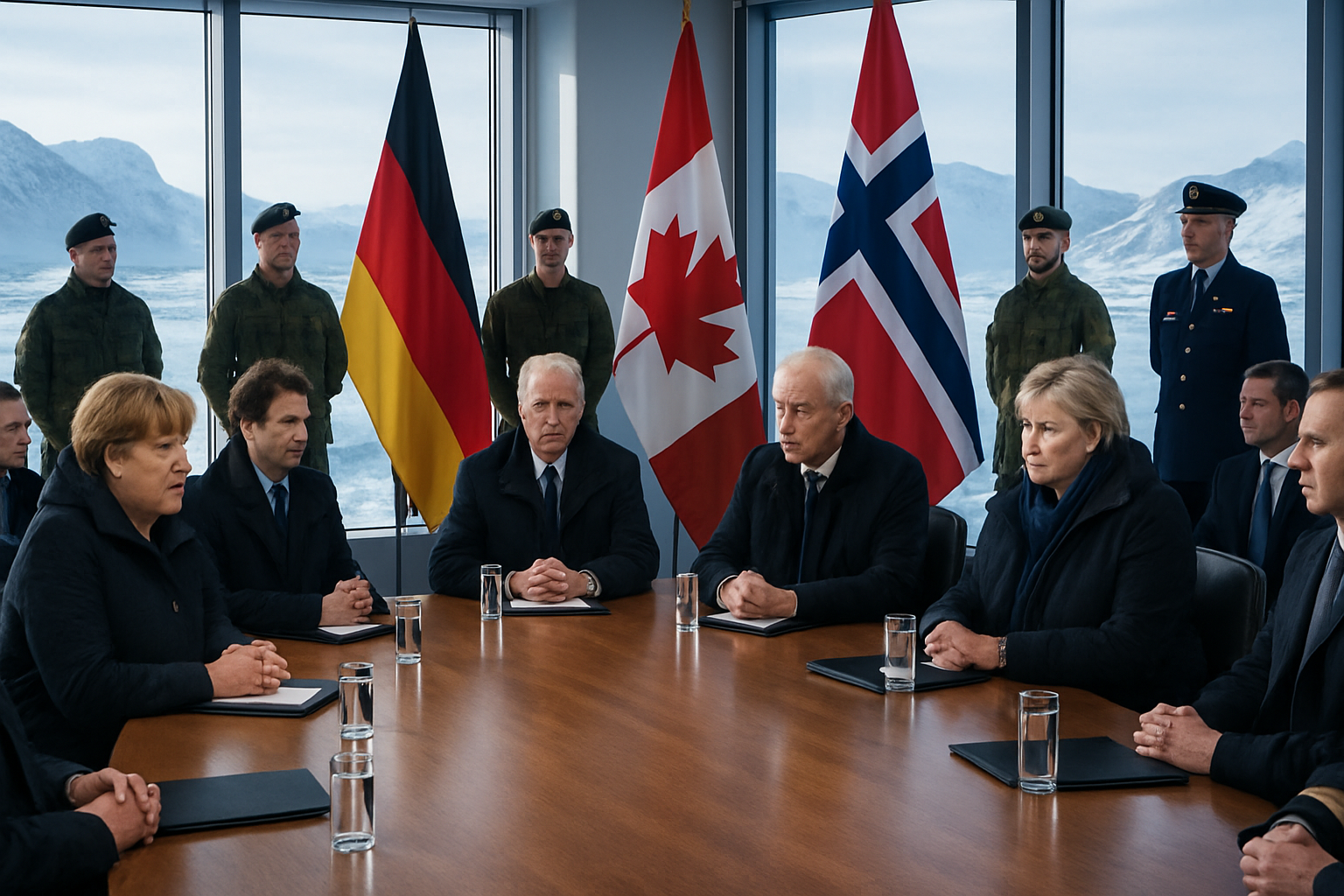
German, Canadian and Norwegian leaders convened in the Norwegian Arctic on Friday for unprecedented security talks, marking a decisive shift in Arctic defense strategy as global tensions and climate change transform the strategic importance of the circumpolar region.
The trilateral meeting, occurring against the backdrop of NATO's largest Arctic exercise, represents the most significant Arctic security cooperation initiative between these three nations since the Cold War. The summit comes as Arctic routes become increasingly accessible due to climate change, while heightened geopolitical tensions require new approaches to regional security.
Strategic Arctic Context
The meeting builds upon the comprehensive NATO Arctic Sentry mission launched in February 2026, which has seen European allies take unprecedented leadership roles in Arctic defense. The UK has doubled its troop presence in Norway from 1,000 to 2,000 soldiers over three years, while Sweden has deployed Gripen jets for Greenland exercises. Finland has contributed operational planning expertise, leveraging its extensive Arctic warfare capabilities.
This European-led initiative addresses multiple security challenges simultaneously: Russian re-establishment of Cold War-era Arctic military bases, Chinese Arctic research expansion, and the strategic implications of climate change opening new shipping routes and resource extraction opportunities.
"We are ready to protect the north,"
— Norwegian Prime Minister Jonas Gahr Støre
The Norwegian statement reflects broader Nordic concerns about Russian military activity, which has increased by 23% in 2025 according to regional intelligence assessments. This uptick coincides with Finland and Sweden's NATO membership, fundamentally altering the strategic balance in the Arctic region.
Canadian Arctic Investment Initiative
The timing of the trilateral meeting is particularly significant given Canada's recent announcement of a transformational $35 billion investment in Arctic defense and infrastructure. Prime Minister Mark Carney's declaration that Canada "can no longer rely on others for security" in the Arctic signals a fundamental shift toward Arctic self-reliance while maintaining alliance cooperation.
This investment represents the most significant expansion of Canadian military presence in the Arctic since the Cold War, encompassing Arctic surveillance systems, climate-resilient infrastructure, enhanced icebreaker capabilities, and specialized military equipment adapted for extreme Arctic conditions.
The "Build-Partner-Buy" framework prioritizes domestic capabilities while fostering substantial Indigenous community involvement and northern employment opportunities. The initiative includes research and development for Arctic-specific engineering solutions, addressing challenges such as permafrost thaw affecting traditional construction and shortened operational seasons.
German Arctic Strategy Evolution
Germany's participation in the Arctic security discussions represents a notable evolution in German foreign policy. Historically focused on European continental security, Germany now recognizes the Arctic's critical importance for global security architecture and economic interests.
The German approach reflects broader European strategic autonomy initiatives, including unprecedented nuclear deterrence discussions with France and enhanced European defense industrial cooperation. Germany's Arctic engagement complements its broader commitment to increasing defense spending to 5% of GDP by 2035, far exceeding NATO's 2% target.
Climate Change Security Nexus
The security cooperation initiative occurs as climate data shows the Arctic experiencing temperature increases at twice the global average. The region has seen 19 consecutive months of global temperatures exceeding 1.5°C above pre-industrial levels, with January 2026 recorded as the hottest month in history.
These changes are opening new Arctic shipping routes and exposing natural resources, creating what experts describe as a new domain of great power competition. The strategic implications extend beyond traditional military concerns to encompass resource competition, environmental protection, and Indigenous rights.
Norway's position is particularly critical for monitoring Russian naval activities and maintaining allied access to Arctic waterways. The country's geographic advantages provide essential surveillance capabilities for North Atlantic and Arctic Ocean security.
Alliance Burden-Sharing Evolution
The trilateral cooperation demonstrates significant evolution in NATO burden-sharing arrangements, with European allies assuming greater leadership roles in regional security operations. This addresses long-standing American calls for increased European responsibility while maintaining unified command structures under alliance frameworks.
The initiative builds upon successful British-Norwegian cooperation models, providing templates for other Arctic partnerships. Enhanced intelligence sharing frameworks, satellite surveillance systems, and maritime patrols create comprehensive monitoring capabilities adapted to contemporary security challenges.
"Arctic security requires specialized investment in extreme weather training and logistical support systems capable of operating in minus-40°C conditions."
— Defense Industry Analyst
Technology and Traditional Knowledge Integration
The cooperation framework emphasizes sophisticated synthesis of cutting-edge technology with traditional ecological knowledge and community-based management approaches. This integration proves most effective for conservation and security operations in the challenging Arctic environment.
Advanced monitoring systems designed for extreme Arctic conditions include equipment capable of operating in temperatures reaching -70°C with wind speeds exceeding 200 kilometers per hour. These systems provide real-time data transmission essential for coordinated security responses across vast Arctic territories.
Russian Response and Regional Dynamics
Russian officials have characterized Western Arctic security initiatives as "escalatory," threatening countermeasures if Greenland becomes militarized. Moscow's warnings reflect broader concerns about NATO's expanded Arctic presence and the strategic implications of enhanced Western cooperation in the region.
Russian Arctic military infrastructure restoration includes reopening Cold War-era bases and systematic expansion of reconnaissance operations. Intelligence reports indicate dramatic increases in Russian submarine incursions, GPS jamming incidents, and underwater cable sabotage attempts across the Nordic-Baltic region.
Economic and Industrial Implications
The Arctic security cooperation creates substantial economic opportunities beyond defense applications. Finland's €800 million lithium mining investment supports renewable energy transitions while reducing Chinese supply chain dependencies. Similar resource development projects, conducted responsibly, could provide sustainable employment while supporting security objectives.
Environmental protection functions as economic development strategy rather than regulatory burden in this framework. Arctic infrastructure investment creates lasting benefits through technological innovation, educational partnerships, and creative industry employment across participating nations.
Future Implementation Challenges
Successful implementation requires sustained political commitment across electoral cycles and sophisticated coordination among diverse Arctic stakeholders. The initiative must balance deterrent effects with diplomatic stability while managing great power competition in an increasingly contested domain.
Technical challenges include developing Arctic-specific military equipment, establishing reliable communication networks across vast distances, and creating logistical support systems capable of sustained operations in extreme conditions.
Global Strategic Implications
The Germany-Canada-Norway Arctic security cooperation establishes precedents for middle-power alliance coordination in strategic regions. Success could provide templates for other contested areas where climate change, resource competition, and territorial sovereignty intersect with great power rivalry.
The initiative represents practical implementation of European strategic autonomy while maintaining alliance relationships. Whether this approach leads to renewed Western unity through institutional adaptation or requires fundamental transatlantic relationship restructuring will influence global security architecture for decades.
As the Arctic continues its climate-driven transformation, the trilateral security cooperation framework offers a model for democratic nations adapting to 21st-century challenges while preserving territorial sovereignty, international law, and environmental stewardship principles essential for long-term regional stability.