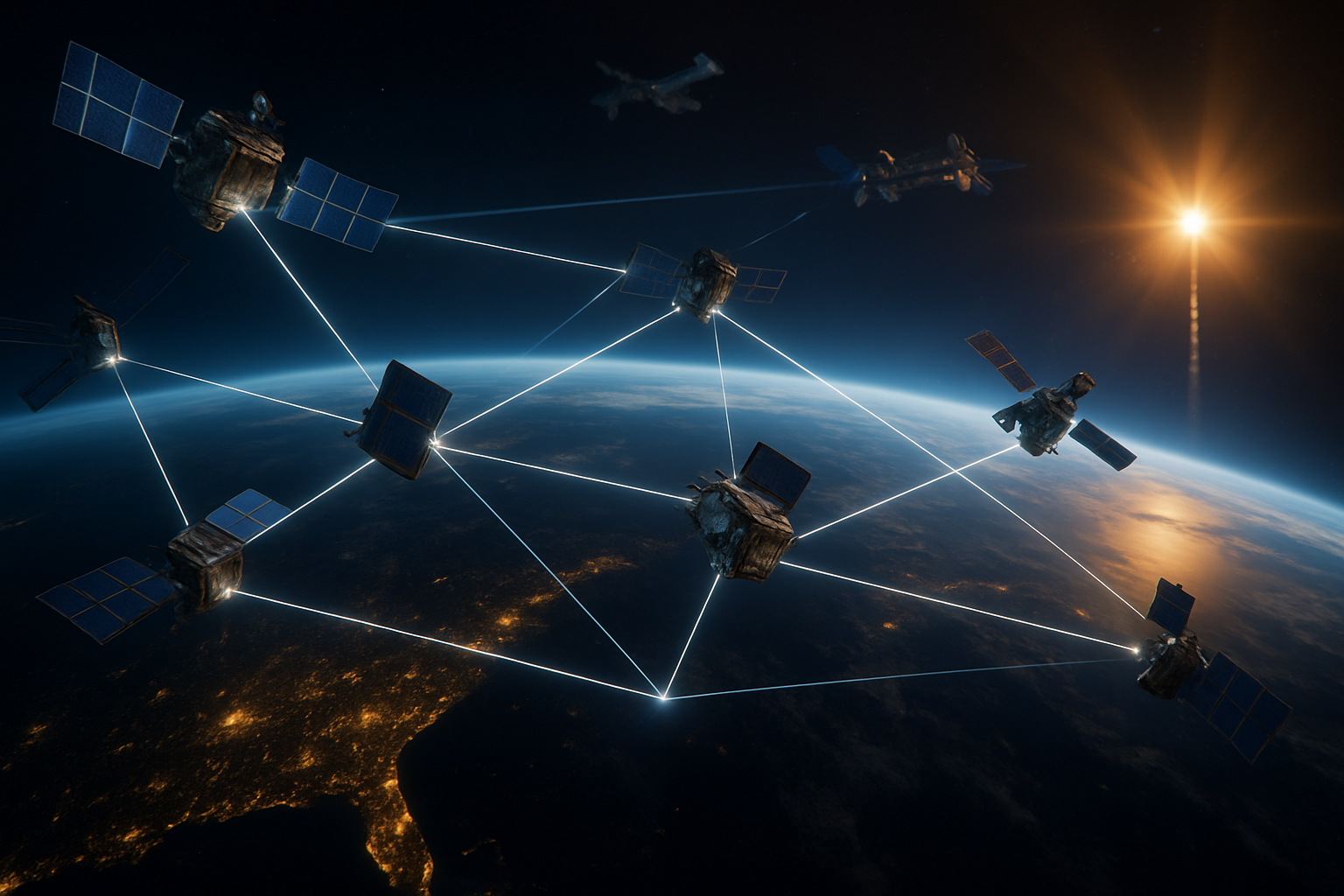
Germany's defense ministry is preparing to invest up to €10 billion in a new military satellite system, while Japan's private rocket sector faces continued technical challenges, highlighting the complex dynamics shaping the global space economy in 2026.
The developments come as the space industry transitions from what analysts call the "AI revolution" to the "space economy golden age," with nations racing to secure technological independence while commercial enterprises reshape traditional aerospace boundaries.
Germany's Strategic Satellite Initiative
Airbus has positioned itself as a leading contender for Germany's SATCOMBw 4 program, offering to establish new final assembly facilities within German borders. The satellite system, designed to serve as Germany's answer to SpaceX's Starlink constellation, represents one of Europe's most significant investments in space-based communications infrastructure.
The program reflects Germany's broader strategy to achieve technological sovereignty in critical defense communications. European nations have increasingly recognized the strategic vulnerability of depending on foreign satellite networks, particularly following demonstrations of commercial satellite systems' military applications in recent conflicts.
"This investment represents more than military capability—it's about ensuring European technological independence in space,"
— Defense Industry Analyst
The German initiative aligns with broader European space manufacturing expansion. Companies like Isar Aerospace are constructing testing facilities in Sweden capable of processing 30 rocket engines monthly, signaling Europe's drive toward launch independence from both American and Russian systems.
Japan's Private Space Sector Challenges
Meanwhile, Japan's private space ambitions face a different reality. The third launch attempt of the Kairos rocket in Kushimoto, Wakayama Prefecture, has been postponed due to unfavorable weather conditions—marking another delay in Japan's efforts to establish a competitive small satellite launch capability.
These setbacks occur despite Japan achieving significant breakthroughs in other technological sectors, including becoming the first country to approve commercialization of regenerative medicine products using induced pluripotent stem (iPS) cells. The contrast highlights the particular challenges facing space technology development, where weather dependence, technical complexity, and safety requirements create unique obstacles.
International Context and Competition
The German and Japanese developments unfold within an increasingly competitive international landscape. China continues advancing its Shenlong reusable spacecraft program, while SpaceX prepares for a potential June 2026 IPO that could value the merged SpaceX-xAI entity at over $1 trillion.
Recent memory from our analysis shows that February 2026 has already witnessed unprecedented space industry activity. NASA's Artemis II mission faces continued delays due to hydrogen leak technical challenges, pushing the first crewed lunar flyby since 1972 to at least April 2026. The International Space Station has seen crew rotations including French astronaut Sophie Adenot's historic eight-month mission, while Pakistan prepares to send its first astronaut to China's Tiangong station in October 2026.
Technological Sovereignty Trends
The global memory crisis—with semiconductor prices surging sixfold—has added urgency to space-based computing solutions. Nations and corporations are increasingly viewing space infrastructure not as experimental technology but as essential infrastructure for economic competitiveness and national security.
- European rocket testing facilities expanding across Sweden and Germany
- Thailand chairing UN space governance initiatives
- Emerging nations gaining space capabilities through strategic partnerships
- Commercial space sector preparing trillion-dollar valuations
Economic and Strategic Implications
The financial scale of current space investments reflects the sector's transformation from government-dominated programs to commercial enterprises driving innovation. Germany's €10 billion satellite commitment represents just one component of a global space economy that analysts project will exceed $1 trillion in coming years.
Space-based data centers are emerging as solutions to terrestrial infrastructure constraints, with companies exploring solar-powered extraterrestrial computing to address Earth's energy and cooling requirements. Elon Musk has predicted space-based AI data centers could become cost-effective within 36 months, citing continuous solar power and absence of atmospheric interference.
"We're witnessing the industrialization of space—moving from exploration to essential infrastructure that underpins modern civilization,"
— Space Industry Executive
Technical Challenges and Solutions
Both Germany's satellite ambitions and Japan's launch delays illustrate persistent technical challenges in space technology development. Weather dependence remains a crucial factor for launch operations, while complex systems integration requires extensive testing and validation procedures.
Recent breakthroughs in autonomous space operations offer potential solutions. NASA achieved historic success with fully AI-planned Mars rover missions in December 2025, demonstrating how artificial intelligence can enable real-time decision-making across cosmic distances. Similar technologies could enhance satellite operations and reduce ground-based control requirements.
Environmental and Regulatory Considerations
As space activity intensifies, environmental concerns are gaining prominence. Austrian scientists recently documented atmospheric pollution from rocket stage reentry, showing lithium concentrations elevated tenfold above normal levels. These findings highlight the need for sustainable space development practices as launch frequency increases globally.
International governance frameworks are evolving to address commercial space activities. The UN Scientific and Technical Subcommittee, chaired by Thailand, is developing new regulatory approaches for private sector space operations that extend beyond traditional government-era space law.
Future Trajectory
The contrasting fortunes of Germany's ambitious satellite program and Japan's rocket development challenges reflect broader themes shaping 2026's space landscape. Success increasingly depends on sustained investment, international cooperation, and technological innovation that addresses both capability requirements and environmental responsibilities.
As nations pursue space-based technological sovereignty, the industry faces critical decisions about sustainable development, international collaboration, and the balance between commercial competition and shared scientific advancement. The outcomes of current initiatives—from Germany's satellite network to Japan's launch capabilities—will significantly influence global space industry development for decades ahead.
With space infrastructure becoming essential rather than experimental, 2026 represents a watershed moment determining which nations and companies will lead humanity's expanding presence beyond Earth's atmosphere. The stakes extend beyond national prestige to fundamental questions about technological independence, economic competitiveness, and sustainable development in the space age.