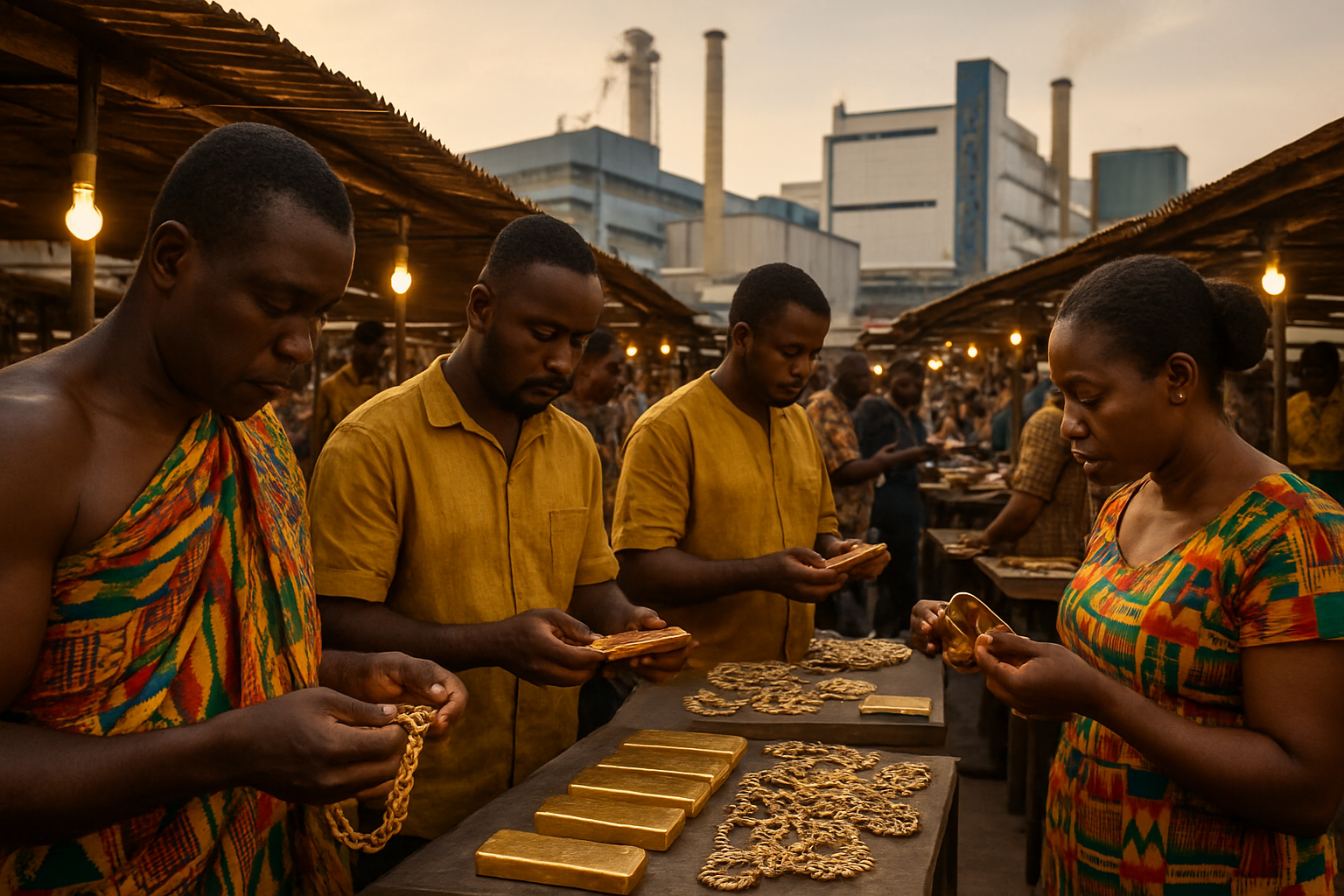
Former Chief Justice Sophia Akuffo has emerged as a powerful voice for Ghana's economic transformation, advocating for the establishment of a vibrant local gold market and comprehensive industrial reset that could position the West African nation as a regional powerhouse through value addition rather than raw material exports.
Speaking on Joy News' PM Express Business Edition, Akuffo delivered a compelling case for why Ghana must stop exporting raw gold and instead build robust domestic processing capabilities. "It's never too late. It's never too late," she declared with conviction. "I am in full agreement with the President on that."
The Vision: From Raw Exports to Value Creation
Drawing from her extensive lifetime experience, Akuffo articulated how she has witnessed firsthand the transformative power of value addition in Ghana's economy. "I have seen within this country, in my lifetime, where from whatever processing, raw processing of raw materials, few, what can be done, the industries that get spun off," she explained.
The former Chief Justice's vision encompasses far more than simple gold processing. She envisions comprehensive industrial ecosystems that emerge from strategic value addition, creating ripple effects throughout the economy. "Even with the main product, in respect of which the main industry exists, what benefits it gives, what volumes you can export, how you can conquer markets within the region, within the continent, and even across to other parts of the world."
"If we had kept going with that concept of value addition, we would be very far ahead of where we are now."
— Sophia Akuffo, Former Chief Justice
Historical Context and Lost Opportunities
Akuffo's assessment reveals a sobering truth about Ghana's economic trajectory. The country once possessed a clear path to industrial growth but abandoned crucial value-addition strategies that could have transformed its economic landscape over decades. This failure to sustain industrial development represents what she characterizes as "decades of industrial progress" lost to short-term thinking.
The timing of this call for economic reset occurs within a broader continental context of unprecedented African mining investment. According to African Finance Corporation data, the continent holds $29.5 trillion in mineral reserves—representing 20% of the global total—with $8.6 trillion remaining untapped. Recent major investments across Africa include Ivory Coast's $1.2 billion gold projects, South Africa's R325 million rare earth commitment, and Burkina Faso's record 94-ton gold production generating over $6 billion in revenue during 2025.
The Dubai Model: Lessons in Strategic Positioning
While Akuffo references Dubai's economic transformation as an inspirational model, the lessons extend beyond simple replication. Dubai's success stemmed from leveraging its strategic geographical position, creating world-class infrastructure, and establishing itself as a regional hub for finance, trade, and services. For Ghana, the equivalent strategy involves capitalizing on its significant gold reserves, established mining expertise, and strategic West African location.
Ghana's potential advantages include its political stability, established mining sector, and growing regional influence within the African Continental Free Trade Agreement (AfCFTA) framework. The nation could position itself as West Africa's precious metals processing hub, similar to how Dubai became the Middle East's commercial gateway.
Continental Integration and Strategic Timing
Akuffo's advocacy comes at a particularly strategic moment for African economic development. The continent is experiencing what analysts describe as an "infrastructure renaissance," with hundreds of billions in investment flowing toward mining, transportation, and industrial development projects. Seven African countries—Angola, DRC, Guinea, Kenya, Morocco, Sierra Leone, and Zambia—are participating in the US-EU-Japan Critical Minerals Partnership, challenging China's 60% production and 90% refining dominance in critical materials.
Ghana's mining sector has already demonstrated significant potential. The recent revival of the Bogoso-Prestea Mine under Heath Goldfields management, achieving its first gold pour after a 24-month shutdown, illustrates the resilience of Ghanaian mining capabilities when properly managed. Managing Director Patrick Appiah Mensah described the revival as demonstrating "resilience and responsible Ghanaian leadership."
Implementation Challenges and Opportunities
Creating a vibrant local gold market requires addressing several complex challenges. Current mining operations focus primarily on extraction for international export, with limited domestic processing infrastructure. Establishing comprehensive value-addition capabilities demands significant capital investment, technical expertise, and supportive regulatory frameworks.
However, Ghana possesses several advantages that could accelerate this transformation. The nation's established mining sector provides foundational expertise, while its educational institutions—including the Kwame Nkrumah University of Science and Technology's Responsible AI Lab—demonstrate capacity for technological innovation. The country's recent approval of a comprehensive national AI strategy positions it well for incorporating advanced technologies into industrial processes.
Economic Multiplier Effects
The economic implications of Akuffo's proposed transformation extend far beyond the gold sector itself. Value-added processing creates employment opportunities across multiple skill levels, from technical operators to engineers and managers. Secondary industries emerge to support processing operations, including equipment manufacturing, logistics, and specialized services.
Regional market opportunities within the AfCFTA framework could provide substantial demand for processed gold products. As African countries increasingly seek to trade within the continent rather than exporting raw materials elsewhere, Ghana could position itself as a preferred supplier of refined gold products for jewelry, electronics, and industrial applications.
Environmental and Social Considerations
Ghana's economic transformation must address ongoing environmental challenges, particularly the persistent problem of illegal galamsey mining that has contaminated major rivers including the Pra, Ankobra, Offin, and Birim. Any comprehensive industrial strategy must incorporate environmental protection as a fundamental component, not an afterthought.
Sophisticated value-addition processing can actually improve environmental outcomes by enabling more efficient resource utilization, better waste management, and stricter regulatory oversight compared to informal mining operations. Modern processing facilities incorporate environmental compliance as standard practice, potentially serving as models for broader sector transformation.
International Cooperation and Strategic Partnerships
Successful implementation of Akuffo's vision requires strategic international partnerships while maintaining Ghanaian ownership and control. The country can leverage relationships with traditional partners while exploring new cooperation opportunities with emerging economies that have successfully developed their own value-addition industries.
China's announcement of zero-tariff access for 53 African countries starting May 1, 2026, creates significant opportunities for Ghanaian processed products to access the world's second-largest economy. Similarly, strengthened cooperation agreements with countries like Lebanon through Interior Minister Mohammed Muntaka Mubarak's recent meetings demonstrate Ghana's capacity for building diverse international partnerships.
Technology Integration and Innovation
Modern gold processing and industrial development require sophisticated technology integration. Ghana's recent approval of its national AI strategy, developed through extensive consultation led by KNUST's Responsible AI Lab, positions the country to incorporate cutting-edge technologies into industrial development while respecting local values and priorities.
The integration of traditional mining knowledge with advanced processing technologies represents a model for authentic development that builds on existing strengths rather than imposing external solutions. This approach aligns with successful African development patterns that combine indigenous expertise with technological innovation.
Regional Leadership Potential
Ghana's successful implementation of comprehensive value addition could establish the nation as a model for other African countries seeking to transform their extractive industries. The country's democratic stability, established institutions, and regional influence position it well for demonstrating how resource-rich nations can capture greater value from their natural endowments.
Within the broader context of African integration, Ghana's success could contribute to continental value chain development, reducing Africa's dependence on exporting raw materials while importing finished products. This transformation aligns with AfCFTA objectives of increasing intra-African trade and industrial development.
The Path Forward
Former Chief Justice Akuffo's advocacy represents more than economic policy recommendations; it articulates a vision for Ghana's potential that builds on the nation's strengths while learning from both domestic experience and international success stories. Her emphasis that "it's never too late" reflects both optimism about Ghana's capabilities and urgency about seizing current opportunities.
The convergence of favorable continental trends, international partnership opportunities, and domestic capabilities creates a strategic window for implementing comprehensive economic transformation. Success depends on sustained political commitment, strategic investments in processing infrastructure, and maintaining focus on long-term development rather than short-term extraction profits.
As Ghana approaches this potential inflection point, Akuffo's vision offers a roadmap for transforming the nation from a raw material exporter into a value-added industrial economy. The question remains whether current leadership will embrace this comprehensive approach to economic development, building on the solid foundation that Ghana's democratic institutions and natural resources provide for sustainable prosperity.