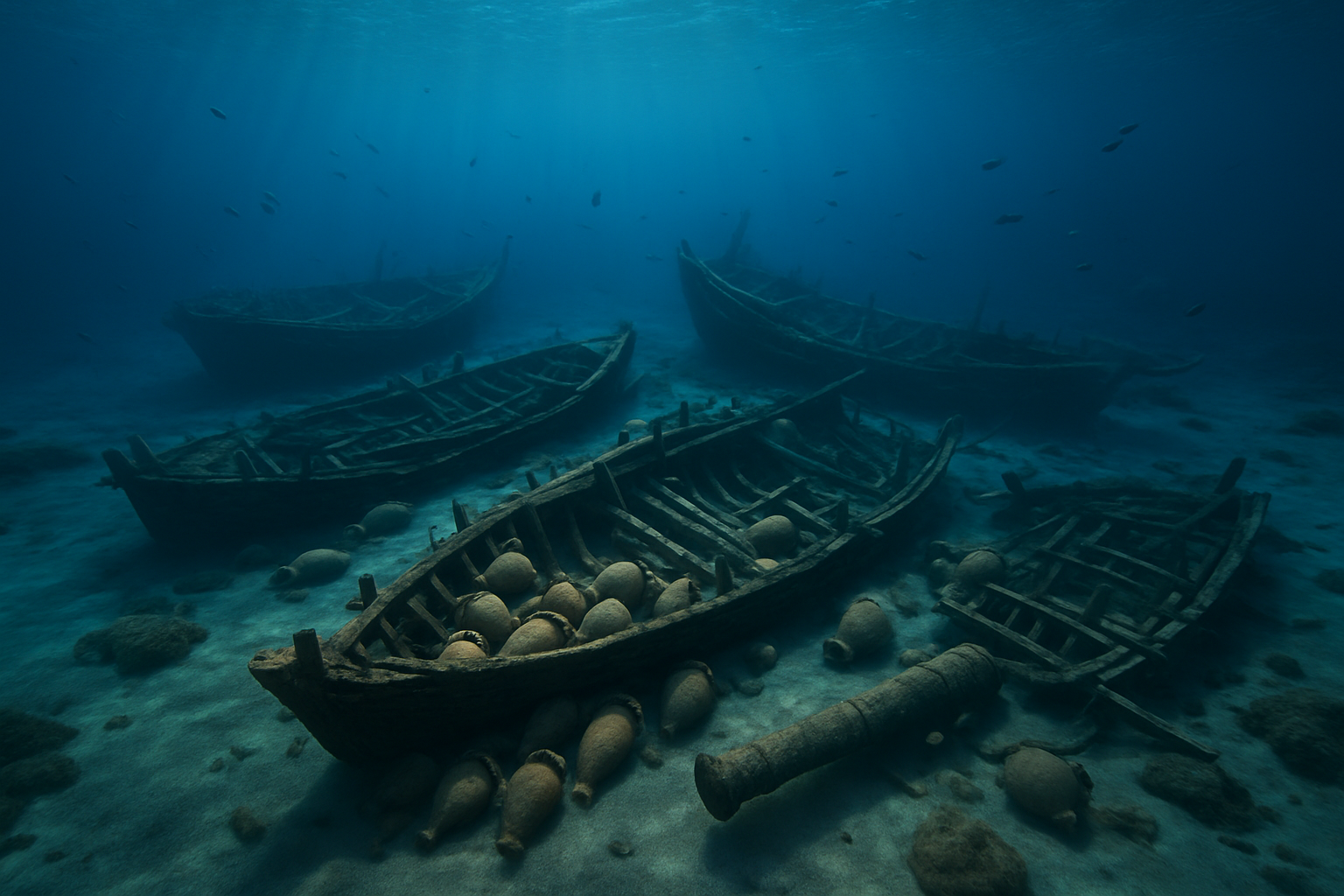
For millennia, the Strait of Gibraltar served as the narrow gateway between the Mediterranean and Atlantic worlds—a crucial bottleneck for global trade and a strategic battlefield for competing empires. Now, Spanish archaeologists have documented an extraordinary underwater cemetery containing 134 shipwrecks that tell the story of three thousand years of maritime history, from ancient Phoenician vessels to Spanish warships lost in battles with the British.
The discovery represents one of the most significant maritime archaeological finds in European waters, offering an unprecedented window into the evolution of naval technology, international commerce, and military strategy across multiple civilizations. However, researchers warn that time is running short to preserve these invaluable historical witnesses as climate change and port construction threaten their survival.
A Treasure Trove Spanning Millennia
The shipwreck collection documented by Spanish maritime archaeologists reveals the extraordinary strategic importance of the Gibraltar Strait throughout history. Among the 134 vessels identified lie Phoenician merchant ships that once carried precious goods between ancient trading posts, Roman galleys that transported legions across the Mediterranean, and Spanish naval vessels that fought desperate battles against British forces for control of this crucial maritime passage.
Each wreck tells a story of human ambition, technological innovation, and often tragic loss. The Phoenician vessels, dating back over 2,000 years, represent some of the earliest evidence of organized maritime trade networks that connected the ancient Mediterranean with Atlantic civilizations. These ships carried luxury goods, raw materials, and cultural influences that shaped the development of European and North African societies.
Roman galleys found among the wrecks provide insights into the military engineering that enabled Rome to dominate the Mediterranean for centuries. Their construction techniques, naval warfare adaptations, and cargo configurations reveal the sophisticated logistics systems that supported the Roman Empire's expansion across multiple continents.
The Spanish Naval Heritage
Perhaps most poignant are the Spanish warships lost during centuries of conflict with British naval forces for control of Gibraltar. These vessels represent a critical chapter in European maritime history, when naval supremacy determined global trade routes and colonial dominance. The archaeological evidence reveals the evolution of naval warfare technology, from early cannon-equipped galleons to more sophisticated ships-of-the-line.
The Spanish ships document the technological arms race that characterized European naval competition during the Age of Exploration and beyond. Their design features, armament configurations, and construction materials provide valuable insights into how naval engineers adapted to changing military requirements and technological innovations.
"This underwater cemetery represents an unparalleled archive of maritime history, with each wreck preserving unique evidence of technological development, international trade, and naval warfare across three millennia."
— Spanish Maritime Archaeological Team
Archaeological Methodology and International Cooperation
The documentation of these 134 shipwrecks exemplifies the sophisticated methodological approaches that characterize the ongoing "2026 Archaeological Renaissance." Spanish researchers employed advanced underwater survey techniques, including ground-penetrating radar adapted for marine environments, sophisticated sonar mapping, and chemical analysis of preserved materials.
Digital documentation systems enable global researcher access while preserving the original archaeological contexts. Three-dimensional mapping techniques create permanent records of each wreck's configuration, allowing scholars worldwide to study these sites without disturbing the delicate underwater environments that have preserved them for centuries.
This discovery builds on the broader pattern of remarkable archaeological breakthroughs occurring throughout 2026, from 5,000-year-old Egyptian drilling machines to 350,000-year-old fire control evidence in England. The convergence of traditional archaeological expertise with cutting-edge analytical technologies continues to reveal previously hidden aspects of human history and technological development.
Climate Change and Preservation Urgency
Despite the excitement surrounding these discoveries, Spanish archaeologists emphasize the urgent threats facing these underwater archaeological sites. Climate change effects, including rising sea temperatures, altered ocean currents, and increased storm intensity, threaten the delicate preservation conditions that have protected these wrecks for centuries.
Port construction and maritime development projects in the Gibraltar region pose additional risks to archaeological integrity. The combination of environmental pressures and human development activities creates an urgent timeline for comprehensive documentation and protective measures.
This preservation urgency reflects broader challenges facing archaeological sites worldwide. January 2026 marked the 18th consecutive month that global temperatures exceeded 1.5°C above pre-industrial levels, creating unprecedented threats to cultural heritage sites through extreme weather, environmental degradation, and accelerated deterioration processes.
International Cooperation and Future Research
The success of the Gibraltar shipwreck documentation project demonstrates the power of international archaeological cooperation. Spanish researchers collaborated with maritime archaeology experts from multiple countries, sharing expertise in underwater survey techniques, historical analysis, and preservation methodologies.
Future research directions include detailed analysis of individual vessel construction techniques, comparative studies with similar shipwrecks discovered in other Mediterranean and Atlantic locations, and comprehensive reconstruction of historical trade networks and naval strategies. Advanced chemical analysis of preserved organic materials may reveal information about ancient diets, trade goods, and technological innovations.
The project also provides templates for collaborative archaeological research that respects local cultural heritage while enabling global knowledge sharing. Digital documentation ensures that findings remain accessible to international scholars while protecting the physical sites from disturbance.
Economic and Cultural Implications
The Gibraltar shipwreck discoveries are expected to generate substantial benefits for cultural tourism, educational partnerships, and enhanced international recognition of Spain's archaeological research capabilities. The underwater archaeological sites position the region as a premier destination for maritime heritage tourism, contributing to sustainable economic development while preserving invaluable cultural resources.
Educational implications extend beyond tourism revenue to include specialized graduate programs, international summer schools, and community education initiatives that connect local residents with their maritime heritage. These discoveries strengthen Spain's position as a leader in underwater archaeological research and heritage preservation.
The economic benefits demonstrate how archaeological research functions as strategic infrastructure, comparable to transportation and communication systems in terms of long-term community value. Countries investing in comprehensive heritage preservation consistently demonstrate superior returns through cultural tourism, international partnerships, and enhanced global competitiveness.
Legacy of the Ancient Maritime Crossroads
The 134 shipwrecks near Gibraltar represent far more than individual archaeological discoveries—they constitute a comprehensive archive of human maritime achievement and international interaction spanning three millennia. From Phoenician merchant ventures to Roman imperial expansion to European naval conflicts, these underwater sites preserve evidence of humanity's continuous efforts to master oceanic travel and expand global connections.
As researchers work urgently to document and preserve these remarkable archaeological treasures, they race against environmental threats that could destroy evidence of humanity's shared maritime heritage. The Gibraltar ship graveyard serves as both celebration of human seafaring achievement and urgent reminder of our responsibility to protect cultural heritage for future generations.
The successful documentation of these sites demonstrates that with adequate funding, international cooperation, and sustained commitment, archaeological research can unlock historical secrets that illuminate our understanding of technological development, cultural exchange, and human adaptation across the centuries. However, the window for effective preservation action continues to narrow as environmental pressures intensify, making immediate coordinated response essential for protecting these irreplaceable witnesses to human maritime history.