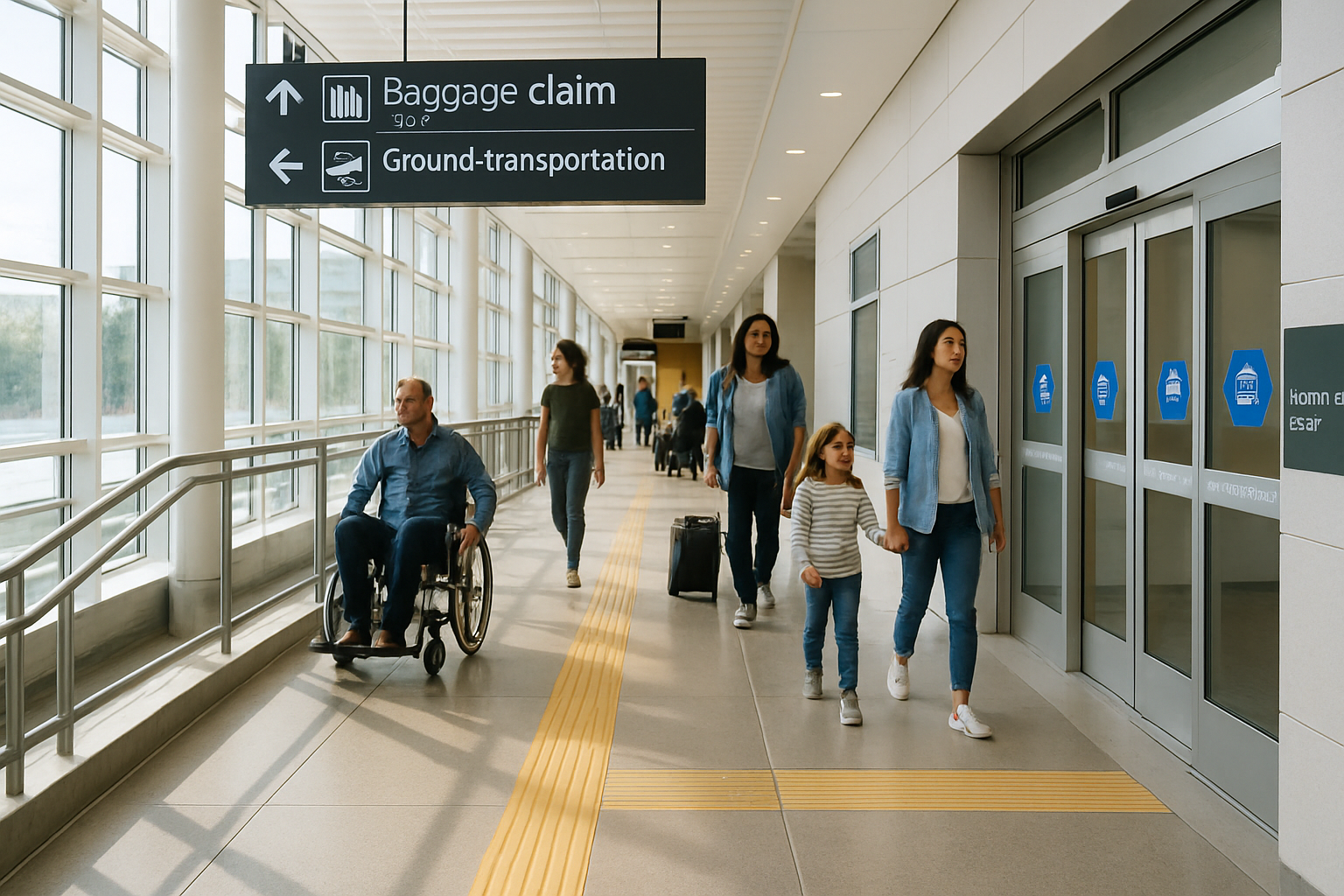
A global revolution in accessibility and disability services is reshaping public spaces and transportation infrastructure, with governments and organizations implementing comprehensive programs that move far beyond basic compliance to create truly inclusive environments for people with disabilities.
From Barbados' ambitious "Access for All" building program to Hong Kong International Airport's pioneering sensory corner for neurodivergent travelers, new initiatives are fundamentally transforming how public spaces accommodate people with disabilities. These developments represent a significant shift from reactive accommodation to proactive inclusive design, setting new international standards for accessibility.
Barbados Leads Caribbean Accessibility Transformation
The Government of Barbados has unveiled one of the Caribbean's most comprehensive accessibility initiatives with the "Access for All" program, announced by Minister of People Empowerment and Elder Affairs Adrian Forde during the opening of the Autism Association of Barbados' new headquarters at the Garrison, St. Michael.
The announcement, coinciding with World Autism Day under the theme "Autism and Humanity, Because Every Life Has Value," signals a fundamental shift in how Caribbean nations approach disability inclusion. The program aims to ensure universal access to all buildings across Barbados, moving beyond minimum compliance standards to create genuinely inclusive environments.
"This initiative represents our commitment to ensuring that every citizen, regardless of their abilities, can fully participate in all aspects of Barbadian society."
— Adrian Forde, Minister of People Empowerment and Elder Affairs
Complementing the building access program, Minister Forde announced dedicated funding for the Sidewalk Access Project, addressing one of the most fundamental barriers to independent mobility for wheelchair users and individuals with mobility impairments. This dual approach recognizes that true accessibility requires comprehensive infrastructure planning that considers the entire journey from street to building interior.
Hong Kong Airport's Neurodivergent-Friendly Innovation
Hong Kong International Airport has opened a groundbreaking 30-square-meter sensory corner designed to ease travel stress for passengers with invisible disabilities, ranging from autism to dementia. The facility joins a growing network of similar spaces at major international airports including Singapore Changi and London Heathrow, as part of a coordinated global effort to enhance aviation inclusivity.
Chris Au Young, the Airport Authority's general manager of terminal and passenger experience, emphasized the facility's role in supporting neurodivergent travelers who may experience sensory overload in busy airport environments. The sensory corner provides a controlled, calming environment where passengers can decompress before or after flights, featuring specialized lighting, comfortable seating, and sensory tools designed by occupational therapy specialists.
This initiative reflects a broader understanding within the aviation industry that accessibility extends far beyond physical accommodations to include cognitive and sensory considerations. As airports become increasingly complex environments with multiple stimuli, facilities like Hong Kong's sensory corner represent essential infrastructure for ensuring equitable travel experiences.
Global Context: The Accessibility Infrastructure Renaissance
These developments occur within what accessibility experts are calling the "Accessibility Infrastructure Renaissance of 2026" – a coordinated international movement toward inclusive design principles that goes far beyond traditional disability accommodation approaches. This transformation builds on years of advocacy work and represents a maturation of accessibility thinking from compliance-based to human-centered design.
Previous initiatives documented in our coverage show this is part of a broader pattern. In March 2026, Algeria announced comprehensive accessibility equipment for new public buses, including automatic ramps, designated wheelchair spaces, audio-visual systems, and tactile guidance elements. The Philippines implemented accessibility enhancements for the Mount Kamuning footbridge in Quezon City, though community feedback highlighted ongoing challenges in ensuring genuine usability versus symbolic compliance.
Similarly, transportation infrastructure developments across the globe have increasingly incorporated accessibility as a core design principle rather than an afterthought. From Croatia's 600,000 accessible housing units to Uganda's inclusive healthcare initiatives, nations are recognizing that accessibility improvements benefit entire communities, not just people with disabilities.
Technology Meets Inclusion: The Digital Accessibility Revolution
Modern accessibility initiatives increasingly leverage sophisticated technology to create more inclusive environments. The Hong Kong sensory corner incorporates advanced lighting systems that can be adjusted for different sensory needs, while Barbados' "Access for All" program will utilize digital monitoring systems to ensure ongoing compliance and maintenance of accessibility features.
This technological integration reflects broader trends seen in countries implementing smart city initiatives. Estonia's 88% renewable electricity transportation systems include accessibility monitoring, while Singapore's comprehensive digital government services (approaching EU averages) incorporate universal design principles ensuring equitable access regardless of ability or technical literacy.
However, the global semiconductor crisis that has driven memory chip prices sixfold higher until 2027 has created challenges for technology-dependent accessibility solutions. This has paradoxically driven innovation toward more sustainable, human-centered approaches that enhance rather than replace fundamental accessibility principles.
Economic and Social Impact of Accessibility Investment
The economic implications of comprehensive accessibility programming extend far beyond initial implementation costs. Research from successful accessibility initiatives shows significant returns through increased workforce participation, reduced healthcare costs, and enhanced community resilience.
Algeria's transportation accessibility improvements support workforce participation for citizens with disabilities, while the Philippines' infrastructure modifications, despite implementation challenges, have demonstrated measurable benefits for broader community mobility. These projects create employment during construction phases while generating long-term economic benefits through enhanced accessibility.
International cooperation is increasingly crucial for sharing best practices and coordinating standards. The European Union's accessibility directive has influenced policy development globally, while organizations like the International Association of Airport Operators are facilitating knowledge sharing about inclusive airport design.
Implementation Challenges and Success Factors
Despite these positive developments, accessibility initiatives face significant implementation challenges. The Philippines' experience with the Mount Kamuning footbridge highlighted the gap between compliant design and genuine usability, requiring ongoing community feedback and adaptive management approaches.
Successful programs demonstrate several critical factors: sustained political commitment extending beyond electoral cycles, comprehensive community engagement with disability organizations, adequate funding for both implementation and ongoing maintenance, and robust monitoring systems to ensure continued accessibility over time.
The global construction industry crisis, with material costs creating negative developer profit margins, has affected accessibility projects worldwide. However, this has also driven innovation toward cost-effective solutions that often prove more sustainable and user-friendly than technology-heavy alternatives.
International Cooperation and Standards Development
The success of accessibility initiatives increasingly depends on international cooperation and standards harmonization. Hong Kong's sensory corner draws on research and best practices from autism organizations worldwide, while Barbados' "Access for All" program incorporates Caribbean-specific considerations while meeting international accessibility standards.
This cooperation extends to technical assistance and knowledge sharing networks. Countries implementing prevention-first healthcare strategies have found that accessibility improvements reduce long-term social service demands while improving population health outcomes. The economic benefits include enhanced community resilience, reduced emergency service costs, and improved workforce productivity.
Regional cooperation frameworks are particularly important for smaller nations like Barbados, which can leverage shared experiences and resources with other Caribbean countries while contributing unique insights about accessibility in tropical climates and tourism-dependent economies.
Future Directions: Climate Resilience and Accessibility
As the world experiences the 20th consecutive month of temperatures exceeding 1.5°C above pre-industrial levels, accessibility planning must increasingly incorporate climate resilience considerations. This includes ensuring accessibility features function during extreme weather events and that emergency evacuation procedures accommodate all community members.
Barbados' location in the hurricane belt makes climate-resilient accessibility particularly crucial, while Hong Kong's airport sensory corner must function effectively during the increasing frequency of extreme weather events that can disrupt travel schedules and increase passenger stress.
The convergence of accessibility planning with climate adaptation represents an emerging challenge requiring innovative solutions. Successful projects demonstrate that well-designed accessibility features often enhance overall infrastructure resilience, creating benefits that extend far beyond disability accommodation.
Measuring Success: Beyond Compliance to Inclusion
The most successful accessibility initiatives measure impact through user experience rather than simple compliance metrics. Hong Kong's sensory corner success will be evaluated through passenger feedback and utilization rates, while Barbados' "Access for All" program includes ongoing community consultation to ensure real-world effectiveness.
This human-centered evaluation approach reflects broader trends in public policy toward outcome-based rather than process-based success metrics. Countries implementing comprehensive accessibility programs report improved social cohesion, economic benefits, and enhanced international reputation as inclusive destinations for business and tourism.
As these initiatives mature, they provide valuable templates for other nations developing accessibility policies. The combination of technological innovation, community engagement, and sustained political commitment demonstrated by both Barbados and Hong Kong offers models adaptable to different cultural and economic contexts while maintaining core principles of universal access and human dignity.
The global accessibility revolution of 2026 represents more than policy change – it embodies a fundamental shift toward recognizing accessibility as essential infrastructure for human flourishing in diverse societies. From Caribbean building standards to Asian airport design, these initiatives establish foundations for more inclusive communities that benefit all citizens while ensuring no one is left behind in an increasingly connected world.