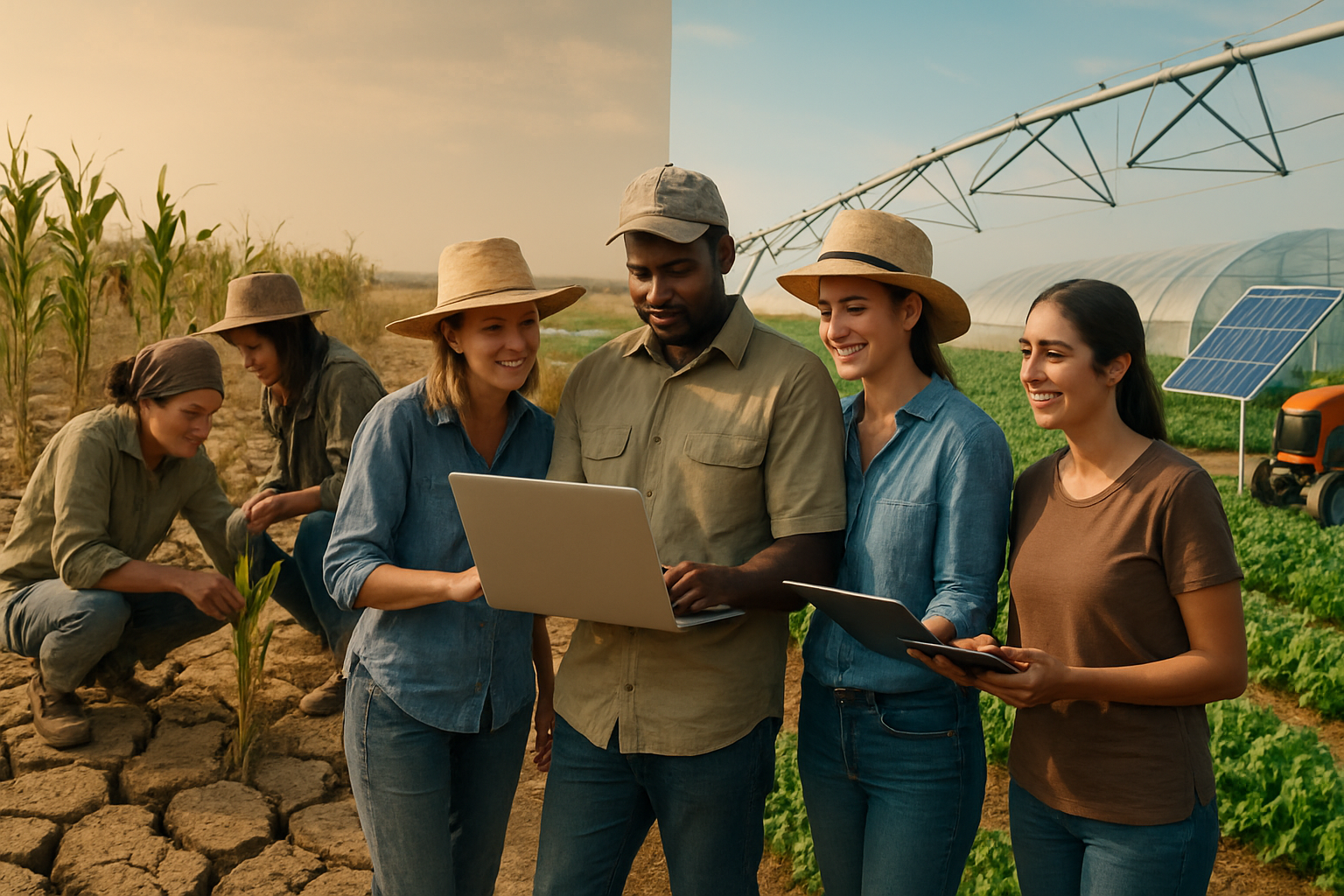
As the world faces its 19th consecutive month of temperatures exceeding 1.5°C above pre-industrial levels, agricultural communities across continents are pioneering revolutionary approaches to food security that combine cutting-edge technology with traditional farming wisdom, creating a global renaissance in sustainable agriculture.
From the drought-stricken fields of Romania to the energy-challenged landscapes of Bangladesh, farmers are demonstrating unprecedented resilience and innovation in the face of mounting climate pressures that threaten global food systems. This agricultural transformation represents one of humanity's most critical adaptations to accelerating climate change.
Romania Leads Drought-Resistant Farming Revolution
In Romania's Vrancea County, farmer Răzvan Avram has become a symbol of agricultural adaptation. As administrator of Green Agro, Avram has completely transformed his farming practices in response to years of devastating drought conditions that have pushed traditional agriculture to its limits.
"What these years of drought have taught us is to change the technology of work and practices on the farm in order to survive. A cooperative is an umbrella for farmers. It protects us from market turbulence."
— Răzvan Avram, Farmer and Green Agro Administrator
Avram's approach exemplifies the sophisticated integration of modern technology with traditional knowledge that defines today's agricultural renaissance. His farm has adopted precision irrigation systems, drought-resistant crop varieties, and cooperative marketing structures that provide resilience against both climate volatility and economic uncertainty.
The Romanian model demonstrates how individual farmers, when supported by cooperative structures, can implement transformative technologies while maintaining economic viability. This approach has attracted attention from agricultural experts across Europe as a template for climate adaptation that preserves farming communities rather than displacing them.
Bangladesh Faces Energy-Agriculture Nexus Crisis
Bangladesh's agricultural sector confronts a different but equally challenging crisis as the country's dependence on energy imports creates cascading effects throughout its food system. With 95% of energy needs met through imports, recent Middle East conflicts have severely disrupted the supply chains that keep Bangladesh's agricultural machinery, irrigation systems, and food processing facilities operational.
The crisis has forced Bangladesh to shut universities and limit fuel sales, directly impacting agricultural education and farm operations. This situation highlights the interconnected nature of global food security, where geopolitical conflicts thousands of miles away can threaten local food production systems.
Agricultural experts in Bangladesh are responding by accelerating the adoption of solar-powered irrigation systems and developing more energy-efficient farming techniques. These adaptations, born from crisis, are creating agricultural systems that are more resilient to external supply chain disruptions.
Global Climate Context Drives Innovation
These agricultural innovations are unfolding during an unprecedented period of global warming. January 2026 marked the hottest month in recorded history, extending a streak of 19 consecutive months above the critical 1.5°C threshold. This sustained warming has fundamentally altered traditional farming cycles, water availability, and pest management strategies worldwide.
The climate crisis is forcing rapid evolution in agricultural practices that would typically take decades to develop. Farmers who historically relied on predictable seasonal patterns now must adapt to erratic weather, extended droughts, unexpected floods, and shifting growing seasons.
Technology-Traditional Knowledge Integration
Across the globe, the most successful agricultural adaptations combine modern technology with centuries of traditional farming wisdom. This synthesis is evident in projects spanning continents:
- Cameroon's PADJI SARL has revolutionized market gardening with laser spray irrigation technology that reduces water consumption by 40-60% while increasing yields
- Kenya's Nguruman irrigation scheme rehabilitation is benefiting over 10,000 farmers through community-based water management
- Algeria's innovative "Tamr Al-Aghanm" project converts date waste into livestock feed, demonstrating circular economy principles
- Finland has achieved breakthrough winter raspberry cultivation using controlled environment agriculture
South-South Cooperation Emerges as Game Changer
Perhaps the most significant trend in global agricultural development is the emergence of South-South cooperation, where developing nations share expertise and resources with peers facing similar challenges. This model is proving more effective than traditional North-South aid relationships.
Zimbabwe's donation of 370 metric tonnes of maize to Malawi during southern Africa's food crisis exemplifies this regional solidarity. Similarly, Bolivia's partnership with India for agricultural research and Uganda's cattle farming revival demonstrate how developing nations are becoming agricultural innovation leaders.
The African Continental Free Trade Agreement (AfCFTA) is enabling cross-border agricultural ventures and shared value chains, creating collective responses to food security challenges that individual nations cannot address alone.
Economic Development Through Agricultural Innovation
Modern agricultural development is functioning as a comprehensive economic development engine that extends far beyond farm-level improvements. The multiplier effects include:
- Rural Employment: New agricultural technologies create jobs in biotechnology, equipment maintenance, and environmental services
- Export Opportunities: Strategic partnerships generate foreign currency earnings while building domestic processing capabilities
- Urban Food Access: Enhanced purchasing power policies improve food accessibility for urban populations
- Infrastructure Development: Agricultural modernization drives investments in transportation, processing, and storage facilities
Egypt's historic livestock expansion program, which issued 916 operating licenses in February 2026 alone, demonstrates this comprehensive approach. The program has disbursed EGP 10.35 billion to benefit 45,353 beneficiaries raising 526,760 head of cattle, creating a complete ecosystem of rural economic development.
Implementation Challenges and Success Factors
Despite remarkable innovations, agricultural transformation faces significant challenges:
Funding Sustainability: Developing nations often struggle with immediate economic pressures that override long-term agricultural investments. Creative financing mechanisms and international cooperation are essential.
Technical Capacity Building: Successful programs require sustained investment in education, training, and institutional development beyond initial technology deployment.
Climate Unpredictability: Rapidly changing environmental conditions disrupt project timelines, requiring adaptive management that can respond to unexpected challenges.
However, successful programs consistently demonstrate key success factors: community ownership, transparent governance, sustained political commitment, and the integration of traditional knowledge with modern technology.
Global Food Security at a Critical Juncture
The convergence of climate change acceleration, population growth, and geopolitical tensions has brought global food security to a critical decision point. The window for building resilient, equitable food systems is narrowing rapidly, making the agricultural innovations of 2026 potentially decisive for the coming decades.
The World Food Programme's struggles in Afghanistan, where 4 million children face malnutrition risk due to funding shortfalls, illustrate the humanitarian stakes. When international organizations must choose which hungry children to help based on budget constraints rather than need, it signals a fundamental failure of global food security architecture.
Looking Forward: Templates for Global Scaling
The agricultural renaissance of 2026 provides multiple templates for scaling successful interventions globally. The diversity of approaches - from Romania's drought adaptation to Bangladesh's energy resilience, from African cooperative innovations to precision agriculture breakthroughs - offers multiple pathways for different national circumstances.
Success requires sustained international cooperation, enhanced coordination across sectors and scales, and recognition of food security as a global public good requiring unprecedented collaboration. The tools and knowledge exist for comprehensive responses, but implementation depends on rapid scaling of successful innovations while maintaining community benefit principles.
As climate change accelerates and traditional farming systems face unprecedented stress, the agricultural innovations emerging in 2026 may determine whether humanity can maintain food security while building sustainable, resilient agricultural systems. The stakes could not be higher, but the ingenuity and cooperation demonstrated by farming communities worldwide provide grounds for cautious optimism in humanity's capacity to adapt and thrive.