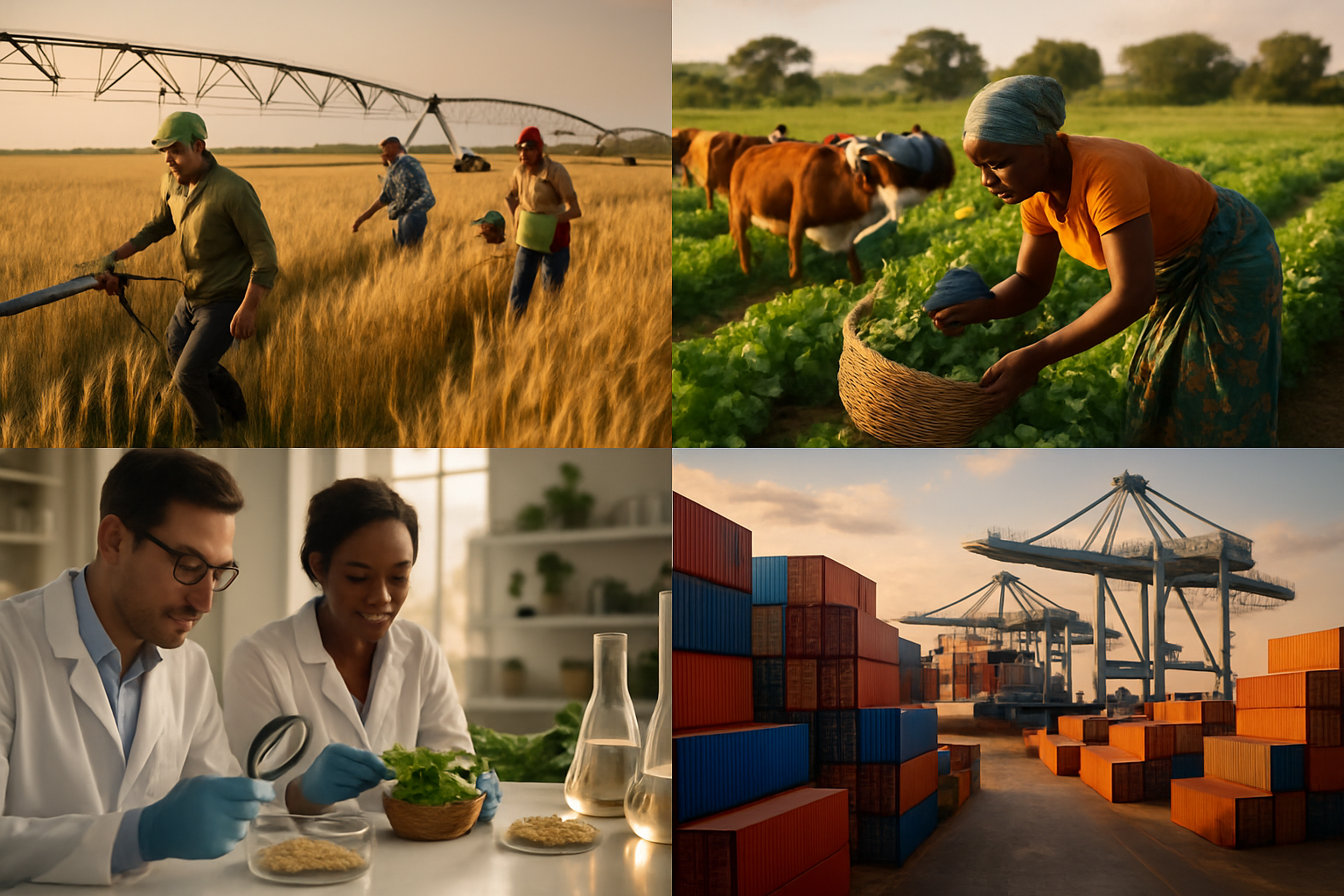
A comprehensive investigation across Argentina, Belize, Bolivia, Brazil, Mozambique, and Sudan reveals the profound challenges and emerging innovations shaping global agriculture during an unprecedented period of climate stress, with developments ranging from export triumphs to devastating livestock diseases.
As February 2026 marks the 18th consecutive month of global temperatures exceeding 1.5°C above pre-industrial levels, agricultural systems worldwide are demonstrating both remarkable resilience and concerning vulnerabilities. The latest developments from seven nations paint a complex picture of an industry in transition, grappling with climate pressures, technological opportunities, and fundamental questions about food security.
Argentina: Wine Industry Embraces Global Trends
Argentina's viticulture sector is experiencing a significant transformation, with more Argentine wineries participating in international exhibitions despite facing domestic consumption challenges. Wine specialist José Luis Beluscio analyzed the evolving market dynamics at Wine Paris 2025, highlighting a global trend toward white wine production and consumption.
This shift comes as Argentine wine producers navigate a complex landscape of changing consumer preferences and climate adaptation strategies. The expansion in international markets represents a critical pivot for an industry that has traditionally focused on domestic consumption and red wine production.
"The crisis in domestic consumption has forced Argentine producers to look outward," notes an industry analysis, reflecting broader patterns observed across global agricultural sectors where domestic challenges are driving international expansion strategies.
Belize: Livestock Disease Emergency Declared
The Ministry of Agriculture, Food Security and New Growth Industries (MAFS-NGI), in coordination with the Belize Agriculture Health Authority (BAHA), has confirmed the presence of Anaplasmosis—commonly known as Tick Fever—in cattle within the El Pilar Area of the Cayo District.
The disease outbreak, confirmed through laboratory testing following farmer reports of cattle health abnormalities and mortalities, represents a significant threat to Belize's livestock sector. Blood samples collected on February 4, 2026, from registered cattle farmers tested positive for the tick-borne disease, prompting immediate containment measures.
"Farm investigations revealed clinical signs consistent with anemia, raising immediate suspicion of a tick-borne disease."
— BAHA Investigation Report
The Anaplasmosis outbreak highlights the interconnected nature of global agricultural challenges, where disease management requires sophisticated veterinary responses and international cooperation frameworks that many developing nations struggle to maintain adequately.
Bolivia: India Partnership Strengthens Agricultural Research
Vice President Edmundo Lara has engaged in high-level discussions with Indian agricultural authorities, meeting with Mangi Lal Jat, Director General of the Indian Council of Agricultural Research (ICAR), as part of Bolivia's international agenda in India.
The collaboration focuses on strategic areas including agriculture, livestock management, and fisheries, representing a significant South-South cooperation initiative. During the visit, Lara toured agricultural facilities producing food for domestic consumption, observing production processes and optimization techniques that could be adapted to Bolivian conditions.
This partnership reflects a broader trend of developing nations sharing agricultural innovation and expertise, moving beyond traditional North-South aid relationships toward peer-to-peer knowledge transfer that respects local contexts while introducing technological advancement.
Brazil: Export Paradox in Global Food Markets
Brazil shipped significantly more food in January 2026 but received less compensation, with agribusiness exports falling 2.2% to $10.8 billion despite a 7% increase in volumes shipped. This counterintuitive trend reflects an 8.6% drop in average commodity prices, confirming a global food deflation pattern documented by both the FAO and World Bank.
Fresh beef emerged as a standout performer in the Brazilian export portfolio, demonstrating the complex dynamics affecting different agricultural sectors within the same national economy. The volume-price disconnect illustrates how global market forces can undermine the economic benefits of increased production efficiency.
The Brazilian experience exemplifies challenges facing agricultural exporters worldwide, where improved productivity and increased output don't necessarily translate to enhanced economic returns due to global market volatility and changing international demand patterns.
Mozambique: Counterfeit Seed Crisis Threatens Food Security
Authorities in Manica province have expressed serious concern about the circulation of falsified seeds, representing a direct threat to agricultural productivity and food security. The counterfeit seed problem undermines farmer investments and crop yields, with potentially devastating consequences for rural communities dependent on agriculture.
The circulation of substandard agricultural inputs represents one of the most insidious threats to food security, as farmers invest limited resources in seeds that may fail to germinate properly or produce expected yields. This crisis particularly impacts smallholder farmers who lack resources to absorb crop failures.
Mozambique's experience with counterfeit seeds reflects broader governance challenges affecting agricultural supply chains across developing nations, where regulatory capacity struggles to keep pace with the scale of agricultural input distribution.
Sudan: Agricultural Crisis Amid Conflict
Farmers in Al-Qadarif state have issued urgent warnings about escalating losses due to increased agricultural crop deliveries to commodity exchanges, forcing producers to sell their harvests due to mounting debts to fertilizer companies and banks alongside rising production costs.
The agricultural crisis in Al-Qadarif reflects the broader humanitarian catastrophe affecting Sudan, where ongoing conflict has disrupted traditional farming cycles and market access. The commodity exchange, intended to provide farmers with fair market access, has become a source of additional pressure as producers face impossible choices between financial survival and agricultural sustainability.
Sudan's agricultural sector, once considered the breadbasket of northeast Africa, now exemplifies how political instability and conflict can rapidly transform productive agricultural regions into zones of humanitarian crisis.
Global Health Context: Disease Patterns Shift
Concurrent with agricultural challenges, Sudan faces expanding health crises with warnings about the spread of dengue fever across six states and continued hepatitis E infections in Gezira state. These health challenges compound agricultural difficulties as rural populations face both food insecurity and inadequate medical care.
The intersection of agricultural crisis and public health emergency in Sudan demonstrates how food system failures create cascading effects across multiple dimensions of human security, requiring integrated responses that address both immediate humanitarian needs and long-term agricultural recovery.
Climate Context and Global Implications
These agricultural developments occur during an unprecedented period of climate stress. Historical context from previous agricultural investigations reveals that January 2026 marked the hottest month in recorded history, continuing an 18-month streak of temperatures exceeding 1.5°C above pre-industrial levels.
This sustained warming pattern is fundamentally altering agricultural systems worldwide, forcing rapid adaptation in everything from crop selection to livestock management. The diverse responses observed across these seven nations—from Argentina's market pivot to Bolivia's research partnerships—reflect different strategies for adapting to accelerating climate change.
"Agricultural transformation spans multiple continents, demonstrating sophisticated technology-tradition integration, community ownership principles, and international cooperation enhancement addressing climate adaptation requirements."
— Agricultural Renaissance Analysis, February 2026
Technology and Traditional Knowledge Integration
Successful agricultural adaptation increasingly requires sophisticated synthesis of cutting-edge technology with traditional farming knowledge and community-based management systems. The Bolivia-India partnership exemplifies this approach, combining modern research capabilities with locally-adapted practices.
This integration proves essential as agricultural systems navigate unprecedented environmental conditions that challenge both traditional farming wisdom and contemporary scientific approaches. Success depends on respecting community structures while introducing beneficial innovations, as demonstrated by various international cooperation initiatives.
Economic Development and Food Security Nexus
The experiences across these seven nations illustrate how agricultural challenges create broader economic development implications. Brazil's export volume-price disconnect affects foreign currency earnings, while Mozambique's counterfeit seed crisis undermines rural economic stability.
These economic dimensions of agricultural challenges require policy responses that address both immediate food security needs and long-term economic sustainability. Success increasingly depends on creating sustainable employment opportunities, price stabilization mechanisms, and rural poverty reduction strategies that extend beyond farm-level interventions.
International Cooperation and South-South Partnerships
The Bolivia-India collaboration represents an emerging pattern of South-South cooperation where developing nations share agricultural expertise without traditional North-South aid dependencies. This peer-to-peer knowledge transfer often proves more culturally appropriate and economically sustainable than conventional development assistance.
Regional integration through frameworks like the African Continental Free Trade Agreement (AfCFTA) creates opportunities for agricultural partnerships and cross-border collaboration that can enhance food security while building economic resilience across developing regions.
Implementation Challenges and Success Factors
Critical implementation challenges identified across these case studies include funding sustainability for developing nations, technical capacity building requirements, climate unpredictability disrupting traditional agricultural cycles, and the need for adaptive management responding to rapidly changing environmental conditions.
Success factors consistently include sustained political commitment, community engagement, international cooperation, resource allocation adequacy, and the ability to balance immediate needs with long-term sustainability objectives.
Future Implications for Global Food Systems
These February 2026 developments provide templates for addressing global food security challenges through community empowerment, technological innovation, and international cooperation. The window for food system transformation appears to be narrowing rapidly, requiring accelerated scaling of successful interventions while maintaining effectiveness principles that ensure community benefits.
The stark contrasts observed—from Argentina's wine market expansion to Sudan's agricultural crisis—demonstrate that global food security increasingly depends on the ability to learn from both successes and failures across diverse agricultural contexts. The coordination of immediate crisis response with long-term resilience building represents one of the most critical challenges facing global food systems in 2026.
As agricultural systems worldwide confront accelerating environmental change, the experiences documented across these seven nations offer crucial insights into the complex intersection of climate adaptation, economic development, and food security that will define agricultural success in the coming decades.