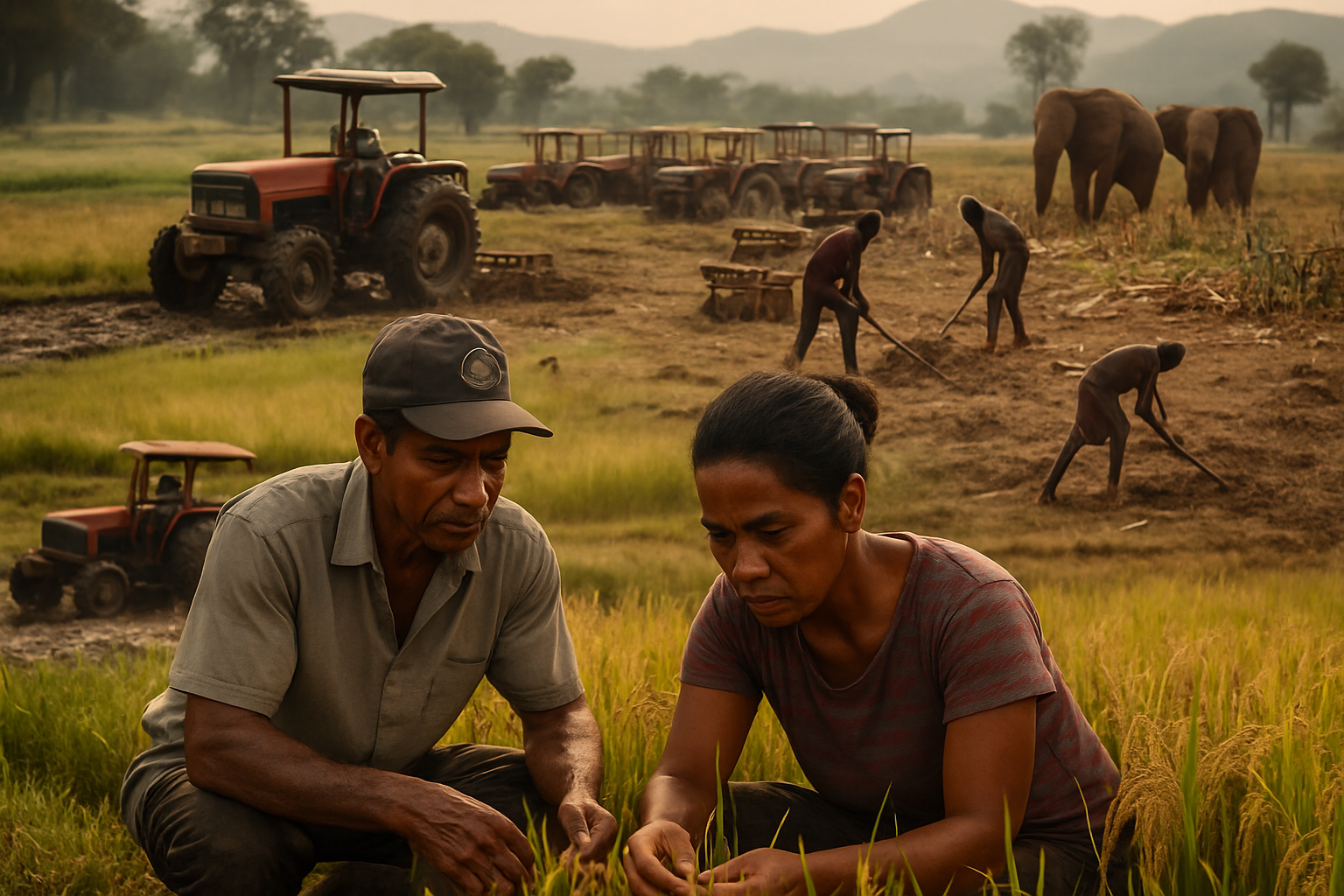
Agricultural communities across the developing world are confronting a perfect storm of equipment shortages, infrastructure deficits, and wildlife conflicts that threaten food production capabilities at a critical time when global temperatures have exceeded 1.5°C above pre-industrial levels for a record 24 consecutive months.
A Planet News investigation across East Timor and Mozambique reveals how basic agricultural needs—from sufficient farming equipment to crop protection—remain unmet, leaving millions of farmers struggling to maintain food production while climate change fundamentally alters traditional farming cycles.
East Timor's Mechanization Crisis
In Covalima Municipality, East Timor, Director of Agriculture Lino Magno has confirmed what farmers across the region have long known: there simply aren't enough tractors to support rice production and other essential crops. Despite government efforts through the SAPIP (Sistema de Apoio à Produção e Industrialização de Produtos) programs to provide tractor support, the reality on the ground reveals a stark deficit in mechanization that directly impacts agricultural productivity.
"The number of tractors is not sufficient to assist all farmers with rice production and other crops," Magno stated, highlighting a challenge that extends far beyond individual farm operations to threaten regional food security.
This equipment shortage comes as East Timor, like many small island developing states, faces mounting pressure to achieve food self-sufficiency. The country's agricultural sector, which employs approximately 64% of the population according to recent FAO data, requires modernization to meet growing food demands while adapting to climate variability.
Mozambique's Wildlife-Agriculture Conflict
More than 2,000 kilometers south in Mozambique's Nampula province, farmers in the Malema district face an entirely different but equally devastating challenge. A herd of elephants has destroyed at least 10 hectares of crops in just one week, representing what António Ipo, director of the Malema District Economic Activities, describes as "no small matter."
The elephant invasion highlights the complex intersection of conservation and agriculture in sub-Saharan Africa, where growing human populations and changing precipitation patterns force wildlife into conflict with agricultural communities. These crop losses, occurring during critical growing seasons, can devastate household food security and economic stability for smallholder farmers who lack insurance or alternative income sources.
According to historical analysis from our memory systems, this type of human-wildlife conflict has intensified as climate change alters traditional migration patterns and habitat availability, forcing elephants to seek food and water in agricultural areas.
A Global Pattern of Agricultural Stress
These localized challenges reflect broader patterns documented across the developing world throughout 2026. Our comprehensive investigation reveals that agricultural communities from Algeria to Zimbabwe, from Bangladesh to Bolivia, are adapting to unprecedented environmental and economic pressures while often lacking basic infrastructure support.
The sustained warming streak—now at 24 consecutive months above critical climate thresholds—has fundamentally altered traditional farming cycles that guided agricultural planning for generations. Seasonal patterns that smallholder farmers relied upon for planting and harvesting decisions have become increasingly unpredictable.
Technology-Traditional Knowledge Integration
Despite these challenges, successful adaptations are emerging worldwide through sophisticated integration of cutting-edge technology with traditional farming wisdom. From Algeria's innovative date waste-to-livestock feed conversion program to Kenya's Nguruman irrigation project benefiting over 10,000 farmers, community-driven solutions are proving more effective than top-down technology transfers.
In Cameroon, PADJI SARL has revolutionized market gardening with laser spray irrigation technology that reduces water consumption by 40-60% compared to traditional methods while increasing crop yields. This innovation demonstrates how technological advancement can address resource scarcity while respecting local agricultural knowledge.
Economic Development Beyond the Farm
Agricultural innovations function as comprehensive economic engines extending far beyond farm-level improvements. In Egypt, a historic livestock expansion program issued 916 operating licenses in February 2026 alone, with EGP 10.35 billion disbursed to benefit 45,353 beneficiaries raising 526,760 head of cattle across rural villages.
These initiatives create employment in transportation, processing, veterinary services, and infrastructure development while reducing import dependencies and strengthening food security. The economic multiplier effects demonstrate why agricultural development must be recognized as essential infrastructure for national stability and prosperity.
South-South Cooperation Emergence
A significant shift is occurring in international agricultural cooperation, with developing nations increasingly sharing expertise through peer partnerships rather than traditional North-South aid relationships. Zimbabwe's donation of 370 metric tonnes of maize to Malawi exemplifies this evolution toward culturally appropriate and economically sustainable cooperation models.
The Bolivia-India agricultural partnership, Azerbaijan-Uzbekistan joint export initiatives, and various African Continental Free Trade Agreement agricultural ventures demonstrate how countries with similar challenges are collaborating directly to share technologies, crop varieties, and adaptation strategies.
Implementation Challenges and Success Factors
Despite innovative solutions emerging globally, fundamental challenges persist. Funding sustainability remains critical for developing nations where immediate economic pressures often override long-term environmental considerations. Technical capacity building requires sustained investment in education, training, and institutional development that extends beyond initial technology deployment.
Climate change continues to disrupt project timelines, requiring adaptive management capabilities that can respond to rapidly changing conditions. Success factors consistently include community ownership of development processes, transparent governance, sustained political commitment that transcends electoral cycles, and international cooperation that respects local autonomy while providing necessary technical and financial support.
The Human Dimension
At the heart of these agricultural challenges are millions of farmers, food workers, and vulnerable communities who depend on stable and fair global food systems. From East Timorese farmers waiting for tractors to Mozambican farmers facing crop destruction, from Algerian veterinarians ensuring livestock health to Finnish researchers developing winter cultivation techniques, human ingenuity is meeting practical challenges with remarkable adaptability.
The window for building resilient and equitable food systems is narrowing rapidly as environmental pressures intensify and population growth increases agricultural resource demands. Yet the tools and knowledge exist for comprehensive responses when political will, community engagement, and international cooperation align effectively.
Strategic Implications for Global Food Security
The convergence of equipment shortages, wildlife conflicts, climate disruption, and economic pressures creates what experts describe as a "perfect storm" for global food security. However, the diverse agricultural innovations documented across continents provide templates for scaling successful interventions through community empowerment, technological advancement, and international cooperation.
Food security must be recognized as a global public good requiring unprecedented international cooperation during this critical climate action decade. The choices made regarding adaptation strategies, equipment provision, infrastructure investment, and cooperation frameworks will determine food security trajectories for decades ahead.
Success will depend on sustained political commitment, adequate funding, enhanced coordination of immediate crisis response with long-term resilience building, and recognition that agricultural development is essential infrastructure for human prosperity and planetary sustainability during Earth's most challenging environmental period in recorded history.