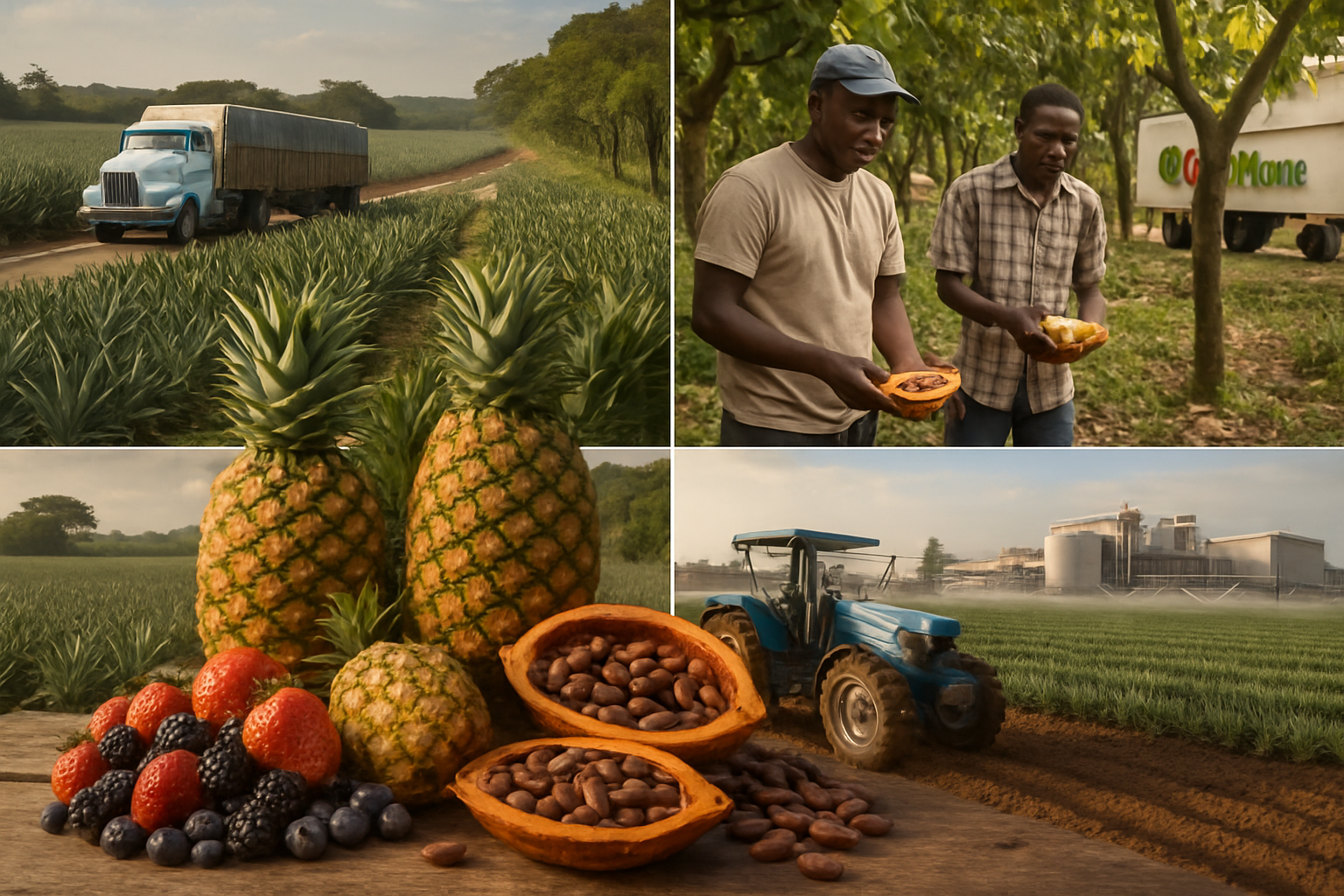
As global food security challenges intensify amid the hottest climate conditions on record, four nations across three continents are implementing groundbreaking agricultural initiatives that could reshape international approaches to rural development and food production systems.
From the Democratic Republic of Congo's conservation-led farmer support programs to the Philippines' innovative village-based feed ecosystems, these developments represent a coordinated global response to agricultural vulnerabilities that have emerged following January 2026 being declared the hottest month in recorded history.
Congo's Conservation Revolution: 11,000 Farmers Transformed
The Institut Congolais pour la Conservation de la Nature (ICCN) has achieved remarkable success in the North Kivu province, supporting over 11,000 farmers across Lubero territory over the past three years. Speaking at a press conference in Beni on February 6, ICCN Communications Director Bienvenu Bwende outlined how this conservation-focused approach has revolutionized agricultural practices in one of Africa's most conflict-affected regions.
This initiative represents a paradigm shift in agricultural development, demonstrating how environmental conservation and farmer productivity can advance simultaneously. The program's success in a region facing significant security challenges provides a template for sustainable agricultural development that other African nations are now studying closely.
"The integration of conservation principles with practical farming support has created sustainable livelihoods while protecting our natural heritage."
— Bienvenu Bwende, ICCN Communications Director
The ICCN program addresses a critical gap identified in our comprehensive analysis of global agricultural initiatives: the need to balance immediate farmer needs with long-term environmental sustainability. Historical data shows that conservation-agriculture integration has become increasingly vital as climate pressures mount across sub-Saharan Africa.
Egypt's Strategic Food Security: Ramadan Preparation Initiative
Egypt's coordinated response to seasonal food demand demonstrates sophisticated supply chain management during critical consumption periods. The collaboration between Supply Minister Sherif Farouk, Agriculture Minister Alaa Farouk, and Mostaqbal Misr Agency head Bahaa El-Ghanam has established what officials call a "food security triangle" designed to coordinate essential goods availability and regulate market movements.
The agreement to import substantial quantities of frozen poultry and poultry parts from multiple countries aims to increase market supply and reduce prices ahead of Ramadan. This strategic approach reflects lessons learned from global food price volatility that has affected millions of consumers across the Middle East and North Africa.
Egypt's initiative aligns with broader regional efforts documented in our analysis, where countries from Bangladesh to Slovakia have implemented targeted food security measures. The timing ahead of Ramadan demonstrates the sophisticated understanding of seasonal consumption patterns that modern food security planning requires.
India's Livestock Feed Crisis: Tamil Nadu vs Karnataka Contrast
Basic Animal Husbandry statistics reveal a troubling divergence in India's agricultural development, with Tamil Nadu losing significant area under fodder crops while Karnataka has successfully improved its coverage. This disparity directly impacts milk production capacity and highlights the complex challenges facing India's dairy sector.
The feed shortage affecting milk production in Tamil Nadu represents a microcosm of global livestock challenges identified in our comprehensive food security analysis. Countries from Sweden to Argentina are grappling with similar livestock industry pressures, ranging from regulatory burdens to climate-induced feed shortages.

Karnataka's success provides valuable lessons for other Indian states and developing countries worldwide. The state's approach to expanding fodder crop coverage has maintained dairy productivity even amid broader agricultural challenges affecting the region.
Philippines' Innovation: Village-Based Feed Ecosystem Revolution
The Philippine Department of Agriculture's rollout of a village-based feed ecosystem represents one of the most innovative approaches to agricultural self-sufficiency documented in our global analysis. This initiative aims to boost both corn and livestock production simultaneously, creating integrated rural economic systems that reduce dependence on external inputs.
The village-based model addresses fundamental challenges identified across multiple countries: the need for localized food production systems that can withstand global supply chain disruptions. Recent events, from infant formula contamination crises in Europe to beef trade disputes between Argentina and the United States, underscore the vulnerability of centralized food systems.
This approach aligns with successful models identified in our research, including Mexico's Sembrando Vida program and Cambodia's Agricultural Market Incentive System (AIMS), both of which emphasize community ownership and integrated agricultural approaches.
Technology Integration and Traditional Knowledge
The Philippines initiative demonstrates the sophisticated integration of modern agricultural technology with traditional farming wisdom. This balance, also observed in Norway's Church Aid programs in South Sudan and Algeria's date waste livestock feed innovation, represents a emerging global standard for sustainable agricultural development.
Global Context: Climate Urgency Driving Innovation
These four initiatives occur within the context of unprecedented climate challenges. January 2026's record-breaking temperatures - with 18 of the past 19 months exceeding 1.5°C above pre-industrial levels - have forced agricultural systems worldwide to adapt rapidly.
The convergence of conservation agriculture in Congo, strategic import coordination in Egypt, livestock feed management in India, and integrated village systems in the Philippines illustrates the diverse approaches required to address food security in the climate emergency era.
"Climate change is fundamentally altering agricultural systems worldwide, requiring both immediate adaptation and long-term resilience building."
— Agricultural Development Expert Analysis
Regional Integration and International Cooperation
These developments contribute to broader trends documented in our analysis, including Norway's $2.9 million South Sudan agricultural transformation program, Kenya's Nguruman irrigation rehabilitation serving 10,000+ farmers, and Rwanda's identification of 417,000 hectares of irrigation potential.
The African continental context is particularly significant, with the African Continental Free Trade Agreement (AfCFTA) creating new opportunities for agricultural trade integration. Egypt's food security coordination and Congo's conservation agriculture directly support these regional integration objectives.
Economic Implications and Market Dynamics
The economic dimensions of these initiatives extend far beyond immediate agricultural output. Congo's conservation agriculture creates sustainable employment in conflict-affected areas. Egypt's food security triangle stabilizes consumer prices during critical periods. India's fodder crop expansion supports dairy industry competitiveness. The Philippines' village-based systems reduce rural poverty through integrated economic opportunities.
Financial market implications include reduced food price volatility, enhanced rural economic stability, and decreased dependency on volatile international commodity markets. These factors contribute to broader economic resilience documented across successful agricultural development programs worldwide.
Challenges and Success Factors
Analysis of these four initiatives alongside global agricultural development trends reveals common challenges: funding sustainability, technical capacity building, climate adaptation, and political commitment across electoral cycles.
Success factors include community ownership, international cooperation enhancement, technology-tradition integration, gender inclusion, and economic development beyond farm-level production. The most successful programs, from Albania's reforestation to Algeria's waste-to-feed innovation, demonstrate these characteristics consistently.
Future Implications: Templates for Global Scaling
These initiatives provide templates for addressing fundamental food security challenges globally. Congo's model demonstrates conservation-agriculture integration. Egypt shows strategic import coordination during peak demand. India's experience reveals the importance of regional agricultural policy coordination. The Philippines illustrates village-based integration potential.
The broader context includes similar innovations documented across Latin America, with Mexico's indigenous farming internationalization at BIOFACH 2026, and Caribbean modernization efforts led by Barbados Minister Indar Weir's calls for agricultural transformation.
As global food systems face unprecedented pressures from climate change, supply chain vulnerabilities, and population growth, these four initiatives represent the evolution from reactive crisis management to proactive resilience building. Their success could determine whether the world achieves sustainable food security in an era of accelerating environmental and economic challenges.
The agricultural renaissance documented across these four nations reflects humanity's capacity for innovation under pressure, combining traditional wisdom with modern technology to create food systems that can sustain communities while protecting the planet's ecological foundations for future generations.