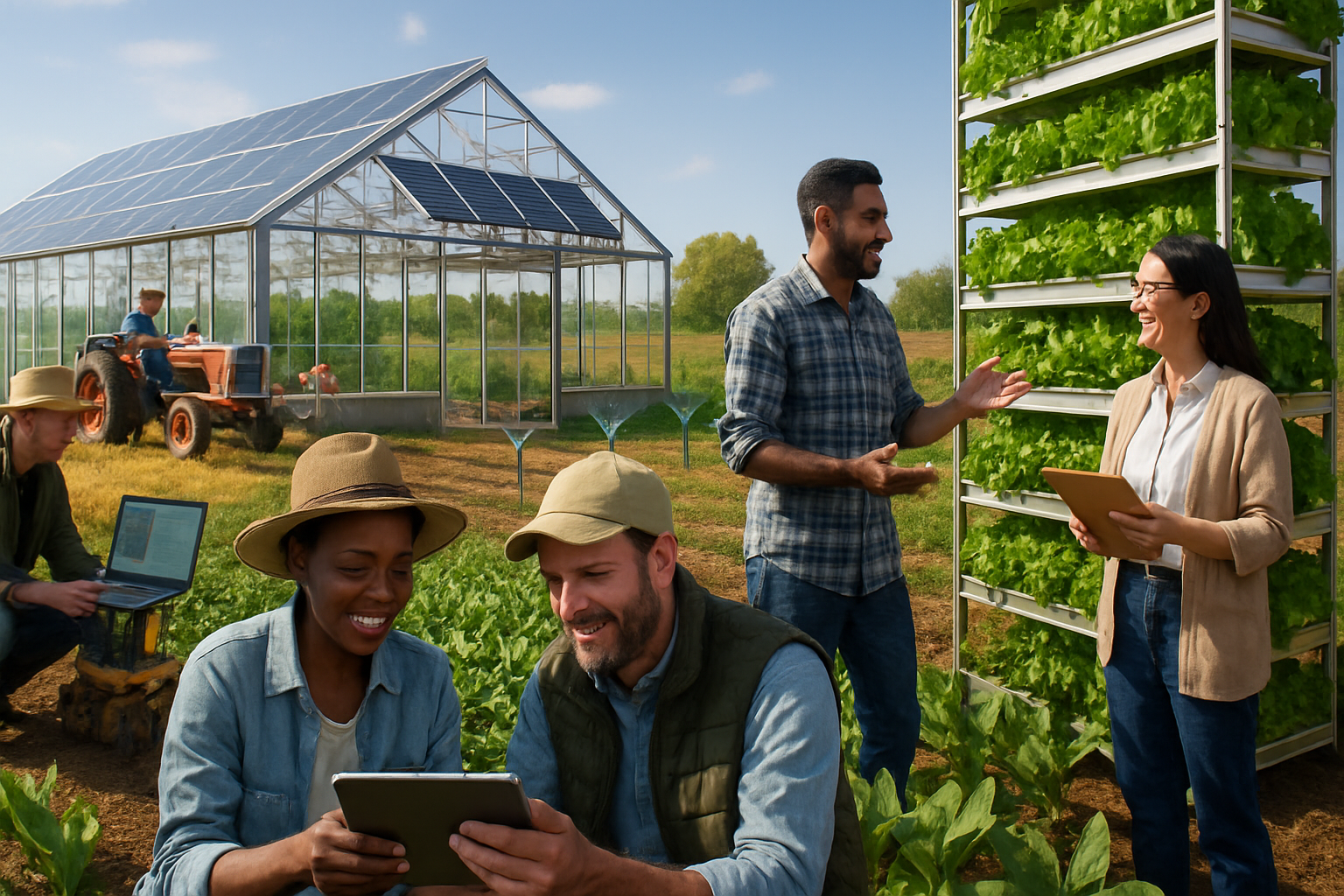
A remarkable agricultural transformation is underway across four continents as nations implement innovative programs to strengthen food security amid unprecedented climate challenges, with initiatives spanning from Caribbean policy reforms to African waste reduction campaigns and Central American regenerative agriculture projects.
The convergence of agricultural innovation and food security measures represents one of the most significant coordinated global responses to mounting hunger challenges. As the world experiences its 21st consecutive month of temperatures exceeding 1.5°C above pre-industrial levels, countries are demonstrating that sophisticated technology-traditional knowledge integration can provide pathways to sustainable food systems.
Caribbean Leadership in Agricultural Reform
Barbados is spearheading a major agricultural sector transformation under newly appointed Minister of Agriculture, Food and Nutritional Security Dr. Shantal Munro-Knight. Following the February 11, 2026 General Election, Dr. Munro-Knight outlined comprehensive plans to boost the foundational economic sector through enhanced student engagement in agricultural careers.
Speaking at the Inter-American Institute for Cooperation on Agriculture and Accountability's annual seminar, the Minister emphasized the critical importance of attracting young people to agriculture as the foundation for long-term food security. This Caribbean approach exemplifies the sophisticated integration of educational policy with agricultural development that is becoming a hallmark of successful food security strategies globally.
The initiative builds on the region's remarkable transformation from food-import dependence to agricultural leadership, with countries like Guyana emerging as major food suppliers through strategic technology adoption and traditional farming practice preservation.
Central American Regenerative Agriculture Revolution
El Salvador has launched an ambitious National Regenerative Agriculture Initiative that could reshape the country's rural economy while significantly bolstering food security. Spearheaded by the Agency for National Development and Design (ADDN) in partnership with international organizations including MurphsLife, this program represents a fundamental shift from chemical-heavy farming to soil health restoration.
The initiative aims to dramatically reduce El Salvador's dependence on food imports by 2026 through systematic implementation of regenerative practices that restore agricultural productivity while enhancing environmental sustainability. This approach demonstrates how nations can address multiple challenges simultaneously - food security, environmental protection, and economic development - through integrated agricultural strategies.
The program's emphasis on soil health restoration reflects growing recognition that sustainable food security requires approaches that protect the ecological foundations of agriculture while meeting immediate food production needs.
African Innovation in Waste Reduction
Burkina Faso's youth-led environmental movement is contributing to food security through innovative waste reduction initiatives. The Network of Slow Food Youth of Burkina (SFYN Burkina Faso) announced the 10th edition of World Disco Soup Day, scheduled for April 25, as part of a comprehensive campaign against food waste.
This grassroots initiative, coordinated by the international Slow Food network, demonstrates how community-driven approaches can address food security challenges through systematic waste reduction. The program represents a growing recognition that food security requires not only increased production but also dramatic improvements in food utilization efficiency.
The Disco Soup movement transforms food waste into community meals through creative cooking events that raise awareness about food system inefficiencies while providing immediate nutrition assistance to vulnerable populations. This model is being replicated across West Africa as part of broader food security strategies.
Climate Adaptation as Agricultural Imperative
The agricultural innovations occurring across these regions take place within an unprecedented climate context. January 2026 marked the hottest month in recorded history, extending a streak of sustained warming that has fundamentally altered traditional farming cycles worldwide.
This sustained temperature increase creates what experts describe as a "threat multiplier" for food systems, enabling pathogen co-circulation that overwhelms safety systems designed for sequential challenges. Traditional preservation methods prove inadequate for rapidly changing environmental conditions, requiring new approaches to food processing and storage.
Countries implementing successful agricultural adaptations demonstrate sophisticated synthesis of cutting-edge technology with traditional farming knowledge. Barbados combines modern agricultural education with Caribbean expertise, El Salvador integrates advanced soil science with indigenous farming practices, and Burkina Faso leverages digital organizing with traditional food preparation techniques.
Technology-Traditional Knowledge Integration
The most effective agricultural adaptations emerging globally consistently demonstrate sophisticated integration of modern technology with traditional ecological knowledge and community-based management systems. This synthesis proves superior to purely technological solutions that ignore local traditions and community structures.
Agricultural development experts increasingly recognize that sustainable food security requires approaches that respect established farming wisdom while incorporating beneficial innovations. The Caribbean's agricultural education focus, Central America's regenerative practices, and Africa's community-driven waste reduction represent different expressions of this fundamental principle.
This integration approach addresses both immediate food production needs and long-term sustainability challenges through solutions that communities can adopt, maintain, and improve over time without dependence on external technological inputs.
Economic Development Beyond Food Production
These agricultural initiatives function as comprehensive economic development engines extending far beyond farm-level improvements. Barbados' educational focus creates sustainable employment in transportation, processing, and veterinary services while reducing import costs. El Salvador's regenerative agriculture generates rural employment opportunities that reduce urban migration pressures.
The economic multiplier effects include infrastructure development, market access enhancement, and value-added processing capabilities that strengthen entire rural ecosystems. Countries implementing comprehensive agricultural protection demonstrate greater economic resilience and attract sustainable investment in agricultural technology, processing, and export development.
This economic dimension proves critical for sustaining agricultural innovations over time, as programs that generate tangible economic benefits for communities create the political and social support necessary for long-term implementation.
South-South Cooperation Emergence
The agricultural developments across these regions reflect a broader trend toward South-South cooperation, where developing nations share expertise through peer partnerships rather than traditional North-South aid relationships. This approach proves more culturally appropriate and economically sustainable than conventional development assistance.
Regional integration frameworks like the African Continental Free Trade Agreement enable agricultural partnerships across national boundaries, creating shared value chains and collective responses to food security challenges that individual nations cannot address independently. The Caribbean's regional collaboration and Central America's cross-border regenerative agriculture networks exemplify this evolution.
These peer-to-peer knowledge transfers respect local autonomy while facilitating beneficial international partnerships, creating templates for scaling successful interventions globally through cultural sensitivity and community ownership principles.
Implementation Challenges and Success Factors
Despite remarkable innovations, significant implementation challenges remain. Funding sustainability presents critical concerns for developing nations where immediate economic pressures often override long-term environmental considerations. Technical capacity building requires sustained investment in education, training, and institutional development beyond initial technology deployment.
Climate change disrupts project timelines, requiring adaptive management that can respond to rapidly changing conditions. Success factors consistently identified across successful programs include community ownership of development processes, transparent governance, sustained political commitment that transcends electoral cycles, and international cooperation that respects local autonomy while providing technical and financial support.
The diversity of approaches provides resilience against single-solution dependencies, offering multiple adaptation pathways suitable for different contexts and resource availability. This diversity proves essential as agricultural systems navigate accelerating climate change and evolving market conditions.
Global Food Security at a Critical Juncture
The window for building resilient, equitable food systems is narrowing rapidly as environmental pressures intensify and population growth increases agricultural resource demands. However, the tools and knowledge exist for comprehensive responses, as demonstrated by pioneering initiatives across the Caribbean, Central America, and Africa.
Success depends on sustained political commitment, adequate funding, and coordination between immediate crisis response and long-term resilience building. Agricultural communities demonstrate remarkable adaptive capacity when supported by appropriate policies, infrastructure, market access, and international cooperation.
The convergence of agricultural innovation, climate adaptation, and food security initiatives in 2026 may prove decisive for global food security trajectories in the decades ahead. The stakes are unprecedented, but the innovative capacity demonstrated by farming communities, governments, and international organizations provides cautious optimism for building sustainable, resilient food systems during Earth's most challenging environmental period in recorded history.
Future Implications and Global Templates
The agricultural innovations emerging from Barbados, El Salvador, and Burkina Faso provide diverse, complementary templates for addressing global food security challenges. Educational reform, regenerative agriculture, and community-driven waste reduction offer different pathways toward agricultural resilience that can be adapted across varied cultural and economic contexts.
These initiatives demonstrate that agricultural transformation combining traditional wisdom with modern innovation, supported by genuine international cooperation, offers pathways to sustainable food systems that protect human prosperity and planetary sustainability during unprecedented environmental challenges.
The human dimension remains central to these efforts - millions of farmers, food workers, and vulnerable communities depend on stable, fair global food systems. The choices made during this critical period regarding agricultural adaptation, international cooperation, and innovation investment will determine food security trajectories for generations to come, making coordinated international action not just beneficial, but essential for global stability and human prosperity.