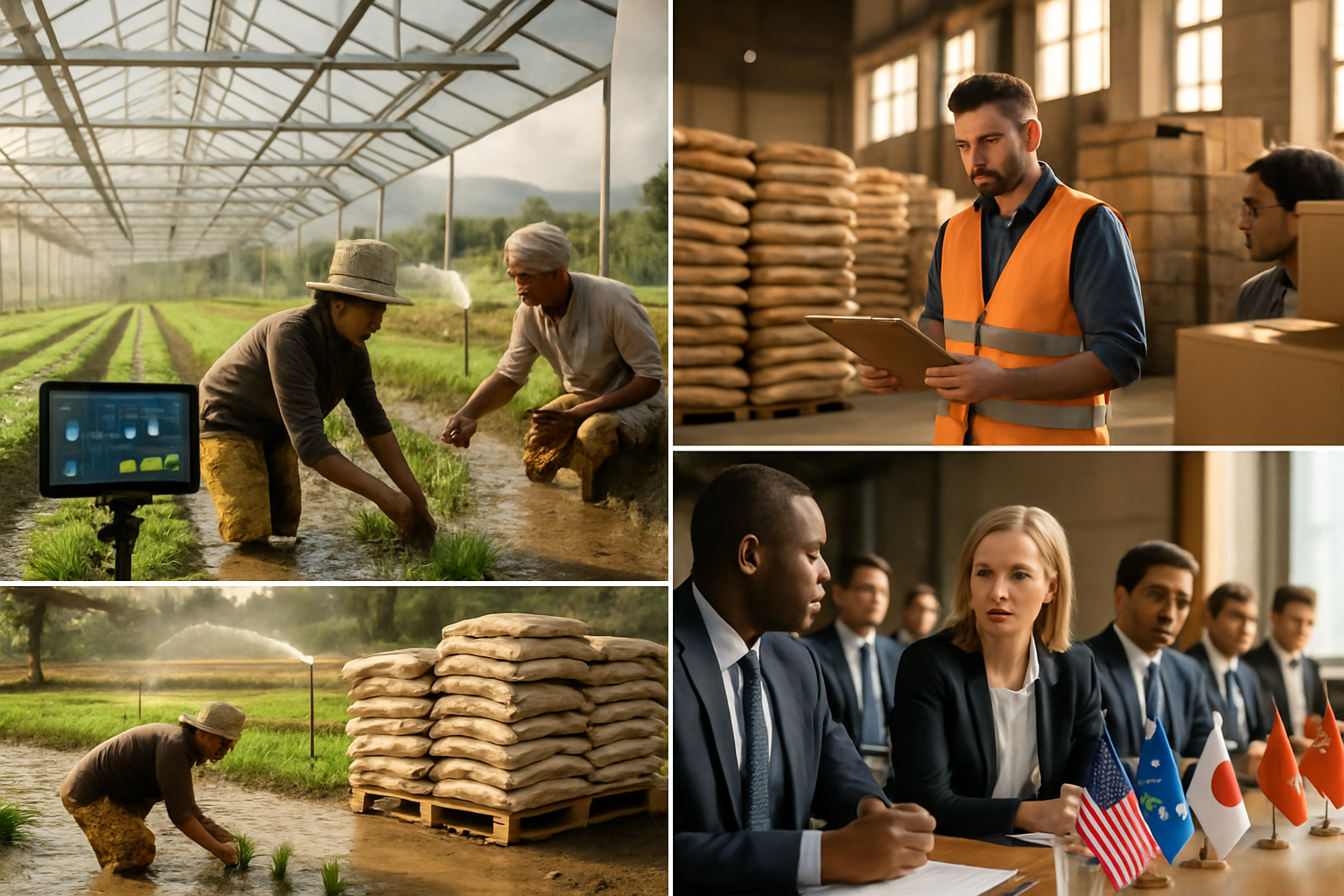
As 2026 marks the 20th consecutive month of global temperatures exceeding 1.5°C above pre-industrial levels, nations across six continents are launching revolutionary agricultural initiatives that could reshape global food security for decades to come.
From Barbados' focus on agricultural sovereignty to China's comprehensive food waste reduction strategies, governments worldwide are recognizing that traditional approaches to food security are insufficient in an era of accelerating climate change and evolving geopolitical tensions.
Caribbean Leadership in Food Sovereignty
The Caribbean region has emerged as an unexpected leader in agricultural innovation. While Barbados grapples with crime and economic headwinds, agricultural experts note that food security has been "sliding down the list of priorities" despite its critical importance for island nations.
"It is instructive to read about India's strategy," observes a recent analysis from Barbados Underground, pointing to the need for Caribbean nations to learn from global agricultural innovation.
— Barbados Underground Editorial
This challenge reflects broader themes across small island developing states, where food sovereignty has become synonymous with political independence and economic resilience.
China's Zero-Waste Revolution
March 30 marked the International Day of Zero Waste, with China taking center stage in addressing food waste on an industrial scale. The United Nations estimates that approximately 1 billion tonnes of edible food are discarded annually, accounting for nearly one-fifth of available food and contributing 8% to 10% of global greenhouse gas emissions.
UN Secretary-General António Guterres delivered a stark warning: "The world wastes far too much food. Every day, we throw away enough to prepare 1 billion meals – while letting 9% of humanity go hungry."
China's response involves coordinated efforts to improve supply chains and drive systemic change toward more efficient and resilient food systems, representing one of the most comprehensive approaches to food waste reduction attempted by any nation.
Technology Meets Tradition
Across the developing world, the most successful agricultural adaptations demonstrate sophisticated synthesis of cutting-edge technology with traditional farming knowledge. This approach has proven superior to purely technological solutions that ignore local traditions and community structures.
Malaysia's transformation under Dr. Stephen Rundi Utom exemplifies this trend. The Sarawak State Minister announced a fundamental shift from "routine administration to outcome-driven delivery" for agricultural transformation, positioning the region to become a major food producer and future net exporter.
Similarly, Kenya's Nguruman irrigation rehabilitation project has benefited over 10,000 farmers, while Algeria's innovative date waste-to-livestock feed conversion demonstrates circular economy principles in practice.
South-South Cooperation Emerges
A significant trend emerging throughout 2026 is the rise of South-South cooperation, where developing nations share expertise through peer partnerships rather than relying on traditional North-South aid relationships.
Examples include Zimbabwe's donation of 370 metric tonnes of maize to Malawi during southern Africa's food crisis, and Bolivia's agricultural partnership with India that combines modern research with locally-adapted practices while respecting community structures.
The African Continental Free Trade Agreement (AfCFTA) has enabled cross-border agricultural ventures and shared value chains, creating collective responses to food security challenges that individual nations cannot address independently.
Climate Adaptation Imperatives
The agricultural innovations of 2026 occur against an unprecedented climate backdrop. January 2026 was confirmed as the hottest month in recorded history, extending a streak of sustained warming that has fundamentally altered farming cycles, water availability, and pest management patterns worldwide.
Traditional seasonal patterns that have guided food production for millennia are no longer reliable, forcing rapid agricultural evolution that typically would require decades to implement.
Countries are responding with diverse strategies:
- Precision agriculture utilizing GPS-guided equipment and AI-powered resource optimization
- Drought-resistant crop varieties and smart irrigation systems
- Controlled environment agriculture protecting against extreme weather
- Circular economy approaches converting agricultural waste into valuable resources
Economic Multiplier Effects
Successful agricultural initiatives are proving to function as comprehensive economic engines that extend far beyond farm-level improvements. These programs create sustainable rural employment, improve food security, and generate economic multiplier effects through transportation, processing, and international trade.
Egypt's historic livestock expansion program exemplifies this approach. The Ministry of Agriculture issued 916 operating licenses in February 2026 alone, with EGP 10.35 billion disbursed to benefit 45,353 beneficiaries raising 526,760 head of cattle across rural villages.
Implementation Challenges
Despite these promising developments, significant challenges remain. Funding sustainability is critical for developing nations where immediate economic pressures often override long-term environmental considerations. Technical capacity building requires sustained investment in education, training, and institutional development beyond initial technology deployment.
Climate change continues to disrupt project timelines, requiring adaptive management that can respond to rapidly changing conditions. Success factors consistently include community ownership, transparent governance, sustained political commitment, and international cooperation that respects local autonomy.
Global Templates for Scaling
The agricultural renaissance of 2026 provides diverse, complementary templates for addressing global food security challenges. From precision technology solutions to traditional knowledge preservation, from regional cooperation to circular economy innovations, the tools and knowledge exist for comprehensive responses to unprecedented challenges.
However, the window for building resilient, equitable food systems is rapidly narrowing as environmental pressures intensify and population growth increases demands on agricultural resources.
"This is what it looks like when science leaves the laboratory and transforms real lives," noted Dr. Monica Musenero Masanza, describing Uganda's agricultural transformation.
— Dr. Monica Musenero Masanza, Uganda Minister
Future Implications
The agricultural innovations and challenges of 2026 may prove decisive for global food security trajectories in the decades ahead. The human dimension remains central to these efforts – millions of farmers, food workers, and vulnerable communities depend on stable, fair global food systems.
Success depends on sustained international cooperation, enhanced coordination across multiple sectors and scales, and increased financial commitments that recognize food security as essential infrastructure for human prosperity and planetary sustainability.
As the world faces this critical climate action decade, the choices made regarding agricultural adaptation, international cooperation, and innovation investment will determine whether food production systems can keep pace with environmental change while serving growing populations and preserving ecological foundations.
The tools, knowledge, and cooperation frameworks exist for comprehensive responses to these unprecedented challenges. What remains to be seen is whether the global community can implement these solutions at the speed and scale required to match the pace of environmental change during this critical period in human history.