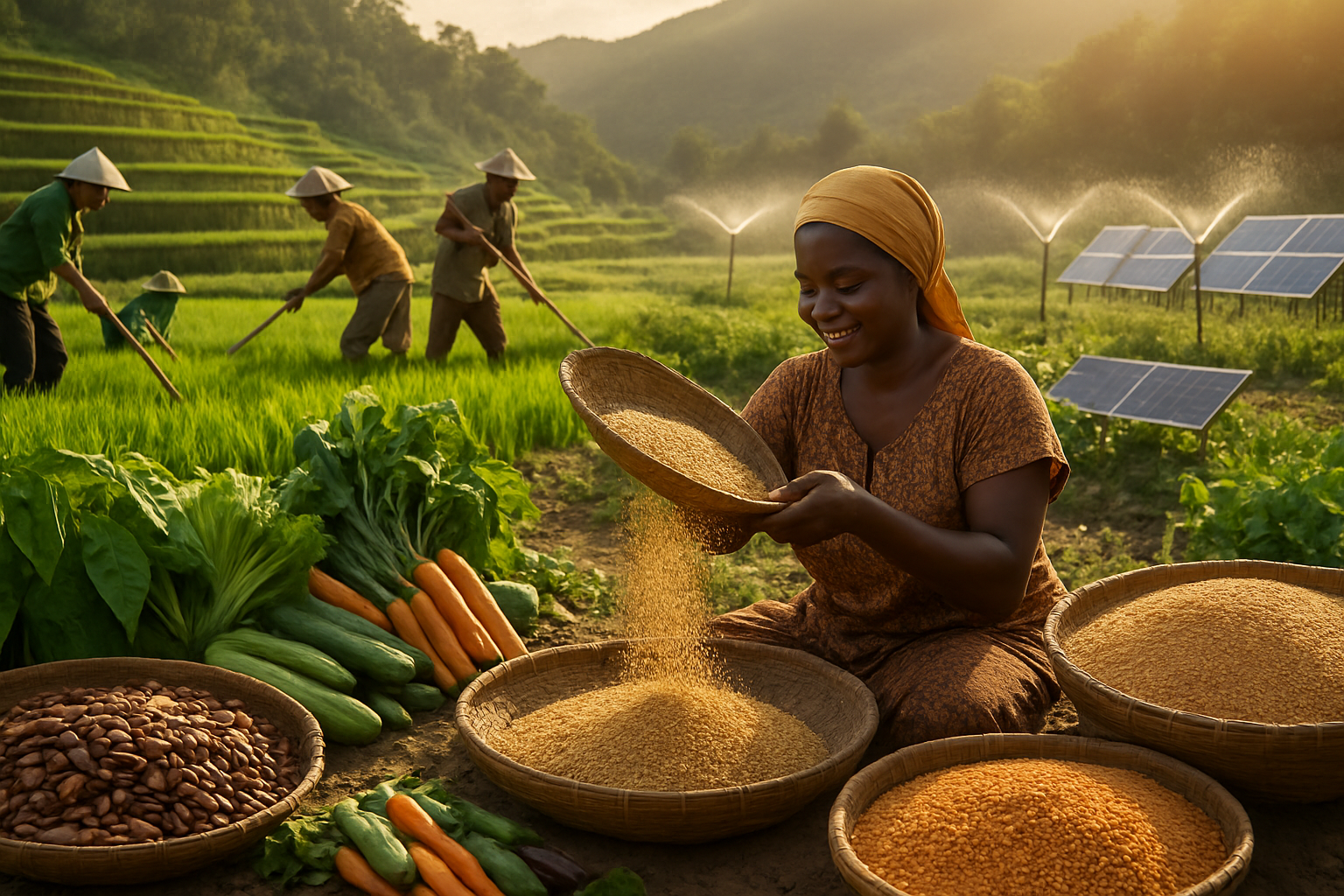
As the world grapples with 20 consecutive months of record-breaking temperatures exceeding 1.5°C above pre-industrial levels, nations across three continents are pioneering revolutionary approaches to agricultural development that could reshape global food security for decades to come.
From the cocoa farms of West Africa to the entrepreneurial ventures of Swedish children, and from war-torn Ukraine's resilient agricultural sector to innovative processing facilities emerging across developing nations, a new agricultural renaissance is taking shape. This transformation represents more than just technological advancement—it embodies a fundamental shift toward sustainable, community-driven food systems that combine centuries-old wisdom with cutting-edge innovation.
Gabon's Strategic Agricultural Vision
In the heart of Central Africa, Gabon is implementing an ambitious agricultural transformation through the recommendations of Murim, an agricultural development association. During a press conference in Libreville on April 3, the organization presented a comprehensive strategy to support the president's poultry project, emphasizing the need for specialized laboratories and enhanced infrastructure.
This initiative represents Gabon's broader commitment to the "Gabon Vert" (Green Gabon) program, which aims to diversify the economy beyond oil dependency through sustainable agricultural development. The country's approach exemplifies how African nations are taking control of their food security destiny through locally-driven initiatives that respect traditional farming practices while embracing beneficial innovations.
"Agricultural transformation must come from within our communities, building on the knowledge our farmers have cultivated for generations while incorporating modern techniques that enhance productivity and sustainability."
— Agricultural Development Expert, Central Africa
Sweden's Grassroots Innovation: Young Entrepreneurs Leading Change
In an unexpected twist to the global agricultural narrative, Sweden's contribution comes from the entrepreneurial spirit of its youngest citizens. Seven-year-old Luigi Berglund and his younger brother Julius have launched a unique business in Borlänge, selling rabbit manure as high-quality fertilizer for home gardeners.
The brothers recognized that rabbit droppings provide excellent organic fertilizer, and their venture has created such demand that customers now face a three-week waiting list. Their mother, Valentina Ioculano, notes an additional benefit: "We have an incredibly clean rabbit cage now."
This grassroots innovation demonstrates how circular economy principles can emerge from the most unexpected sources. The boys' enterprise illustrates the potential for small-scale, sustainable agricultural solutions that reduce waste while providing valuable resources for food production.
Ukraine's Agricultural Resilience Under Fire
Perhaps nowhere is agricultural resilience more dramatically demonstrated than in Ukraine, where farmers continue to maintain food production despite ongoing conflict. The Ukrainian Cabinet of Ministers recently approved crucial changes to support programs for agricultural producers in frontline areas, increasing compensation for Ukrainian-made farm equipment to 40% for farmers operating in combat zones.
This unprecedented support recognizes the vital importance of maintaining food production capacity even under the most challenging circumstances. Ukrainian farmers, often working within sight of active combat zones, represent the ultimate testament to human determination in preserving food security.
The Ukrainian experience highlights the vulnerability of global food systems to geopolitical disruptions while also showcasing the remarkable adaptability of agricultural communities. These farmers are not merely surviving; they are innovating under pressure, developing new techniques for rapid planting and harvesting, mobile equipment strategies, and risk-adapted crop selection.
The Climate Context: Agriculture Under Pressure
These agricultural developments unfold against the backdrop of unprecedented environmental challenges. January 2026 was confirmed as the hottest month in recorded history, extending a streak of 20 consecutive months above the critical 1.5°C warming threshold. This sustained temperature increase is fundamentally altering traditional farming cycles, water availability, and pest management patterns worldwide.
The convergence of climate pressures with geopolitical tensions, supply chain disruptions, and evolving consumer preferences creates what experts describe as a "perfect storm" for global food security. Yet, as demonstrated by the initiatives in Gabon, Sweden, and Ukraine, this crisis is also catalyzing innovation at an unprecedented pace.
Technology Meets Tradition: The New Agricultural Paradigm
Across all three regions, the most successful agricultural adaptations demonstrate a sophisticated synthesis of cutting-edge technology with traditional ecological knowledge. This integration represents a fundamental evolution in agricultural development methodology, moving beyond simple technology transfer toward comprehensive frameworks that respect cultural contexts while leveraging global capabilities.
In Gabon, agricultural specialists are combining traditional poultry management practices with modern disease prevention protocols and processing techniques. Swedish innovation, while seemingly simple, demonstrates how traditional composting wisdom can be transformed into modern entrepreneurial ventures. Ukraine's approach merges time-tested rapid farming techniques with contemporary equipment and risk management strategies.
South-South Cooperation: A New Model for Development
These agricultural developments reflect a broader trend toward South-South cooperation, where developing nations share expertise through peer partnerships rather than relying on traditional North-South aid relationships. This approach has proven more culturally appropriate and economically sustainable than conventional development assistance.
The African Continental Free Trade Agreement (AfCFTA) is enabling agricultural partnerships across national boundaries, creating shared value chains and collective responses to food security challenges that individual nations cannot address independently. Similar regional integration efforts are emerging across Latin America and Asia.
Economic Multiplier Effects
Agricultural innovations function as comprehensive economic engines extending far beyond farm-level improvements. Gabon's agricultural development creates employment in transportation, processing, and packaging while generating foreign currency through exports. Sweden's rabbit manure enterprise, though small-scale, demonstrates how agricultural innovation can create sustainable rural employment and reduce input costs for food producers.
Ukraine's agricultural support programs maintain crucial export capacity while preserving rural employment under extraordinary circumstances. These initiatives create economic multiplier effects through infrastructure development, market access enhancement, and the strengthening of entire rural ecosystems.
Implementation Challenges and Success Factors
Despite these promising developments, significant challenges remain. Funding sustainability is a critical concern for developing nations, where immediate economic pressures often override long-term environmental considerations. Technical capacity building requires sustained investment in education, training, and institutional development beyond initial technology deployment.
Climate change continues to disrupt project timelines, requiring adaptive management strategies that can respond to rapidly changing conditions. The diversity of approaches provides resilience against single-solution dependencies, offering multiple adaptation pathways for different contexts.
Success factors consistently emerge across all initiatives: community ownership of development processes, transparent governance structures, sustained political commitment that transcends electoral cycles, and international cooperation that respects local autonomy while providing necessary technical and financial support.
Looking Forward: Templates for Global Food Security
The agricultural transformations occurring in Gabon, Sweden, and Ukraine provide diverse but complementary templates for addressing global food security challenges. These range from institutional agricultural development and grassroots circular economy innovations to crisis-adaptive farming techniques.
The window for building resilient and equitable food systems is narrowing rapidly as environmental pressures intensify and population growth increases demands on agricultural resources. However, these three cases demonstrate that effective solutions exist across the spectrum from high-tech agricultural facilities to children's entrepreneurial ventures.
The coordination of immediate crisis response with long-term resilience building is crucial for food systems serving growing populations amid accelerating environmental change. Agricultural innovation must keep pace with climate change while maintaining effectiveness principles that ensure community benefit and environmental sustainability.
The Human Dimension
At the center of these agricultural developments are millions of farmers, food workers, and vulnerable communities who depend on stable and fair global food systems. From Gabonese poultry farmers implementing new techniques to Swedish children discovering business opportunities in waste products, and Ukrainian farmers maintaining production under fire, the human dimension of food security remains paramount.
The choices made during this critical period may determine food security trajectories for decades ahead, making coordinated international action more urgent than ever. The tools and knowledge exist for comprehensive responses to current challenges—the question is whether implementation can occur at the speed and scale required to match the pace of environmental and social change.
As these three distinct yet interconnected stories demonstrate, the future of global food security will be written not in laboratories or boardrooms alone, but in the fields, farms, and communities where human ingenuity meets the practical challenges of feeding our world. The agricultural renaissance of 2026 offers both inspiration and practical templates for scaling these successes globally, providing hope for maintaining food security during what may prove to be Earth's most challenging environmental period in recorded history.