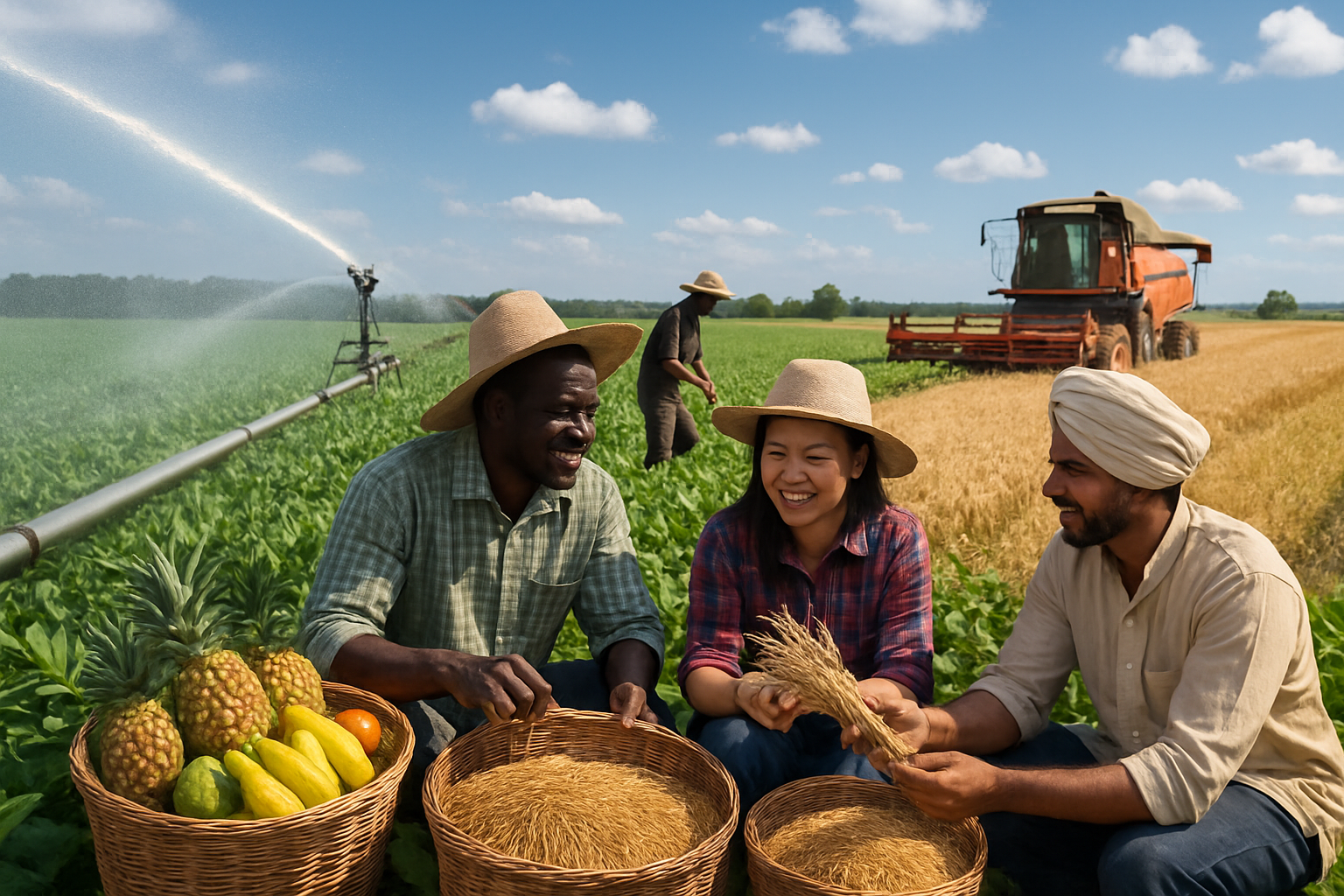
A new era of international agricultural cooperation is emerging as global leaders intensify efforts to address food security challenges, with major initiatives launched across Africa, Latin America, and the Caribbean signaling unprecedented coordination in tackling one of the 21st century's most pressing issues.
Recent developments spanning from Ghana's financial infrastructure innovations to Latin American agricultural cooperation programs demonstrate a sophisticated, multi-regional approach to ensuring food security amid escalating climate pressures and global economic uncertainty.
Financial Infrastructure Underpins Agricultural Trade
Speaking at the 2026 Africa Prosperity Dialogues at the Accra International Conference Centre, Pearl Nkrumah, Managing Director of Access Bank Ghana and Chairperson of the Ghana Stock Exchange, emphasized the critical role of efficient payment systems in facilitating African agricultural trade and investment.
"For me, most importantly, is how do we enable that platform to make it smooth and fluid for a woman to be able to find partners in other regions and fund their product,"
— Pearl Nkrumah, Access Bank Ghana
Nkrumah's remarks highlight a fundamental challenge facing agricultural development across developing nations: access to financing alone is insufficient without the infrastructure for seamless payments and regulatory support. This observation comes as African agricultural initiatives are experiencing unprecedented growth, with recent projects spanning from Kenya's Nguruman irrigation scheme rehabilitation benefiting over 10,000 farmers to Algeria's innovative date waste-to-livestock feed conversion technology.
The call for a single African currency to enable seamless trade reflects broader continental integration efforts through the African Continental Free Trade Area (AfCFTA), which could revolutionize agricultural trade patterns across the continent's 54 nations.
Latin American Agricultural Leadership Intensifies
The Inter-American Institute for Cooperation on Agriculture (IICA) has elevated its regional engagement under new Director General Muhammad Ibrahim, who recently participated in the International Economic Forum for Latin America and the Caribbean organized by CAF (Development Bank of Latin America and the Caribbean).
During the forum, Ibrahim held strategic meetings with senior authorities from Jamaica, Ecuador, Paraguay, Panama, and other international organizations, focusing on scaling up programs and projects aimed at underpinning agricultural development across the region. This diplomatic initiative represents a coordinated effort to strengthen agricultural cooperation mechanisms at a time when climate change is fundamentally altering farming patterns across Latin America and the Caribbean.
The timing of these high-level meetings is particularly significant, coming as the region faces unprecedented climate challenges. January 2026 was recorded as the hottest month in global history, with 18 of the past 19 months exceeding 1.5°C above pre-industrial levels, creating urgent pressure for climate-adapted agricultural practices.
Zero Hunger Initiative Marks Milestone
Simultaneously, the Zero Hunger Trust Fund is preparing to mark its 10th anniversary with a series of activities, according to reports from Saint Vincent and the Grenadines. While specific details of the commemoration events remain limited, the milestone represents a decade of sustained international commitment to addressing global hunger through coordinated funding mechanisms.
The Zero Hunger initiative has played a crucial role in supporting agricultural development programs across developing nations, providing targeted funding for projects that directly address food insecurity at the community level. The 10th anniversary comes at a critical juncture as global food security faces mounting pressures from climate change, supply chain disruptions, and geopolitical tensions.
Historical Context and Emerging Patterns
These latest developments build upon a remarkable surge in agricultural initiatives documented across multiple continents throughout early 2026. Cambodia's Agricultural Market Incentive System (AIMS) has promoted gender integration and market access for smallholder farmers, while Mexico's "Sembrando Vida" program recently sent 19 farmers representing Indigenous communities to the BIOFACH 2026 organic fair in Germany, demonstrating international knowledge exchange.
In Africa, the agricultural renaissance extends beyond the current initiatives to include Ethiopia's shift from emergency relief to long-term climate resilience through water infrastructure investment, and Rwanda's identification of 417,000 hectares of undeveloped irrigation potential. These projects collectively represent a sophisticated integration of traditional knowledge with modern technology, emphasizing climate resilience and community ownership.
The Norwegian Church Aid's $2.9 million agricultural transformation program in South Sudan, running until November 2026, exemplifies the multi-partner consortium approach that is becoming increasingly common in international agricultural development. Led by incoming Country Director Cathrin Seland, the program builds on over 50 years of organizational presence in the region since 1972.
Climate Adaptation and Technology Integration
The convergence of these agricultural initiatives reflects a growing recognition that food security challenges require integrated solutions combining climate adaptation, technology transfer, and traditional knowledge preservation. Belize's recent launch of climate-smart agriculture using nuclear techniques, supported by the International Atomic Energy Agency (IAEA), demonstrates the sophistication of modern agricultural innovation.
This approach contrasts sharply with recent industrial food safety crises in Europe, where recalls of infant formula brands due to bacterial contamination highlighted vulnerabilities in complex food processing chains. The emphasis on sustainable, community-based agricultural practices emerging across developing nations offers an alternative model that prioritizes both food security and food safety.
Regional Integration and Future Prospects
The current wave of agricultural cooperation initiatives signals a fundamental shift toward regional integration and South-South cooperation in addressing food security challenges. The coordination between IICA's regional engagement, Ghana's financial infrastructure development, and the Zero Hunger Trust Fund's continued operations demonstrates unprecedented alignment of institutional priorities.
This coordination is occurring against a backdrop of significant geopolitical changes, including recent diplomatic developments in Venezuela and evolving trade relationships between major powers. The emphasis on agricultural self-sufficiency and regional cooperation may represent a strategic response to global supply chain vulnerabilities exposed by recent crises.
Success of these initiatives will depend on sustained funding, political commitment, and continued international cooperation. However, the breadth and coordination of current programs suggest a maturing approach to agricultural development that integrates community ownership, gender equality, climate adaptation, and technology transfer while preserving traditional knowledge systems.
As these programs unfold throughout 2026, they may establish new models for addressing 21st century food security challenges through coordinated international action, positioning developing nations as leaders in sustainable agricultural innovation rather than merely recipients of aid.