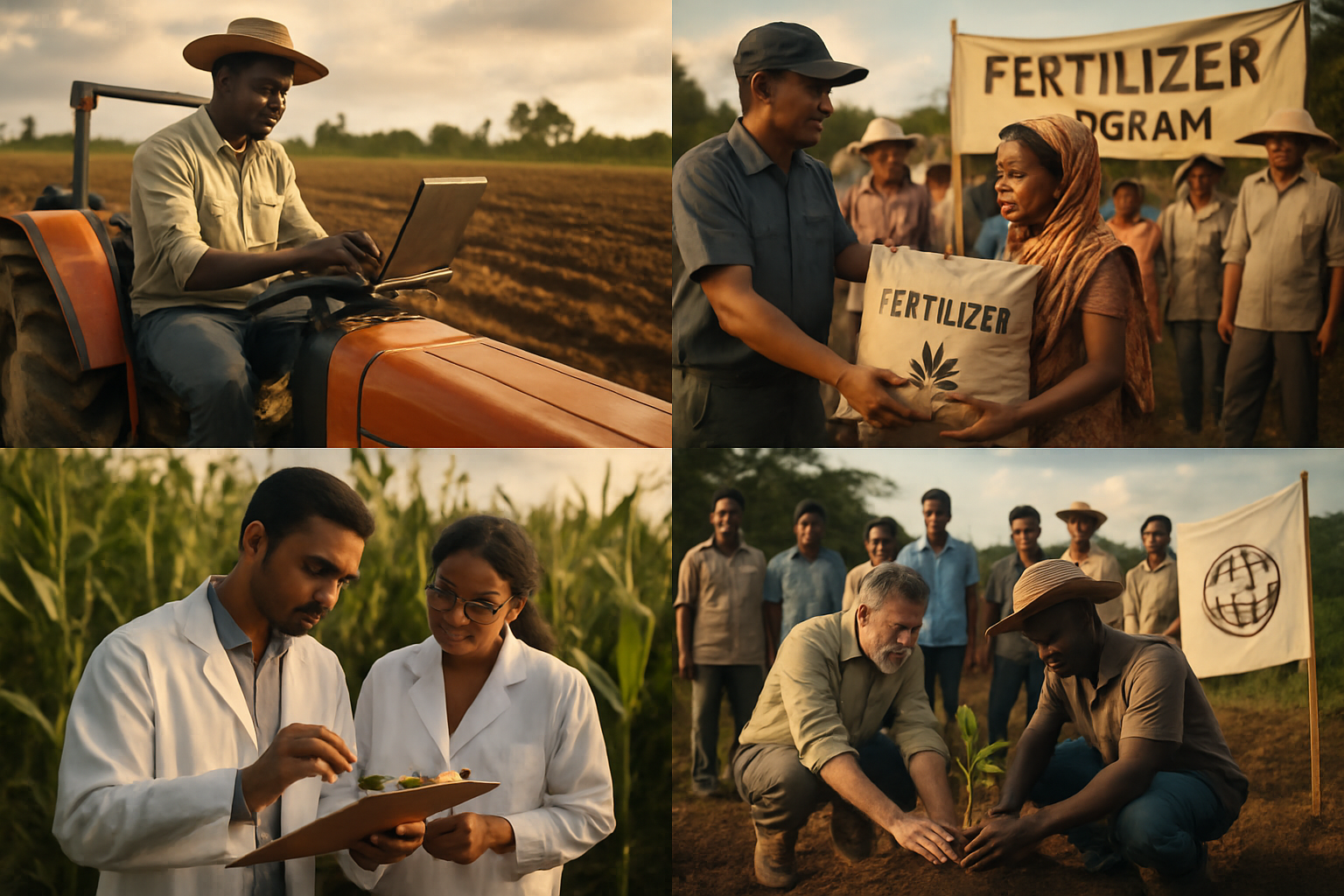
A remarkable convergence of agricultural development programs is transforming global food security prospects, as nations from Malawi to Jamaica implement groundbreaking initiatives that combine traditional farming wisdom with cutting-edge technology and international cooperation.
February 2026 has emerged as a pivotal moment for global agriculture, with five major initiatives spanning three continents demonstrating how coordinated action can address food security challenges while building long-term agricultural resilience. From subsidized fertilizer programs restoring hope to struggling farmers, to advanced seed production techniques crossing borders, these developments signal a new era of agricultural cooperation.
Malawi's Agricultural Lifeline: Fertilizer Subsidies Transform Rural Lives
In Lilongwe, 61-year-old Felatu Dickson stood beside a 50-kilogram bag of NPK fertilizer at the Mpingu distribution point, hardly believing his luck. After years of farming without government support, Dickson had finally accessed Malawi's Farm Inputs Subsidy Programme (FISP), a development that could transform his agricultural prospects.
"This is my first time to benefit from this programme. I have been a farmer all along, but I have never benefited from this programme. I am grateful because of this support and I expect to harvest more this time," said Dickson, his voice filled with cautious optimism.
The FISP represents a critical intervention in Malawi's agricultural sector, where smallholder farmers have struggled with rising input costs and unpredictable weather patterns. The program provides subsidized fertilizer and seeds to vulnerable farming families, targeting those who have historically been excluded from agricultural support systems.
Around Dickson, fellow farmers chatted excitedly as they waited to redeem their own inputs, sharing smiles and hopeful glances. The scene at Mpingu reflects a broader transformation occurring across Malawi's central region, where the subsidized fertilizer program is restoring hope to communities that have faced persistent food insecurity.
Argentina's Agricultural Export Breakthrough: Grain Markets Surge
While Malawi focuses on smallholder support, Argentina is demonstrating how advanced agricultural systems can drive economic growth through international trade. January 2026 marked a remarkable achievement for Argentine agriculture, with foreign exchange earnings reaching $1.85 billion, surprising analysts with both the magnitude and composition of exports.
The month was characterized by dramatic increases in wheat and barley shipments, alongside continued strong exports of maize and industrialized soy products. Argentine wheat exports alone accumulated nearly 9 million tons in declarations of foreign sales (DJVE's) between December 2025 and February 2026, representing approximately 50% of the estimated exportable balance of 18 million tons.
Most significantly, Argentina achieved a historic milestone by resuming direct wheat exports to China after a 30-year hiatus. This breakthrough demonstrates how diplomatic and commercial relations can unlock new markets for agricultural producers, potentially reshaping global grain trade patterns.
The Argentine success story illustrates how established agricultural systems can leverage technological improvements and market access to achieve exceptional results, providing a model for other nations seeking to enhance their agricultural export potential.
Jamaica's Cocoa Revival: Building Resilience Through Grafted Seedlings
In the Caribbean, Jamaica is pursuing agricultural diversification through strategic investment in its cocoa sector. The Jamaica Agricultural Commodities Regulatory Authority (JACRA) recently planted 100 grafted cocoa seedlings on a commercial farm in Nine Turns, Clarendon, as part of a broader program to restore Jamaica's cocoa productivity.
"This planting in Nine Turns is more than an agricultural exercise — it represents our dedication to long-term viability in the cocoa sector. By increasing access to clean planting material, we are empowering farmers to achieve higher yields and greater resilience against disease," said Wayne Hunter, acting director general at JACRA.
The initiative comes in response to challenges facing Jamaica's cocoa sector, including the aftermath of Hurricane Melissa in October 2025, which damaged existing plantations and highlighted the need for climate-resilient varieties. The grafted seedlings were specifically selected for their disease resistance and improved yield potential, representing a scientific approach to agricultural recovery.
Jamaica's cocoa revival strategy emphasizes the importance of quality planting material and genetic diversity in building agricultural resilience. This approach provides a template for other Caribbean nations seeking to strengthen their agricultural sectors against climate-related risks.
Algeria's Food Security Initiative: Ramadan Preparation and Social Solidarity
Algeria's approach to food security demonstrates how government programs can address both immediate needs and long-term sustainability. The country's Ministry of National Solidarity announced the licensing of approximately 2,200 "Rahma" (Mercy) restaurants to operate during the holy month of Ramadan, providing affordable meals to vulnerable populations.
This initiative was announced during the launch of a National Campaign to Reduce Waste and Rationalize Consumption, organized by the Ministry of Internal Trade and National Market Control in coordination with the Ministry of Environment and Quality of Life. The campaign emphasizes the connection between food security and sustainable consumption patterns.
Algeria's dual approach—providing immediate food access while promoting consumption awareness—reflects a sophisticated understanding of food security challenges. The combination of social protection and environmental consciousness provides a model for other nations balancing immediate needs with long-term sustainability goals.
Uzbekistan's Knowledge Transfer: Learning Advanced Practices in China
The most forward-looking initiative comes from Uzbekistan, where farmers from the Namangan region are participating in a working visit to China to study advanced agricultural practices. This knowledge transfer program represents the cutting edge of international agricultural cooperation, where developing nations learn from each other's successes.
The Uzbek delegation is focusing on advanced seed production practices, learning techniques that could revolutionize agricultural productivity in Central Asia. This South-South cooperation demonstrates how developing nations can share technological knowledge and best practices without relying solely on traditional North-South aid relationships.
The China visit reflects Uzbekistan's commitment to agricultural modernization and its recognition that sustainable food security requires continuous learning and adaptation. The knowledge gained from this exchange could benefit not only Uzbekistan but potentially the broader Central Asian region through subsequent knowledge sharing.
Global Context: Climate Challenges and Agricultural Innovation
These agricultural developments occur against a backdrop of unprecedented climate challenges. January 2026 was recorded as the hottest month in global history, with 18 of the past 19 months exceeding 1.5°C above pre-industrial levels. This warming trend is forcing agricultural systems worldwide to adapt rapidly to changing conditions.
The diverse approaches demonstrated by these five initiatives—from Malawi's input subsidies to Uzbekistan's technology transfer—reflect different strategies for building agricultural resilience. What unites them is a recognition that food security requires coordinated action addressing immediate needs while building long-term adaptive capacity.
International cooperation has become increasingly important, with programs like Norwegian Church Aid's $2.9 million South Sudan initiative and the broader African agricultural renaissance demonstrating how shared knowledge and resources can address common challenges.
Technology Integration and Traditional Knowledge
A key theme across these initiatives is the integration of modern technology with traditional agricultural knowledge. Jamaica's grafted cocoa seedlings combine scientific plant breeding with local farming expertise. Uzbekistan's Chinese study tour seeks to blend advanced seed production techniques with Central Asian agricultural conditions.
Even Algeria's Ramadan restaurant program reflects this integration, using traditional social solidarity mechanisms enhanced by modern organizational and distribution systems. Malawi's fertilizer subsidy program leverages traditional farming practices while providing modern inputs that can significantly increase yields.
This technology-tradition synthesis appears to be a crucial factor in successful agricultural development, allowing communities to maintain their agricultural identity while adapting to contemporary challenges.
Economic Implications and Rural Development
The economic implications of these agricultural initiatives extend far beyond farm gates. Argentina's export success demonstrates how agricultural productivity can drive foreign exchange earnings and support national economic development. Jamaica's cocoa revival aims to create sustainable rural livelihoods while building export capacity.
Malawi's fertilizer program directly addresses rural poverty by providing essential inputs to smallholder farmers who form the backbone of the national economy. Algeria's food security initiative supports social stability during economically challenging periods.
Uzbekistan's knowledge transfer investment represents a long-term approach to agricultural development that could transform regional food production capacity. These diverse economic strategies reflect different development priorities but share a common recognition of agriculture's central role in economic development.
Challenges and Implementation
Despite their promise, these initiatives face significant implementation challenges. Malawi's fertilizer program must ensure equitable distribution and prevent corruption. Argentina needs to maintain quality standards while expanding production. Jamaica requires sustained investment in research and development for its cocoa sector.
Algeria's food security initiative depends on effective coordination between multiple government agencies and sustained funding. Uzbekistan's technology transfer program requires successful adaptation of Chinese practices to Central Asian conditions and effective dissemination of knowledge to local farmers.
Climate change adds another layer of complexity, as programs must build resilience against increasingly unpredictable weather patterns while delivering immediate benefits to participating communities.
Future Prospects and Scalability
The success of these diverse agricultural initiatives could provide templates for scaling up food security interventions globally. Malawi's subsidized input approach could be adapted to other African countries facing similar challenges. Argentina's export strategy offers lessons for emerging agricultural economies.
Jamaica's resilience-focused approach to crop development provides a model for climate adaptation in small island developing states. Algeria's integration of social protection with environmental awareness could inform policy in other countries balancing immediate needs with sustainability goals.
Uzbekistan's South-South learning approach demonstrates the potential for developing nations to share knowledge and build collective capacity for agricultural development.
International Cooperation and Coordination
These initiatives also highlight the importance of international cooperation in addressing global food security challenges. From bilateral knowledge sharing between Uzbekistan and China to Jamaica's use of international agricultural research, successful programs increasingly rely on cross-border collaboration.
The timing of these initiatives—occurring simultaneously across different continents—suggests a growing recognition that food security challenges require coordinated global responses. International organizations, bilateral cooperation agreements, and South-South partnerships all play crucial roles in facilitating this coordination.
As climate pressures intensify and global population growth continues, the lessons learned from these diverse agricultural initiatives will become increasingly valuable for policymakers seeking to ensure food security for their populations.
The agricultural renaissance of February 2026 represents more than isolated success stories—it demonstrates humanity's capacity to respond creatively and cooperatively to one of our most fundamental challenges: ensuring everyone has access to adequate, nutritious food. From Malawi's grassroots fertilizer distribution to Uzbekistan's high-tech learning missions, these initiatives offer hope that agricultural innovation, traditional wisdom, and international cooperation can build a more food-secure world.