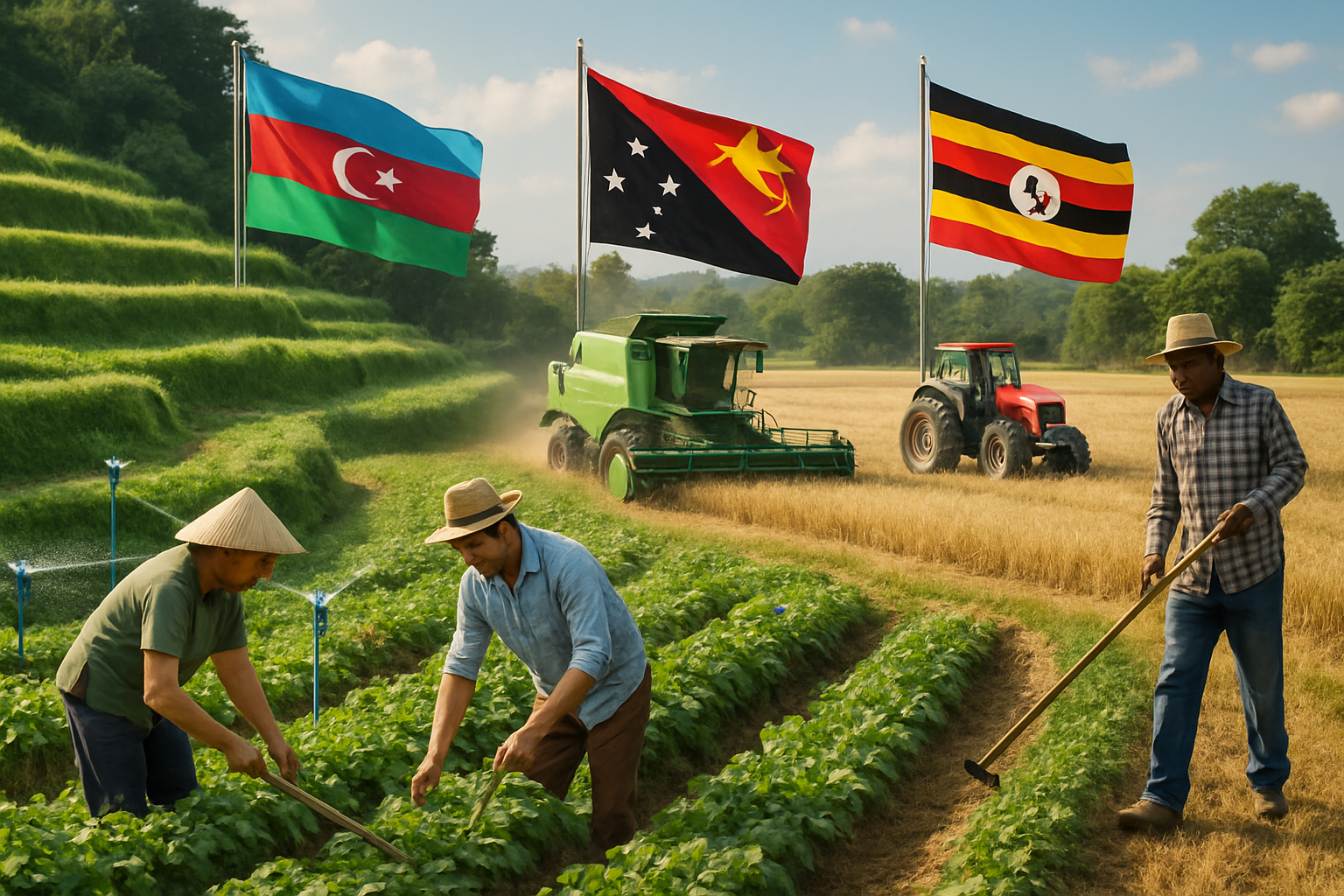
Nations across multiple continents are implementing coordinated agricultural development strategies to address mounting food security challenges, combining traditional farming wisdom with cutting-edge technology during the most sustained period of global warming in recorded history.
As the world experiences its 20th consecutive month of temperatures exceeding 1.5°C above pre-industrial levels, countries are demonstrating remarkable innovation in agricultural policy, trade partnerships, and technological adoption. From Azerbaijan's strategic partnerships with Uzbekistan to Uganda's integration of science and innovation in dairy farming, a global agricultural renaissance is taking shape.
South-South Cooperation Drives Agricultural Innovation
Azerbaijan and Uzbekistan have launched discussions on jointly exporting agricultural products to third countries, marking a significant shift toward South-South cooperation in agricultural development. This partnership represents a new phase in bilateral cooperation that bypasses traditional North-South aid dependencies, focusing instead on mutual benefit and shared expertise.
The collaboration comes as Azerbaijan reported a notable surge in liquid vegetable oil production during the first two months of 2026, according to the State Statistics Committee. This increase demonstrates the country's expanding agricultural processing capabilities and its readiness to engage in more sophisticated international partnerships.
"This is what it looks like when science leaves the laboratory and transforms real lives."
— Dr. Monica Musenero Masanza, Uganda's Minister of Science, Technology, and Innovation
Technology Meets Traditional Wisdom
In Uganda, the transformation at Katebe Farm in Lyantonde District exemplifies the powerful synthesis of technology and traditional agricultural knowledge. Minister Dr. Monica Musenero Masanza has praised the farm's evolution as a real-world example of how innovation and science can directly improve livelihoods and spur economic growth.
The farm demonstrates the most successful pattern emerging across global agricultural development: sophisticated integration of cutting-edge technology with traditional farming wisdom and community-based management. This approach contrasts sharply with top-down technology transfers that often fail to account for local knowledge systems and community structures.
Similarly, Papua New Guinea is addressing food security through Prime Minister James Marape's call for boosting livestock production while reducing imports. The initiative aims to strengthen domestic food production capacity while maintaining the country's agricultural traditions and ecological connections.
Agroecology and Market Value Creation
In East Africa, groundbreaking work is being done to unlock the market value of agroecological products. Dr. Million Belay, Coordinator of the Alliance for Food Sovereignty in Africa (AFSA), presented research on cross-border trade in agroecological products within the East African Community during a March workshop in Kampala.
The research highlights a critical challenge: smallholder farmers are already implementing practices that save soils, protect biodiversity, and strengthen communities, but these efforts often go unrecognized in traditional market systems. The work emphasizes that "smallholders are already saving soils, biodiversity, and communities; they just need the market to notice."
This represents a fundamental shift in how agricultural value is measured and rewarded. Rather than simply focusing on yield maximization, the approach recognizes the multiple benefits that sustainable farming practices provide to ecosystems and communities.
Climate Adaptation and Agricultural Resilience
The agricultural developments are occurring during unprecedented environmental stress. January 2026 was confirmed as the hottest month in recorded history, extending a streak of 20 consecutive months above critical temperature thresholds. This sustained warming has fundamentally altered farming cycles, water availability, and pest management patterns worldwide.
Countries are responding with sophisticated climate adaptation strategies that combine drought-resistant crop varieties, precision irrigation systems, and enhanced livestock management. The approach demonstrates how agricultural systems can maintain productivity while building resilience against climate volatility.
Economic Development Beyond Farming
The agricultural innovations are functioning as comprehensive economic development engines that extend far beyond farm-level improvements. In Azerbaijan, the vegetable oil production surge creates employment in transportation, processing, and packaging while generating export revenue. Uganda's dairy sector transformation supports entire rural ecosystems through improved supply chains and value-added processing.
Papua New Guinea's livestock development initiative is designed to reduce import dependencies while creating sustainable rural employment opportunities. This approach recognizes agriculture as essential infrastructure for economic resilience rather than just food production.
Regional Integration and Trade Enhancement
The African Continental Free Trade Agreement (AfCFTA) is enabling agricultural partnerships across national boundaries, creating shared value chains and collective responses to food security challenges that individual nations cannot address independently. This regional integration approach is proving more effective than traditional aid relationships.
The success of these initiatives demonstrates that peer-to-peer knowledge sharing and technology transfer can be more culturally appropriate and economically sustainable than conventional development assistance programs.
Implementation Challenges and Success Factors
Despite promising developments, significant challenges remain. Funding sustainability is a critical concern for developing nations, where immediate economic pressures often override long-term environmental considerations. Technical capacity building requires sustained education, training, and institutional investment beyond initial technology deployment.
Climate change continues to disrupt project timelines, requiring adaptive management that can respond to rapidly changing conditions. However, several success factors have emerged across different contexts:
- Community ownership and engagement in development processes
- Transparent governance structures
- Sustained political commitment that transcends electoral cycles
- International cooperation that respects local autonomy
- Integration of traditional knowledge with modern technology
- Economic development approaches that extend beyond farm-level improvements
Global Food Security Templates
The agricultural transformations occurring across Azerbaijan, Papua New Guinea, Uganda, and East Africa provide templates for addressing global food security through diverse, complementary approaches. The diversity of strategies—from strategic export partnerships to agroecological market development to science-driven dairy modernization—offers multiple pathways toward agricultural resilience.
This diversity is crucial because it provides resilience against single-solution dependencies while offering adaptation pathways suitable for different national circumstances, cultural contexts, and resource endowments.
Future Implications and Strategic Significance
The convergence of agricultural innovations in early 2026 represents a critical juncture for global food security. The window for building resilient, equitable food systems is narrowing rapidly as environmental pressures intensify and population growth increases demands on agricultural resources.
However, the tools and knowledge exist for effective responses, as demonstrated by the pioneering initiatives across multiple continents. Success depends on sustained political commitment, adequate funding, and coordination between immediate crisis response and long-term resilience building.
The agricultural renaissance of 2026 may ultimately determine whether food production systems can keep pace with accelerating environmental change while serving growing populations during what experts call the critical climate action decade. The stakes are unprecedented, but the innovative capacity demonstrated by farming communities and their governments provides reasons for cautious optimism.
As demonstrated across Azerbaijan's trade partnerships, Uganda's science integration, Papua New Guinea's livestock development, and East Africa's agroecological innovations, the synthesis of traditional wisdom with modern technology, combined with genuine international cooperation, offers a pathway toward sustainable food systems that can protect both human prosperity and planetary sustainability during Earth's most challenging environmental period.