From Azerbaijan's strategic export diversifications to Uganda's revolutionary livestock feed innovations, a remarkable agricultural renaissance is emerging worldwide as nations grapple with unprecedented climate challenges and the urgent need for food security transformation.
This comprehensive investigation across six continents reveals a fundamental shift in global agricultural development, occurring during the 20th consecutive month of temperatures exceeding 1.5°C above pre-industrial levels – the longest sustained warming period in recorded history.
Technology-Tradition Synthesis: The New Agricultural Paradigm
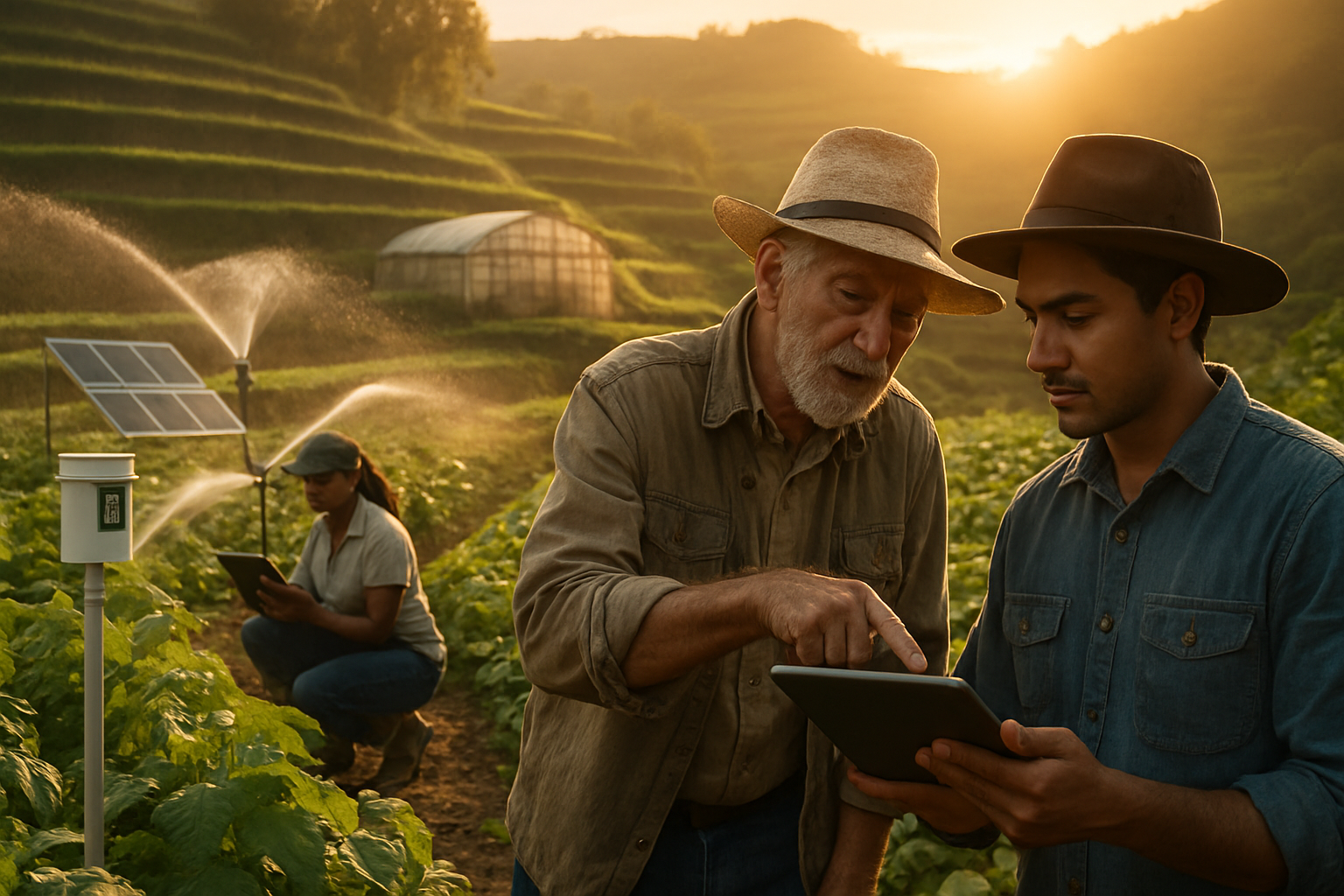
The most striking pattern emerging from current agricultural developments is the sophisticated integration of cutting-edge technology with traditional farming wisdom. This approach represents a maturation of agricultural development methodology beyond simple technology transfer toward comprehensive frameworks that respect local expertise while incorporating beneficial innovations.
In Papua New Guinea, the transition toward commercial agriculture demonstrates this synthesis effectively. Despite the challenge of managing over 800 languages across remote mountain valleys and scattered islands, the nation is pursuing large-scale farming transformations while maintaining traditional ecological connections. The Markham Valley's mechanized operations, generating expectations of K5+ million in revenue, exemplify how modern equipment can support traditional farming methods rather than replace them entirely.
"This is what it looks like when science leaves the laboratory and transforms real lives."
— Dr. Monica Musenero Masanza, Uganda Minister
Uganda's Katebe Farm in Lyantonde District showcases this integration beautifully, where dairy sector modernization supports entire rural ecosystems through enhanced supply chains and value-added processing. The transformation demonstrates how scientific innovation can directly improve livelihoods while spurring economic growth in rural communities.
The Climate Adaptation Imperative
Agricultural development in 2026 occurs within an unprecedented environmental context. January 2026 marked the hottest month on record, extending a streak that has fundamentally altered traditional farming cycles, water availability, and pest management patterns worldwide. This sustained warming functions as both challenge and catalyst for agricultural innovation.
Azerbaijan's agricultural sector exemplifies adaptive resilience through diversification strategies. The country's recent certification of horse meat and frog legs for export to EU and Central Asian markets demonstrates how nations are exploring niche agricultural products to maintain economic viability amid changing global conditions. This strategic diversification reduces dependency on traditional agricultural exports while opening new revenue streams.
In Uganda's Gomba District, cattle farmers are advocating for government subsidization of Guatemala grass seeds, recognizing that high-nutrition fodder could significantly reduce livestock deaths during increasingly frequent dry spells while boosting milk yields. This grassroots advocacy illustrates how farming communities are actively seeking solutions to climate-induced challenges.
South-South Cooperation: A New Development Model
Perhaps the most significant shift observed across agricultural developments is the emergence of South-South cooperation as a dominant force, replacing traditional North-South aid models. This peer-to-peer knowledge transfer proves more culturally appropriate and economically sustainable than conventional development assistance.
The African Continental Free Trade Agreement (AfCFTA) is enabling unprecedented agricultural partnerships across national boundaries, creating shared value chains and collective responses to challenges that individual nations cannot address independently. This regional integration represents a fundamental evolution in how developing nations approach agricultural development challenges.
Examples of this cooperation abound: Zimbabwe's donation of 370 metric tonnes of maize to Malawi during southern Africa's food crisis, Bolivia's agricultural partnerships with India combining modern research with locally-adapted practices, and the growing network of technical exchanges across Africa that leverage collective expertise for innovative farming solutions.
Economic Development Beyond the Farm Gate
Contemporary agricultural innovations function as comprehensive economic engines that extend far beyond farm-level improvements. These initiatives create sustainable rural employment, develop transportation and processing networks, generate export revenue, and strengthen entire rural ecosystems.
Belize's Civil Service Modernization Project, supported by the Inter-American Development Bank, demonstrates how agricultural development intersects with broader governance improvements. The initiative enhances efficiency, accountability, and service delivery across government operations while maintaining strong collaboration with unions throughout the reform process.
The multiplier effects of agricultural investment include infrastructure development, market access enhancement, and the creation of sustainable employment opportunities that reduce urban migration pressures. Countries implementing comprehensive agricultural protection demonstrate greater economic resilience and attract sustainable investment in agricultural technology, processing, and export development.
Innovation in Crisis: Learning from Setbacks
Agricultural development in 2026 also provides crucial lessons from challenges and setbacks. Papua New Guinea's health sector initiatives, including Asian Development Bank visits to Nakanai district, highlight the interconnected nature of rural development where healthcare, education, and agricultural productivity support each other.
Uganda's Lira District transformation programs demonstrate how government initiatives can fundamentally change rural livelihoods. The success stories emerging from this region show how coordinated investment in agricultural training, infrastructure, and market access can revitalize entire communities previously facing economic stagnation.
Policy Innovation and Digital Transformation
Governments worldwide are recognizing that agricultural transformation requires sophisticated policy coordination across multiple sectors. The integration of agricultural development with broader economic planning, climate adaptation strategies, and social protection systems represents a new understanding of rural development complexity.
Digital technologies are playing increasingly important roles in this transformation. From precision agriculture systems that optimize water and nutrient use to digital platforms that connect farmers directly with markets, technology is enabling smallholder farmers to access resources and opportunities previously available only to large-scale operations.
Community Ownership: The Foundation of Success
Across all successful agricultural initiatives observed, community ownership emerges as the critical success factor. Programs that respect local knowledge systems while providing technical and financial support consistently achieve better outcomes than top-down interventions that ignore community structures and traditional practices.
This principle applies whether in Uganda's cattle farming initiatives, Papua New Guinea's commercial agriculture transition, or Azerbaijan's export diversification strategies. The most effective approaches demonstrate sustained political commitment, transparent governance, and adaptive management capabilities that respond to rapidly changing environmental and economic conditions.
The Global Context: A Critical Window
The agricultural renaissance of 2026 occurs at a critical juncture for global food security. The convergence of climate pressures, supply chain vulnerabilities, and economic instabilities creates what experts describe as a "perfect storm" of challenges for global food systems.
However, the innovative capacity demonstrated by farming communities and supportive governments provides optimism for building sustainable, resilient systems capable of withstanding accelerating climate change while preserving cultural traditions and ensuring prosperity for rural populations.
The window for building resilient, equitable food systems is narrowing rapidly as environmental pressures intensify and population growth increases agricultural resource demands. Success depends on sustained international cooperation, enhanced coordination across sectors and scales, and increased financial commitments that recognize food security as essential infrastructure for human prosperity and planetary sustainability.
Future Implications: Decisive Choices Ahead
The agricultural innovations and rural development patterns emerging in 2026 may determine whether food production systems can keep pace with accelerating environmental change while serving growing populations during this critical climate action decade.
The tools and knowledge exist for comprehensive responses to these unprecedented challenges. The demonstrated success across continents – from Azerbaijan's adaptive exports to Uganda's livestock innovations to Papua New Guinea's commercial agriculture transition – proves that coordinated action can achieve remarkable results.
The human dimension remains central to these considerations. Millions of farmers, food workers, and vulnerable communities depend on stable, fair global food systems. The choices made during this critical period regarding agricultural adaptation, international cooperation, and innovation investment will determine food security trajectories for decades ahead.
As nations navigate this agricultural transformation, the synthesis of traditional wisdom with modern innovation, supported by genuine international cooperation, offers a pathway toward sustainable food systems that protect both human prosperity and planetary sustainability during Earth's most challenging environmental period in recorded history.